
Healthcare marketing has a persistent blind spot. Most brands invest heavily in credentials, clinical data, and service features, yet patients still struggle to connect with them emotionally. The research is striking: storytelling boosts empathy in medical training 6.67 times more than traditional lectures alone. If narrative has that power inside clinical education, consider what it can do for your brand when patients are deciding who to trust with their health. This article makes the case for why healthcare brands need storytelling, not as a creative luxury, but as a strategic necessity.
Table of Contents
- Key takeaways
- Why storytelling matters beyond marketing
- How storytelling builds patient trust and brand engagement
- Balancing clinical credibility and emotional storytelling
- Frameworks for storytelling strategies in healthcare brands
- Measuring storytelling impact in your healthcare brand
- My take on storytelling’s real role in healthcare brands
- Build your healthcare brand story with Com
- FAQ
Key takeaways
| Point | Details |
|---|---|
| Storytelling builds measurable trust | Narrative-based approaches improve empathy and patient communication far beyond clinical facts alone. |
| Patient journey stories convert | Mapping emotional milestones into campaigns increases engagement, conversion, and long-term loyalty. |
| Compliance and story can coexist | Anchoring patient stories in real data keeps messaging credible and regulation-ready. |
| Video is the highest-impact format | Video testimonials generate dramatically more shares and engagement than text or static images in healthcare. |
| Measure narrative performance | Track engagement, satisfaction scores, and conversion data to refine your storytelling over time. |
Why storytelling matters beyond marketing
Storytelling in healthcare is not a metaphor for nice copywriting. It is, at its core, a clinical and psychological mechanism that changes how people process information and form trust. Narrative medicine, the practise of using patient stories to teach empathy and communication in medical training, has produced measurable improvements in humanistic care ability (SMD=2.62), empathy (SMD=1.51), and doctor-patient communication (SMD=2.19) across 1,364 residents in a 2026 systematic review.
The neuroscience behind this matters for marketers. Narrative medicine education activates brain regions related to empathy and emotional regulation, which means stories do not just feel good. They physically change how listeners relate to the people in front of them. For healthcare brands, this is not a soft benefit. It is the mechanism through which a patient decides whether your organisation feels safe enough to trust.
Here is what this means for brand strategy:
- Patients make healthcare decisions under emotional stress, not rational clarity
- Clinical features and credentials answer logical questions but rarely resolve emotional hesitation
- A well-told story about a patient outcome or a practitioner’s commitment speaks directly to the part of the brain where trust decisions are actually made
- The importance of storytelling in healthcare extends beyond awareness and into the core patient relationship
Healthcare brands that treat storytelling as an add-on to their communications miss the point entirely. The story is not wrapping paper around the product. The story is the trust-building infrastructure.
How storytelling builds patient trust and brand engagement
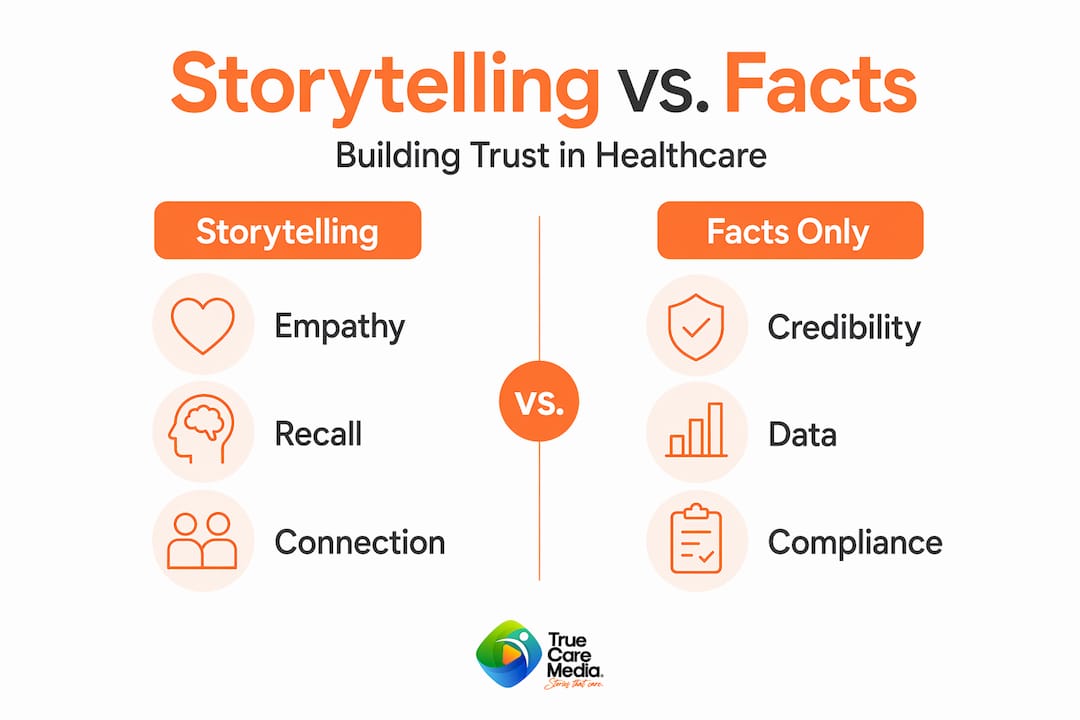
The practical marketing case for storytelling is compelling. Brand messages delivered through stories stick up to 22 times better than plain facts alone. For healthcare brands spending significant budget on content that patients forget within days, this is a problem worth solving.

Telehealth brands have shown this most clearly. Leading platforms like Hims & Hers have built their entire brand presence around patient transitions and founder origin stories, not clinical feature lists. These brands process over 10,000 patient encounters daily, and their storytelling approach is central to managing that scale while still feeling human. Patients do not just use these platforms. They feel affiliated with them.
Pro Tip: When developing patient testimonials, focus on the emotional turning point in the patient’s experience, not just the clinical outcome. The moment a person felt heard, understood, or hopeful is what other patients will recognise and respond to.
The benefits of storytelling in healthcare marketing show up in several concrete ways:
- Patient video testimonials generate 1200% more shares than text and image content combined, which extends story reach without increasing ad spend
- Founder and practitioner origin stories create a “known person” effect that reduces the anonymity patients fear in large health organisations
- Strategic storytelling transforms brands from faceless platforms into perceived partners, which improves both conversion and retention
Authenticity is the deciding factor here. A polished but hollow patient story performs worse than a rough but genuine one. Patients are exceptionally good at detecting when a story has been sanitised for legal or brand safety reasons. The more human and specific a story is, the more work it does.
Balancing clinical credibility and emotional storytelling
Regulated healthcare marketing sits in a difficult position. You need stories that move people, but you also need claims that survive scrutiny. This is not a contradiction. It is actually an opportunity that most healthcare brands underuse.
The approach that works is what wellness brand experts describe as anchoring emotional narratives in real customer data. Wellness brands build credibility by pairing consistent storytelling with verifiable health outcome data across every patient touchpoint. The story draws people in. The data gives them permission to believe it.
Here is how to implement this in practice:
- Choose a clear brand health philosophy that is specific enough to be credible and broad enough to sustain multiple patient stories over time.
- Pair every patient narrative with a data point that validates the story without overwhelming it. One well-chosen statistic inside a story lands better than five bullet points after it.
- Audit your touchpoints for consistency. A story told brilliantly on your website but contradicted by a cold phone script or an impersonal intake form breaks trust faster than no story at all.
- Have legal and clinical review integrated early, not at the end. Stories rewritten at the final stage lose the human quality that made them work in the first place.
The medtech sector offers a useful lesson here. Medtech brands win by out-storying competitors through empathy and clinical reality rather than product specifications. The brands that lead are not the ones with the longest clinical evidence sections. They are the ones that understand what a clinician or patient actually feels during care, and speak to that directly.
Pro Tip: Build a “story brief” template that requires any patient narrative used in marketing to include the specific emotional challenge the patient faced, the turning point, and one verifiable outcome. This keeps stories compliant and human at the same time.
| Approach | Outcome |
|---|---|
| Clinical features only | High credibility, low emotional connection, poor recall |
| Emotional story only | High engagement, lower credibility, regulatory risk |
| Story anchored in data | Strong credibility, emotional resonance, regulatory defensible |
Frameworks for storytelling strategies in healthcare brands
Turning storytelling from a one-off campaign tactic into a sustained brand asset requires structure. The brands that do this well do not wait for a good story to appear. They build the systems that generate good stories consistently.
Start with a narrative platform. This is a defined brand story position that answers three questions: who your brand is for, what transformation you enable, and why you are the credible guide to that transformation. Every patient story, social post, and clinical case study should be traceable back to this platform. Without it, storytelling becomes episodic and forgettable.
Mapping patient journey narratives is the next practical step. Healthcare branding through narratives works best when it follows the emotional arc patients actually experience: the initial fear or confusion, the moment of decision, the support received during care, and the outcome. When your content reflects these stages in sequence, patients see themselves in your stories at every point of their own journey.
For channel selection:
- Video remains the highest-trust format for healthcare storytelling. Short-form testimonials for social media and longer-form patient journey videos for your website serve different but complementary purposes.
- Your website’s About and Team pages are dramatically underused storytelling real estate. A practitioner’s “why I do this work” story on their profile page does more trust work than a list of qualifications.
- Email nurture sequences built around patient stories outperform feature-based emails in healthcare because they give prospective patients something to relate to before they have even booked an appointment.
- Social proof content on platforms like Instagram and LinkedIn should feature real voices, not brand voice narration about your own services.
Pro Tip: Repurpose a single patient story across at least four formats: a short video clip, a written case study, a social media carousel, and a quote graphic. The story does more work, and you spend less time creating from scratch.
The home care provider storytelling model is worth studying here. Providers who document their care workers’ relationships with clients, the small moments of dignity and connection, build a brand story that no competitor can copy. It is specific to them because it is genuinely theirs.
Measuring storytelling impact in your healthcare brand
Storytelling without measurement is faith-based marketing. You need to know what your narratives are actually doing.
The metrics that matter most for healthcare storytelling are not always the obvious ones. The table below outlines what to track and why:
| Metric | What it tells you |
|---|---|
| Video completion rate | Whether the story is holding attention or losing people mid-way |
| Enquiry source attribution | Which stories are driving actual patient contact |
| Time on page for story content | Whether written narratives are being read, not just visited |
| Social share rate | Whether stories resonate enough for people to pass them on |
| Patient satisfaction scores | Whether the brand story aligns with the actual care experience |
Qualitative feedback is equally revealing. Consistent health outcome messaging backed by real data across all touchpoints is what builds trust over time, and patient feedback is the signal that tells you whether your story is landing as intended or drifting from the lived experience.
Review your brand touchpoints every six months specifically for narrative fidelity. Do your social posts, your website, your onboarding documents, and your staff language all tell the same story? Fragmentation here is trust erosion you may not notice until you see it in your conversion numbers.
My take on storytelling’s real role in healthcare brands
I’ve spent years working with NDIS providers, allied health brands, and aged care organisations, and the pattern I see most often is this: the brands that struggle most with marketing are not the ones with bad services. They are the ones with extraordinary services and no story to show for it.
What I’ve found is that healthcare teams often resist storytelling because they conflate it with exaggeration. They worry that putting a human face on their work means softening the clinical reality. In my experience, the opposite is true. The most powerful healthcare stories I’ve been involved in creating are the ones that do not flinch. They show the hard moments, the uncertainty, the effort. That honesty is precisely what makes them credible.
The brands I’ve seen shift their patient engagement most dramatically are the ones that stopped trying to convince people through features and started trusting their stories to do the work. In healthcare, storytelling is not just a tactic. It is the functional mechanism through which complex care becomes something a patient can understand, trust, and choose.
My contrarian view is this: if your storytelling strategy lives inside your marketing team, you have already limited its potential. The most effective healthcare brand narratives are built when clinical, operational, and marketing leads sit in the same room from the start. Story is not a communications layer. It is a strategic decision about who you are and how you want to be known.
— Mishal
Build your healthcare brand story with Com
If you have read this far, you already know that storytelling is not optional for healthcare brands that want to earn genuine patient trust. The question is where to start.
Com helps NDIS providers and allied health brands build that trust through video production, photography, and purposeful storytelling that reflects the real work they do. Whether you are looking to develop aged care storytelling videos that differentiate your facility, or need a complete narrative approach for your home care provider brand, the team at Com brings both creative skill and deep sector understanding to every project. If you are ready to move beyond features and into stories that actually move people, this is the place to start.
FAQ
Why do healthcare brands need storytelling?
Healthcare brands need storytelling because patients make trust decisions based on emotional recognition, not clinical data alone. Stories make complex care experiences relatable, reduce anxiety, and create the sense of connection that converts interest into commitment.
How does storytelling impact healthcare marketing outcomes?
Storytelling delivers messages that are retained up to 22 times more effectively than plain facts, while video testimonials generate 1200% more shares than text content. These outcomes translate directly into stronger brand awareness and higher patient conversion rates.
How can healthcare brands balance storytelling with regulatory compliance?
The most reliable approach is to anchor every patient story in one verifiable outcome or data point, and to involve legal and clinical reviewers early in the story development process rather than at the final approval stage. Stories built with compliance in mind from the start retain their human quality.
What formats work best for healthcare brand storytelling?
Video is the highest-trust and highest-reach format, particularly patient testimonials and practitioner origin stories. Written case studies, email nurture sequences, and social proof content on team profile pages are strong supporting formats that extend the reach of a central narrative.
How do you measure whether healthcare storytelling is working?
Track video completion rates, enquiry source attribution, time spent on story-led pages, social share rates, and patient satisfaction scores. Qualitative feedback from patients about whether the brand story matched their actual care experience is equally telling and often reveals gaps that metrics alone will not show.