
Aged care providers across Australia are facing a crowded, competitive market where every organisation claims to offer “person-centred care,” “experienced staff,” and “a warm, welcoming environment.” Families searching for the right provider are overwhelmed by nearly identical service lists and brochures that all sound the same. The providers who break through this noise are not the ones with the longest list of services. They are the ones who show, rather than tell, what life actually looks like in their care. Video storytelling shifts messaging from abstract service descriptions to real relationships, daily culture, and lived outcomes that build trust before families ever make contact.
Table of Contents
Key Takeaways
| Point | Details |
|---|---|
| Trust through storytelling | Video stories showing culture and relationships foster trust beyond basic service lists. |
| Compliance is essential | Consent, privacy, and de-identification rules must be followed at every step. |
| Avoid unfair marketing claims | Always align your video content with NDIS and home care pricing regulations. |
| Plan emotional impact carefully | Balance emotional storytelling with compliance to protect clients and organisation. |
| Expert help available | Specialist media providers can guide safe, differentiated video production for aged care. |
Assessing differentiation goals and readiness
Before you pick up a camera, you need to be clear on two things: what genuinely sets your organisation apart, and whether you have the compliance foundations in place to film and share content responsibly.
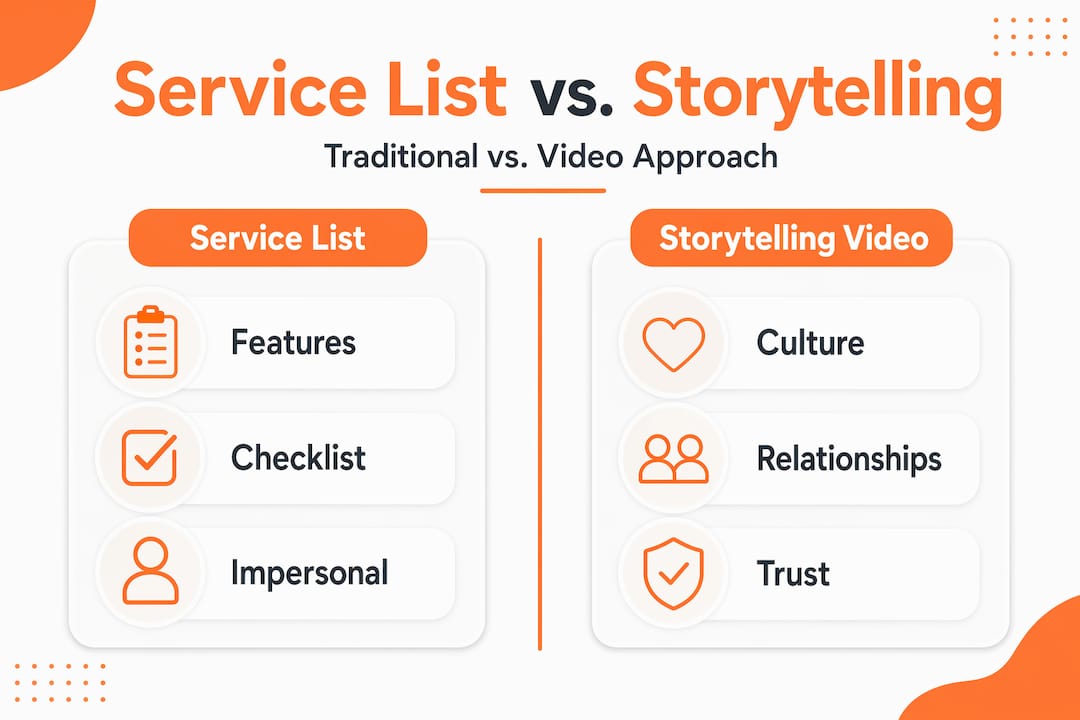
Most aged care providers default to competing on services. They list meal preparation, personal care, transport, and allied health support. The problem is that every competitor offers the same list. Families are not choosing between service catalogues. They are choosing between organisations they trust with someone they love. Shifting messaging from services to relationships, day-to-day culture, and lived outcomes is where video storytelling creates genuine differentiation.
Start by asking your team a few grounding questions. What do clients and families say about you in reviews and conversations? What moments in a typical day reflect your values? What staff behaviours or team rituals make your culture distinct? The answers to these questions are the raw material for your video stories.
Compliance and consent checklist before you film:
-
Obtain written, informed consent from every person who appears on camera, including staff, clients, and family members
-
Confirm consent is voluntary, specific to the intended use, and can be withdrawn at any time
-
Identify whether any content involves “protected information” under the Aged Care Act
-
Consult your privacy officer or legal adviser before filming in clinical or personal care settings
-
Establish a clear process for reviewing and approving content before publication
-
Document all consent records and store them securely
A compliance-aware approach to aged care video treats privacy and consent as core production constraints, not afterthoughts. Getting this wrong is not just a regulatory risk. It damages the trust you are trying to build.
Comparison: traditional service lists vs. video storytelling
| Approach | What it communicates | Audience response |
|---|---|---|
| Service list brochure | Features and capabilities | “They offer what we need” |
| Staff profile page | Qualifications and experience | “They seem professional” |
| Video storytelling | Culture, relationships, lived experience | “We feel like we already know them” |
| Client testimonial video | Real outcomes from real people | “We trust them with our family” |
Pro Tip: Use the “decision journey” story model. Start with a video that introduces your culture and values. Follow it with content that shows how your team supports clients day to day. Then address common family concerns and FAQs in a third video. This sequence mirrors how families actually make decisions and builds trust at every stage.
Check out healthcare storytelling case studies to see how other providers have structured their video content to guide families through this journey.
Planning compelling, compliant video stories
With goals and compliance clear, here is how to plan stories that stand out without putting your organisation or clients at risk.
Step-by-step: from concept to consent to distribution
-
Define your story angle. Choose one clear theme per video. Options include a day-in-the-life of a support worker, a family’s experience transitioning to home care, or a behind-the-scenes look at how your team plans client care.
-
Identify participants. Decide who will appear on camera. Consider whether clients can and want to participate, or whether staff-only content is more appropriate for your current consent capacity.
-
Obtain written consent. Use a plain-language consent form that explains exactly how the footage will be used, where it will be published, and how participants can withdraw consent. Never film first and ask permission later.
-
Script or brief your participants. You do not need a word-for-word script, but participants should know the key messages and feel comfortable. Rehearsal reduces anxiety and improves authenticity.
-
Film with privacy in mind. Avoid capturing identifiable information in the background, such as client names on whiteboards, medical equipment, or personal documents. Frame shots deliberately.
-
Edit with a compliance review built in. Before the final cut is approved, have your privacy officer or a senior manager review the footage for any accidental disclosures.
-
Distribute through approved channels. Confirm that your website, social media platforms, and any third-party distribution channels are appropriate for the content and audience.
Privacy risk areas to consider during planning:
| Risk area | What to watch for | Recommended action |
|---|---|---|
| Client identity | Names, faces, identifying details | Get explicit consent or de-identify |
| Medical information | Diagnoses, medications, care needs | Exclude unless specifically consented |
| Background details | Documents, whiteboards, signage | Clear or blur before filming |
| Family members | Incidental appearance in footage | Obtain consent or exclude from frame |
| Social media sharing | Uncontrolled redistribution of content | Use platform privacy settings and watermarks |
Critical warning: Under Australia’s Aged Care Act, using or disclosing protected information without authorisation is an offence. De-identification is strongly recommended wherever possible. Penalties for unauthorised disclosure are significant and can affect your organisation’s registration and reputation.
The structure of your stories also matters enormously. A video that opens with a warm moment between a support worker and a client, moves into a brief explanation of your care philosophy, and closes with a family member reflecting on their experience is far more persuasive than a talking-head video of your CEO listing your services. Emotion drives decision-making. Structure makes emotion land.
Explore video compliance case studies to see how providers have navigated these planning challenges in practice.

Production tips: filming, editing and sharing safely
Now that your video story is mapped out, let us make sure filming and sharing are handled securely to protect your clients and your organisation.
Best practices for safe filming and editing:
-
Always have a designated privacy lead on set who can pause filming if a concern arises
-
Use a shot list that specifies exactly what will and will not be captured in each scene
-
Brief all crew members, including external videographers, on your privacy obligations before filming begins
-
Review raw footage immediately after filming to flag any accidental disclosures before editing begins
-
Store raw footage on secure, access-controlled servers and delete it once the final edit is approved
-
Use watermarking on draft cuts shared for internal review to prevent premature distribution
Accidental breaches are far more common than deliberate ones. A support worker mentioning a client’s name on camera, a whiteboard visible in the background, or a family photo on a bedside table can all constitute a privacy breach if captured and published without consent. These are not hypothetical risks. They happen regularly in organisations that treat compliance as a post-production concern rather than a pre-production priority.
Common mistakes to check before publishing:
-
Has every person visible in the footage provided written consent for this specific use?
-
Are there any audible references to client names, diagnoses, or personal details in the audio track?
-
Does the footage include any identifiable background information?
-
Has the content been reviewed by someone with privacy authority in your organisation?
-
Is the platform where you are publishing the content appropriate for the audience and content type?
Sharing caution: Guidance on online and social sharing specifically encourages providers to think carefully before discussing clients online and to control who receives information. Social media platforms, in particular, carry risks of uncontrolled redistribution that can take content far beyond its intended audience.
Pro Tip: Build a pre-publication checklist that every piece of video content must pass before it goes live. Include a de-identification review, a consent verification step, and a final approval sign-off from a senior leader. This takes less than 30 minutes and can prevent significant regulatory and reputational harm.
For more practical guidance, explore video storytelling tips tailored specifically for aged care and NDIS providers.
Marketing and pricing claims: NDIS and home care rules
Great video storytelling in aged care must also ensure all claims and pricing are sector-compliant, especially under NDIS rules. This is an area where many providers underestimate the risk.
When you create video content that references your pricing, packages, or value proposition, you are making marketing claims that fall under specific regulatory frameworks. The NDIS Quality and Safeguards Commission takes a strong stance on this.
How to frame offers and pricing in compliant video content:
-
Avoid price comparisons that imply NDIS participants receive different pricing. The NDIS Code of Conduct explicitly prohibits unfair pricing and price differentiation where higher prices are charged to NDIS participants without reasonable justification. If your video implies that NDIS clients pay more for the same service, you are at risk.
-
Be specific and accurate in any claims you make. If your video states that you offer “the best outcomes in Melbourne” or “the most experienced team in the region,” you need evidence to back that up. Unsubstantiated superlatives are a common compliance pitfall.
-
Disclose relevant fees transparently. If your video content is designed to attract new clients and references pricing, ensure that pricing information is accurate, current, and consistent with your published schedules.
-
Align all claims with your service agreements. Video content that promises outcomes or services not reflected in your formal agreements creates both a regulatory and a contractual risk.
-
Review content against the NDIS Code of Conduct before publishing. This is not optional. The Code applies to all provider communications, including marketing materials and video content.
Statistic callout: The NDIS Quality and Safeguards Commission identifies unfair pricing as a prohibited conduct under the NDIS Code of Conduct. Providers found to be engaging in price differentiation without justification face investigation, registration conditions, and potential deregistration. The reputational damage from a public finding is often more significant than the formal penalty.
Review the NDIS fair pricing video resources available for providers to understand how these rules apply to your specific marketing context.
Why emotion and compliance must go hand-in-hand
Here is the perspective that most guides on aged care video marketing avoid: the providers who create the most emotionally powerful content are not always the ones who get the best results. Sometimes they are the ones who face the most serious compliance consequences.
We have seen this pattern repeatedly. An organisation invests in a genuinely moving video featuring a client’s recovery journey. The footage is beautiful. The story is real. And then it turns out that the consent process was incomplete, or the content included details that conflict with privacy constraints under the Aged Care Act. The video gets pulled. The organisation faces scrutiny. The trust they were trying to build is damaged instead.
The uncomfortable truth is that compliance is not the enemy of great storytelling. It is the discipline that makes great storytelling sustainable. When you build consent and privacy into your production process from day one, you create content that you can stand behind completely. You can share it widely, promote it proudly, and use it for years without fear.
The most effective strategy we have seen is to craft stories around universal human experiences rather than specific client details. Stories about kindness, belonging, dignity, and connection resonate deeply with families without requiring you to expose any individual’s personal circumstances. A video that shows a support worker remembering a client’s favourite music, or a team celebrating a client’s birthday, communicates everything a family needs to know about your culture without disclosing a single piece of protected information.
Pro Tip: If consent for client-specific stories is limited, build your video library around staff stories, team culture moments, and values-in-action scenes. These are just as emotionally resonant and carry far lower compliance risk. Families respond to evidence of genuine care, regardless of whether the person in the frame is a client or a staff member.
The providers who get this right treat emotion and compliance as partners, not competitors. They plan stories that are designed to move people and designed to protect people. That combination is what builds lasting trust. Explore how to develop an effective aged care video strategy that holds both values at once.
Connect with True Care Media for tailored aged care video solutions
If you are ready to move beyond checklists and create impactful, compliant video, here is how to take the next step.
True Care Media specialises in helping NDIS providers and allied health brands build trust through powerful video, photography, and storytelling. We understand the unique regulatory environment of aged care and NDIS services, which means we bring compliance awareness to every production, not just creative flair.
Our team works with providers at every stage, from clarifying your differentiation strategy and planning compliant story frameworks, through to filming, editing, and distribution guidance. We have supported organisations across Australia to create video content that genuinely reflects their culture and earns the trust of families before they ever make a call. Browse our aged care video case studies to see the methodology in action and find out how we can tailor an approach for your organisation’s goals, audience, and compliance requirements.
Frequently asked questions
What privacy permissions are required for filming aged care clients?
Providers must obtain explicit written consent for any appearance or imagery, and must avoid sharing sensitive or identifying information without authorisation. A compliance-aware approach treats consent as a core production constraint, not an afterthought.
Can we show staff and clients together in promotional videos?
Yes, but only after securing valid consent from all parties and ensuring no unauthorised disclosure of protected information. Using or disclosing protected information without authorisation is an offence under Australia’s Aged Care Act.
How can video storytelling help differentiate aged care providers?
Storytelling video builds trust and familiarity by showing culture, relationships, and lived experiences instead of listing services. Shifting messaging from services to day-to-day relationships and outcomes is where real differentiation happens.
Are there risks with discussing client details in videos?
Yes, sharing personal or identifying information without de-identification or authorisation can breach compliance rules and carry significant penalties. Unauthorised disclosure of protected information is an offence with stated maximum penalties under the Aged Care Act.
What NDIS rules apply to video marketing claims?
Providers must ensure content aligns with the NDIS Code of Conduct, particularly avoiding unfair pricing and unjustifiable price differentiation in any claims made about services or costs.