
Visual storytelling is not a marketing accessory for aged care providers. It is, increasingly, a core practice that shapes resident wellbeing, accreditation outcomes, and public trust in ways that text and compliance registers simply cannot match. Understanding why aged care needs visual storytelling means looking beyond the brochure and into the evidence: what happens cognitively and emotionally when older adults see and share their own stories, and what providers gain when they make that a priority.
Table of Contents
- Key takeaways
- Why aged care needs visual storytelling for resident wellbeing
- Changing how the public sees ageing
- Visual storytelling and aged care accreditation
- Building a trustworthy aged care brand through storytelling
- Practical steps for getting started
- My honest view on why this matters now
- How Com can help your aged care storytelling
- FAQ
Key takeaways
| Point | Details |
|---|---|
| Wellbeing outcomes are measurable | Life review storytelling reduces depression and anxiety while improving life satisfaction in residents. |
| Compliance becomes tangible | Photo-documentation and visual dashboards give assessors clearer evidence of person-centred care than text registers alone. |
| Authenticity beats polish | Resident-led, unpolished narratives build deeper trust with families than corporate-produced content. |
| Perception shifts are community-wide | Storytelling projects reshape how the public understands ageing, moving focus from clinical to human. |
| Accreditation and culture align | Visual storytelling supports aged care standards while simultaneously building a healthier internal culture. |
Why aged care needs visual storytelling for resident wellbeing
The most compelling case for visual storytelling in aged care is not marketing. It is clinical. Research consistently shows that life review through storytelling reduces depression and anxiety symptoms while measurably enhancing life satisfaction among older adults. That is not a soft finding. That is a therapeutic outcome.
Formats range from digital photo albums and recorded oral histories to printed memory books and resident-led video diaries. Each approach engages residents differently, and the most effective programmes tend to combine visual content with sensory triggers. When a resident with dementia holds a photograph from their childhood home while listening to a piece of music from that era, the multi-sensory memory engagement that follows is neurologically distinct from verbal prompting alone. The sensory context creates pathways that support emotional recall and reduce agitation.
Storytelling games using photos, music, and nature-inspired prompts have demonstrated particular value for residents with memory challenges. These tools stimulate recall, encourage social interaction, and introduce moments of genuine joy into routines that can otherwise feel repetitive. Narrative structures also help residents organise and retrieve thoughts, which has direct application in cognitive rehabilitation programmes.
One meaningful challenge is digital literacy. Not every resident can operate a tablet or navigate a digital story app, and forcing that approach on someone who finds technology stressful does more harm than good. Tools must match cognitive profiles and digital skills to maximise participation. This means providers need a menu of formats, not a single solution.
- Use printed photo timelines for residents with low digital confidence
- Introduce voice-recorded narratives for those who prefer speaking over writing
- Involve family members in populating digital story platforms on behalf of residents
- Trial storytelling groups where residents share verbally and staff document visually
- Revisit and refresh story content regularly to keep engagement active
Pro Tip: Start with one resident’s life story as a pilot. Document the process, note the emotional response, and use that as your internal proof of concept before rolling out programme-wide.
Changing how the public sees ageing
The importance of visual storytelling in aged care extends well beyond facility walls. Community perceptions of ageing remain heavily influenced by clinical imagery and deficit-focused narratives. Storytelling projects are actively pushing back against that.
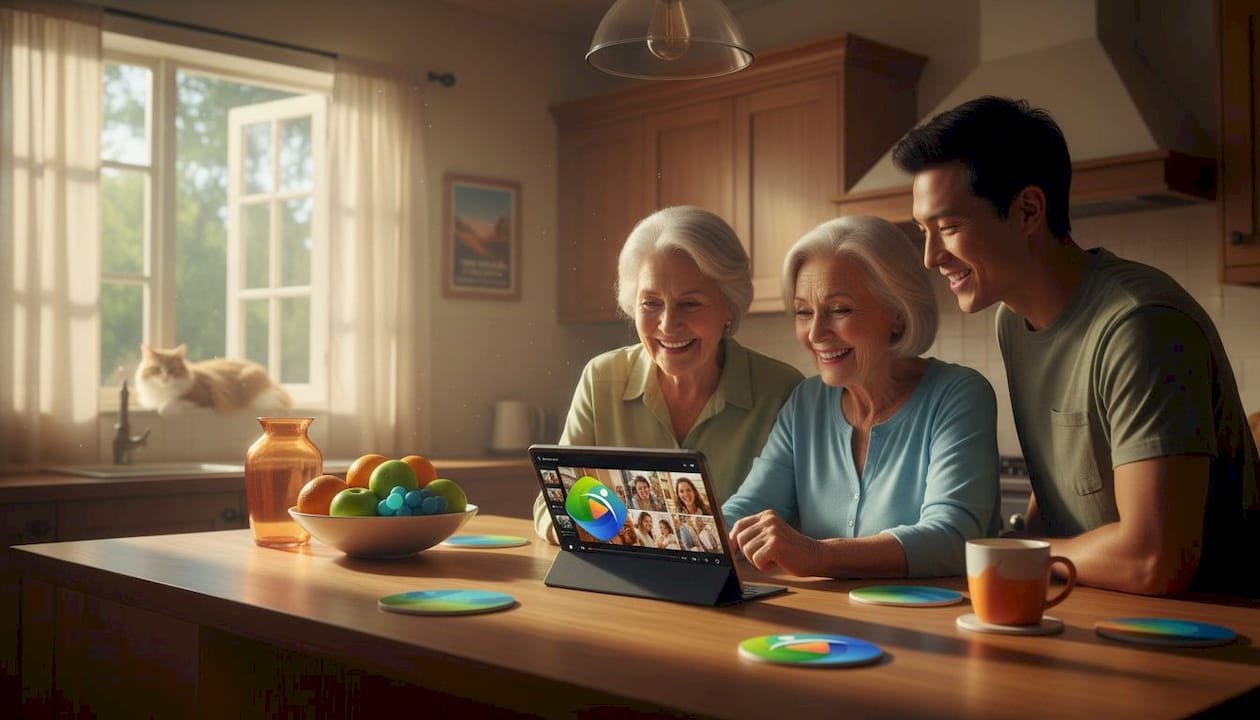
Picture Yourself and Living Connected are two Australian initiatives that demonstrate how creative partnerships using visual storytelling shift public focus from what residents can no longer do toward the richness of their lives. These projects put older adults in front of cameras on their own terms, sharing passions, histories, and personalities that the clinical model rarely surfaces.
The effect on families is just as significant. When a daughter sees a short video of her father laughing during a cooking reminiscence session, her trust in the facility does not just increase. It deepens in a way that a monthly newsletter could never achieve. Authentic resident stories communicate safety, dignity, and genuine human connection simultaneously.
What does not work is the opposite of authenticity. AI-generated content lacks the emotional depth required for meaningful communication in aged care contexts. Families and residents are perceptive. They can tell when a story has been manufactured versus witnessed. The power of storytelling in this context comes entirely from its truth.
Practical ways care providers can strengthen community engagement through storytelling include:
- Partnering with local schools or arts organisations for intergenerational storytelling projects
- Sharing resident stories (with consent) across social media and community newsletters
- Creating a resident spotlight series that runs consistently, not just during awareness months
- Inviting family members to contribute to memory projects and then sharing outcomes with them
Visual storytelling and aged care accreditation
The connection between aged care accreditation and visual storytelling is underappreciated. Text-heavy compliance registers are useful, but they describe care in the abstract. Visual documentation shows it in practice.
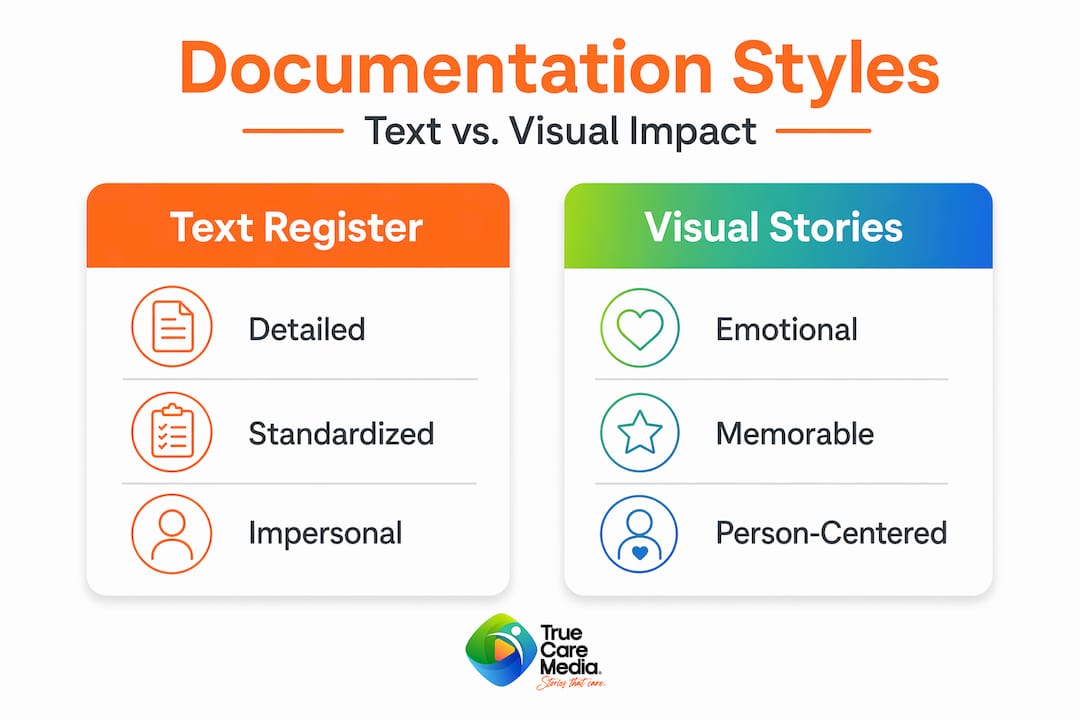
Consider the difference between a written entry that states “resident participated in person-centred leisure activity” and a short video clip showing that resident engaged and smiling during that activity. For assessors working through aged care accreditation standards, the visual evidence is immediately more verifiable. Photo-documentation and visual dashboards make person-centred care tangible in ways that written records rarely achieve.
| Documentation type | Strengths | Limitations |
|---|---|---|
| Text register | Detailed, searchable, standardised | Abstract, time-consuming to interpret |
| Photo-documentation | Visual, immediate, emotionally resonant | Requires consent management and storage |
| Short video evidence | Shows interaction and engagement clearly | Production time and privacy considerations |
| Visual dashboard | Patterns visible at a glance | Needs consistent data input to be meaningful |
Visual storytelling as ‘living’ documentation of person-centred care goes beyond compliance. It creates an ongoing record of how care is actually delivered rather than how it is intended to be delivered. That distinction matters enormously when assessors are evaluating genuine practice versus documented policy.
Pro Tip: Build a simple photo consent library into your intake process. When residents and families agree to documentation early, you remove the friction that stops staff from capturing meaningful moments throughout the year.
Building a trustworthy aged care brand through storytelling
Senior care communities with storytelling-based brand voices build more trust and convert prospective residents better than those without. That figure is not a marketing claim. It reflects a real gap in how aged care facilities communicate their identity.
The benefits of storytelling in elder care extend to the brand level because families making care decisions are not choosing a service. They are choosing an environment where someone they love will spend meaningful time. The question they are really asking is: “Will my person be seen here?” Visual storytelling answers that question directly.
Authenticity is the non-negotiable element. Low-fi, resident-led storytelling projects consistently build deeper trust and emotional connection than high-production marketing media. A shaky phone video of a resident showing off their garden plot communicates something a polished promotional film cannot. Check out how aged care providers use video storytelling to genuinely differentiate their brand.
Building that kind of brand voice requires deliberate choices:
- Train staff to notice and document ordinary moments worth sharing
- Establish a consistent visual style that feels warm rather than clinical
- Balance care information with personal stories so content serves multiple audiences
- Involve residents in deciding what is shared and how they are represented
- Review storytelling content regularly to reflect the actual community, not an idealised version of it
How visual aids improve aged care communication also extends internally. When staff see residents as fully realised individuals with rich histories, the quality of relational care improves. Storytelling is not only outward-facing.
Practical steps for getting started
Implementing visual storytelling does not require a production budget or a communications team. It requires intention, a process, and consistency.
- Begin with life story collection. Give new residents and their families a simple life story form during admission. Photographs, key dates, favourite music, places that matter. This becomes the seed of every story that follows.
- Introduce multi-sensory storytelling sessions. Combine photographs with objects, music, and familiar smells in small group sessions. Document the responses you observe.
- Create resident-led projects. Let residents photograph their own environments, write captions, or narrate short audio recordings. Their voice is always more powerful than a staff member’s description of their experience.
- Involve families actively. Invite families to contribute photographs and context, and share outcomes back with them. This closes the loop and deepens their engagement with the facility.
- Use technology where it genuinely helps. For residents comfortable with tablets, platforms designed for memory support and digital storytelling can be genuinely enriching. For others, printed formats work just as well.
- Monitor and measure. Track mood, engagement, and participation over time. Use observations and care notes to build a picture of how storytelling is affecting individual residents.
Ethical considerations matter throughout. Consent must be informed and revisited, not just collected once. Residents experiencing cognitive decline require additional care around ongoing consent, involving family members or legal guardians where appropriate.
Pro Tip: Assign one staff member per shift as the ‘story spotter’ on a rotating basis. Their job is simply to notice and document one moment worth sharing. Over a month, that adds up to a rich archive of authentic content.
My honest view on why this matters now
I have worked alongside aged care teams who treat storytelling as something they will get to “once the compliance work is done.” That framing is the problem. The compliance work is never done, and storytelling never makes it onto the list.
What I have seen, when providers actually commit to visual storytelling as a practice rather than a project, is a shift that touches everything. Residents feel more known. Staff feel more connected to why they do the work. Families feel more trusting. And assessors, reviewing documentation, see an organisation that cares about its residents as people rather than case files.
The real risk in 2026 is not that aged care providers do too much storytelling. The risk is that the sector keeps treating it as optional while the evidence for its impact on resident wellbeing, compliance quality, and community trust continues to accumulate. Engaging seniors through visual narratives is not a trend. It is a practice grounded in how human memory, identity, and connection actually work.
The providers I trust are the ones who can show me what their residents’ lives look like, not just describe their care ratios. That distinction is everything.
— Mishal
How Com can help your aged care storytelling
Knowing why visual content matters in healthcare is one thing. Knowing how to produce it consistently and ethically is another. Com works with aged care providers and allied health organisations to create video, photography, and storytelling content that reflects the real lives of residents and builds genuine trust with families and communities.
Whether you are just beginning to explore visual storytelling or looking to strengthen an existing approach, Com’s work is grounded in authenticity and purpose. Explore the full picture of aged care video storytelling and discover how a well-crafted story can support both accreditation readiness and your organisation’s long-term reputation. You can also visit Com’s full services to see how professional storytelling is applied across the healthcare and aged care sector.
FAQ
What is visual storytelling in aged care?
Visual storytelling in aged care refers to using photographs, video, memory books, and multi-sensory narratives to document and share residents’ lives, experiences, and care. It serves both therapeutic and communication purposes across clinical and community contexts.
How does visual storytelling improve aged care outcomes?
Life review and sensory storytelling measurably reduce depression and anxiety in residents while improving life satisfaction and cognitive engagement, particularly for those living with dementia.
Can visual storytelling support aged care accreditation?
Yes. Photo-documentation and visual dashboards provide assessors with direct evidence of person-centred care practices, going beyond what text registers can demonstrate on their own.
Does the content need to be professionally produced?
No. Resident-led, unpolished narratives consistently build more trust and emotional connection with families than high-production marketing content. Authenticity is the priority.
How do you manage consent for visual storytelling?
Introduce a photo and story consent process at admission, build it into family communications, and revisit consent regularly. For residents with cognitive decline, involve families or legal guardians in ongoing consent decisions.