
Families choosing home care rarely make that decision from a brochure. They make it from a feeling. Understanding what is home care provider storytelling explains why some agencies fill their books while others, offering identical services at lower prices, struggle to convert enquiries into clients. Storytelling in home care is the practice of sharing real experiences from caregivers, clients, and families to create emotional resonance that service lists simply cannot produce. 70% of consumers feel more valued by personalised content, which is why narrative sits at the heart of modern home care marketing.
Table of Contents
- What is home care provider storytelling and why it matters
- The role of visual content in effective storytelling
- Legal and ethical considerations: sharing client stories responsibly
- How to collect and craft authentic home care stories
- Measuring the impact of storytelling on client engagement and trust
- Fresh perspective: why storytelling is the future of home care marketing
- How True Care Media helps you tell stories that build trust
- Frequently asked questions
Key Takeaways
| Point | Details |
|---|---|
| Storytelling builds trust | Sharing genuine client and caregiver experiences creates emotional connections that increase family confidence in your services. |
| Visuals amplify messages | Videos showing real interactions engage audiences better and help them feel familiar with your agency before contact. |
| Respect privacy rigorously | Always use written consent or strict anonymization standards to share stories without violating privacy laws. |
| Systematic story collection | Encourage caregivers to share meaningful moments and collect detailed testimonials to ensure authentic content. |
| Storytelling influences decisions | Effective storytelling can sway families to choose your agency over competitors, even at a higher price point. |
What is home care provider storytelling and why it matters
Home care provider storytelling is not copywriting dressed up with warm language. It is the deliberate, authentic sharing of genuine human moments: a caregiver who noticed a client’s mood shift before anyone else did, a family who finally felt relief after years of uncertainty, a support worker whose dedication changed a participant’s daily life. These are the stories that build belief.
Most providers still lead with a list: “We offer 24-hour care, medication management, and transport support.” Those services matter, but they do not answer the question families are actually asking, which is: “Can I trust these people with someone I love?” That question is emotional, not logistical. Families sometimes choose higher-priced agencies because genuine storytelling in marketing creates a perceived empathy and understanding that clinical service descriptions never will.
The impact of storytelling in caregiving extends well beyond marketing. It shapes culture inside your organisation, gives caregivers a sense of pride and purpose, and signals to NDIS participants and their families that your team sees people, not cases. Effective storytelling:
- Shows the relational quality of care, not just the technical delivery
- Reduces the fear and uncertainty families feel when entering the home care system
- Highlights quality-of-life improvements that resonate emotionally, such as regained independence or rekindled joy
- Positions your agency as one that genuinely understands the lived experience of disability and ageing
- Creates a point of difference that price competition cannot erode
Pro Tip: Before producing any external content, ask yourself whether the story you are telling would move someone who has never heard of your agency. If it reads like a testimonial template, it is not storytelling yet.
For a deeper look at how narrative approaches translate into actual video content, explore stand out with storytelling video to see how agencies are already doing this well.
The role of visual content in effective storytelling
Text can tell a story. Video shows it. That distinction is not minor. When a family watches a caregiver laugh alongside a client during a morning routine, they are not reading about trust, they are experiencing it. This is what researchers call narrative transportation: the psychological state in which an audience becomes absorbed in a story and lowers their critical defences. Resistance drops. Belief builds.
Video allows families to see relationships, meet staff, and experience an agency’s culture before they ever make contact. That is a profound shift in how trust is established. Traditionally, trust came after engagement. With video storytelling, it can come before the first phone call.
Not every provider needs full cinematic production. Effective visual storytelling in home care can include:
- Short documentary-style videos following a day in the life of a support worker
- Testimonial interviews with clients or family members sharing their journey in their own words
- Voiceover narratives using photography to tell a client’s story without identifying them on screen
- Podcast or audio formats offering emotional authenticity for audiences who prefer listening
- Staff introduction videos that humanise your team and reduce the anxiety of meeting strangers
Pro Tip: Authentic beats polished every time in home care video. Families are not looking for a television advertisement. A genuine, slightly imperfect conversation filmed on a good camera will outperform a scripted performance in a studio.
Understanding how different video formats serve different emotional goals is covered in detail in this patient experience videos guide, which translates directly to home care and NDIS contexts.
Legal and ethical considerations: sharing client stories responsibly
Storytelling without boundaries is a liability. In Australia, home care providers and NDIS managers must navigate the Privacy Act 1988 and the Australian Privacy Principles, which carry similar intent to the American HIPAA framework. Understanding both helps you build a watertight content process.
HIPAA requires written patient authorisation before using identifiable stories. De-identified stories must rigorously remove 18 personal identifiers to avoid violations. Two de-identification methods exist: Safe Harbor, which removes all listed identifiers, and Expert Determination, where a qualified statistician certifies that re-identification risk is negligible.
Crucially, de-identified stories still risk re-identification, particularly when context clues are present. A story mentioning a rare condition, a specific suburb, and an unusual age combination could identify a participant to their own community even without a name attached. This is not hypothetical. It is a documented risk.
| Privacy approach | Risk level | Recommended for |
|---|---|---|
| Written consent with full identification | Low | Video testimonials, named case studies |
| De-identification with Safe Harbor | Medium | Written stories, anonymised profiles |
| Expert determination | Low to medium | Complex or sensitive health narratives |
| Combined story composites | Low | Illustrative examples, service descriptions |
A practical privacy checklist for Australian NDIS managers and home care providers:
- Obtain signed, specific written consent before filming or publishing any client story
- Remove all 18 HIPAA-equivalent identifiers including dates, postcodes, and employment details
- Review context clues: condition specificity, demographic combination, and location references
- Blend elements from multiple participants’ experiences when a single story creates identification risk
- Store consent documentation securely and link it to the corresponding content asset
- Review consent annually if content remains live
Pro Tip: Treat consent as an ongoing relationship, not a one-time checkbox. If a client’s circumstances change significantly, revisit whether the original story still reflects their wishes.
The NDIS video compliance guide covers how to approach these requirements practically within a video production context.
How to collect and craft authentic home care stories
The most common reason home care providers do not use storytelling is not lack of interest. It is lack of a system. Stories are happening in your organisation every single day. The challenge is capturing them before they disappear into a shift handover note.

Agencies can uncover stories by asking caregivers directly: “Tell me about a moment this week that made you smile.” That single question, asked consistently, surfaces material that no marketing brief could invent. Collecting full client testimonials rather than short statements gives you rich narrative material to work with.
A systematic approach to story collection:
- Create a monthly story submission process where caregivers log meaningful moments through a simple form or voice message
- Brief team leaders to listen for stories during supervision sessions and flag them to your communications team
- Train support workers on the difference between a service report and a story: one documents what happened, the other captures what it meant
- Conduct short client interviews in familiar, comfortable settings with questions focused on feelings and experiences, not service features
- Follow up after milestones: first months of care, significant health improvements, and family transitions are prime story moments
When collecting client stories, home care storytelling techniques around safety matter as much as technique. Always:
- Offer the option to review and approve any content before publication
- Ask open questions: “What has changed for you?” rather than “Did we help you?”
- Involve a trusted family member if the client prefers support during the interview
- Record only with explicit verbal and written consent, and explain exactly where the story will appear
Pro Tip: Build storytelling into your onboarding culture. When new caregivers understand from day one that sharing meaningful moments is part of the job, story collection becomes natural rather than extracted.
For agencies building this from scratch, the advice on collecting stories for aged care video provides a useful starting framework.
Measuring the impact of storytelling on client engagement and trust
Narrative methods in home care are not just emotionally compelling. They are measurably effective. 70% of consumers feel more valued by personalised content, and the connection between perceived empathy and provider selection is well documented in home care decision-making research.
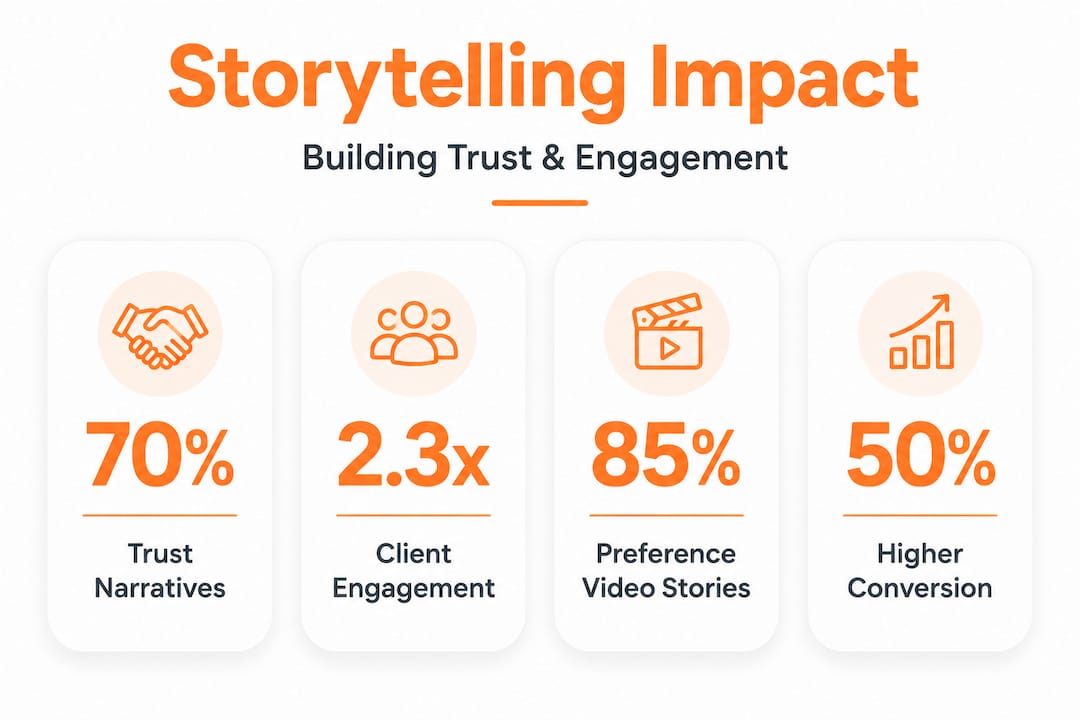
In health promotion, storytelling interventions yield high engagement when true personal narratives are used and culturally tailored to the audience. This is particularly relevant for NDIS providers working with culturally and linguistically diverse communities, where generic marketing consistently underperforms.
| Marketing approach | Trust impact | Client conversion | Emotional resonance |
|---|---|---|---|
| Service list only | Low | Low | Minimal |
| Testimonial quotes | Medium | Medium | Moderate |
| Authentic video storytelling | High | High | Strong |
| Culturally tailored narrative | Very high | Very high | Deep and lasting |
The case for engaging clients through storytelling comes down to what actually influences decisions under emotional pressure. When families are navigating disability care for the first time or transitioning an ageing parent into supported living, they are not in a rational decision-making state. They need reassurance. Stories provide it. Facts cannot.
Home care provider communication that leads with narrative rather than credentials sees measurably stronger outcomes across enquiry conversion, client retention, and community referrals. The importance of caregiver narratives also extends inward: teams that see their stories valued are more likely to stay, more likely to engage, and more likely to deliver the quality of care your marketing promises.
Fresh perspective: why storytelling is the future of home care marketing
Here is the uncomfortable reality most home care marketing advice skips: if your website looks like every other provider’s website, you have already lost. The conventional approach, featuring service lists, accreditation badges, and stock photography of smiling older adults, is not just ineffective. It is actively counterproductive, because it signals to families that you see them as a category, not a person.
We have seen this pattern repeatedly. Providers who invest in genuine storytelling video consistently report that enquiries arrive warmer. Families say things like, “I feel like I already know your team.” That is narrative transportation at work. That psychological shift, from stranger to trusted presence, happens before a single consultation.
The deeper insight is this: storytelling is not a marketing channel. It is an expression of organisational character. Providers who understand the impact of storytelling in aged care are not just running better campaigns. They are building organisations that attract better caregivers, retain clients longer, and generate organic referrals because their reputation precedes them.
The mistake is treating storytelling as a one-off campaign. A single video published and forgotten does almost nothing. What builds trust is an ongoing stream of genuine moments: monthly caregiver stories, quarterly client journeys, seasonal updates from your team. That consistency signals that the care you describe is not a snapshot. It is a culture.
For NDIS managers specifically, the opportunity is even more significant. NDIS participants and their support networks have often experienced providers who failed them. A high volume of genuine, diverse stories that reflect your actual team and community creates credibility that no amount of compliance documentation can match.
How True Care Media helps you tell stories that build trust
You now understand what home care provider storytelling is, why it works, and what responsible practice looks like. The harder part is doing it consistently, compliantly, and in a way that actually moves people.
True Care Media specialises in video production and storytelling for NDIS providers and allied health brands across Australia. We do not produce generic corporate content. We work with your team to find the real moments, craft them into compelling visual stories, and ensure every piece of content is privacy-compliant and aligned with your audience’s values. Whether you are building your first aged care storytelling video or scaling a content strategy for multiple NDIS streams, our team brings the experience and sensitivity this sector demands. Explore how NDIS admissions teams win with video or visit True Care Media to start the conversation.
Frequently asked questions
What is home care provider storytelling?
It is the practice of sharing authentic personal experiences from caregivers and clients to build emotional connections and trust with families considering home care services, going well beyond listing what an agency offers.
How can I use client stories without violating privacy laws?
Always obtain written consent before publishing identifiable content, or rigorously de-identify the story by removing all personal identifiers, context clues, and any detail combination that could allow community-level re-identification.
Why is video more effective than text for home care storytelling?
Video creates narrative transportation, a state in which viewers become absorbed in the story and lower their resistance, making emotional trust-building far more effective than written descriptions alone.
How do I collect authentic stories from caregivers and clients?
Ask caregivers to share meaningful moments from their week rather than service summaries, and gather full-length client testimonials in comfortable settings with clear consent to build a genuine and usable story library.
Can combining multiple client stories improve content impact?
Yes. Blending aspects of multiple stories creates richer, more representative narratives while significantly reducing the risk of re-identification, making it a strong approach for sensitive health and disability content.