
Choosing the right patient journey video content examples for your healthcare organisation is harder than it looks. Every patient’s story is different, every audience expects something real, and the formats available span everything from polished documentaries to 60-second mobile testimonials. Patient-centric storytelling consistently outperforms brand-driven clinical messaging, yet most healthcare marketers still default to safe, provider-narrated formats that audiences tune out. This article walks you through seven standout examples, the criteria that separate effective videos from forgettable ones, and practical guidance for making smarter choices.
Table of Contents
- Key takeaways
- Criteria for selecting patient journey video content examples
- 1. ‘The gift of green bananas’: cultural storytelling through family dynamics
- 2. ‘Built to heal’: documentary-style community health access
- 3. Short patient testimonials: emotional punch in 60 seconds
- 4. Animated wordless storytelling: behaviour change across cultures
- 5. Pre and post-op instructional patient videos
- 6. Facility tours featuring patient narration
- 7. Clinician-to-patient explainer videos with patient follow-up
- Comparison of the seven patient journey video styles
- Recommendations for choosing or producing patient journey videos
- My perspective on what patient journey storytelling actually requires
- How Com can help you produce patient journey videos that connect
- FAQ
Key takeaways
| Point | Details |
|---|---|
| Authenticity drives performance | Patient voice and lived experience produce stronger emotional connection than provider-led narration. |
| Format matters for reach | Videos under two minutes with captions perform better on mobile and boost SEO engagement signals. |
| Compliance is non-negotiable | Written consent and privacy safeguards must be in place before any patient footage goes public. |
| Cultural context builds trust | Storytelling that reflects community identity resonates far more deeply with specific audiences. |
| Style should match purpose | Different video formats suit different goals, from reducing anxiety to building institutional trust. |
Criteria for selecting patient journey video content examples
Before you get inspired by examples, you need a framework for evaluating them. Not every well-produced video is right for your brand, your audience, or your regulatory obligations.
Here are the core criteria worth assessing:
- Authenticity and patient voice. Does the patient narrate their own experience, or does a clinician speak on their behalf? 90-second patient story videos bridge data and emotion far more effectively than brand-controlled scripts.
- Video length and format. Successful patient journey videos keep runtimes under two minutes and prioritise patient voice over provider narration for both engagement and accessibility.
- Consent and compliance. Under HIPAA-equivalent frameworks, written patient authorisation is required for any external marketing, PR, or social media use of patient footage. The authorisation must detail purpose, expiration, and revocation rights.
- Accessibility features. Captions and transcripts are not optional extras. They boost SEO, make content usable for hearing-impaired viewers, and are standard practice for responsible healthcare video storytelling.
- Cultural sensitivity. Does the video reflect the community it represents? Generic stock-style patient stories rarely land with specific cultural groups.
- Engagement metrics. Look for evidence of behavioural impact: not just views, but time-on-page, referral clicks, and conversion data where available. Embedding patient story content increases website dwell time by approximately 40%.
Pro Tip: Always review your organisation’s clinical photography and video policy before production begins. Nonclinical patient footage requires valid authorisation and controlled storage, separate to clinical documentation processes.
1. ‘The gift of green bananas’: cultural storytelling through family dynamics
This patient journey film centres on a Pacific Islander family navigating a serious illness diagnosis together. The title references a cultural metaphor for hope and uncertainty, immediately signalling to the audience that this is not a generic hospital story.
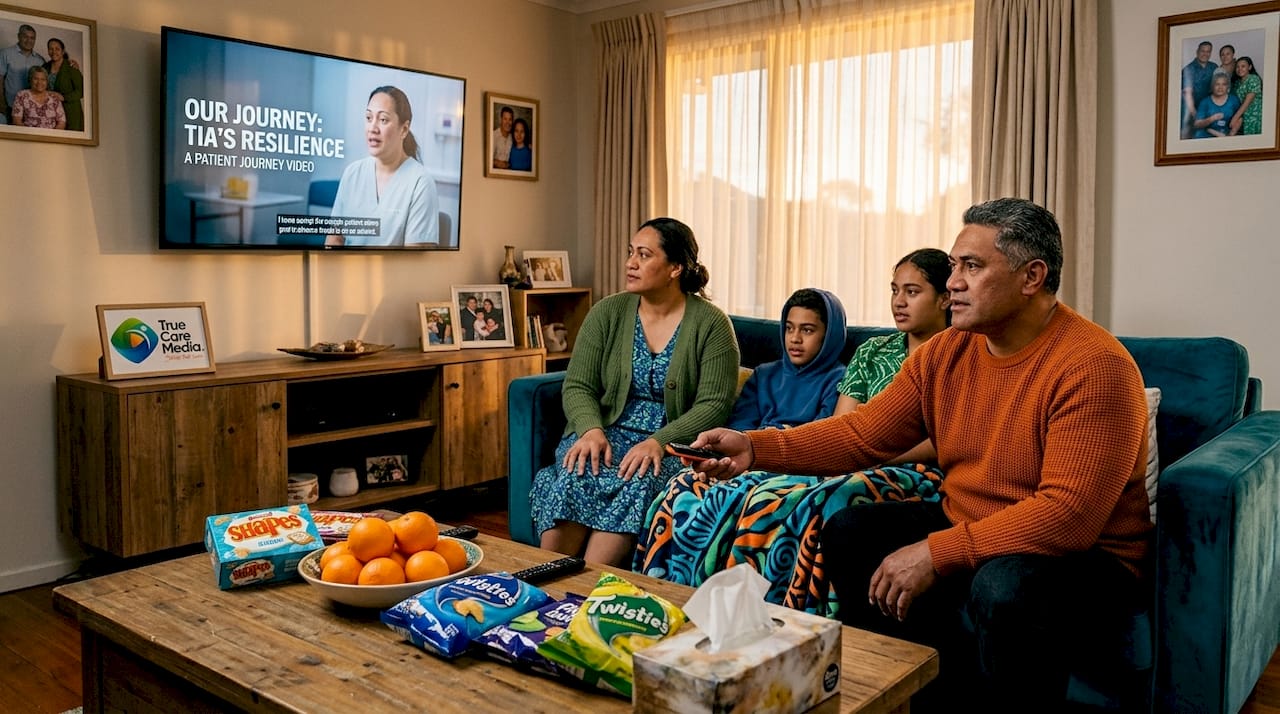
What makes it work is the decision to let the family’s voice carry the entire narrative. There is no clinical voiceover explaining the situation. Instead, the viewer witnesses conversations between family members, symbolic gestures, and moments of quiet resilience that reflect genuinely held cultural values around collective care.
Key strengths of this approach:
- Community voice is prioritised over institutional messaging
- Symbolic cultural references create emotional depth without explanation
- The patient and family remain the subject, not supporting characters
The limitation is reach. Stories this specific do not translate broadly without context, so they work best when your audience shares the cultural background being depicted or when your organisation is actively building trust within that specific community.
2. ‘Built to heal’: documentary-style community health access
Documentary-style healthcare videos give creative teams more room to capture complexity. This example follows patients and providers within an underserved community, using historical context and multiple voices to explain how systemic barriers shape health outcomes.
Creative freedom in documentary formats yields more authentic narratives than traditional branded content, because the storytelling is driven by what actually happened rather than a pre-approved message. Institutions that invest in this format signal that they trust their community’s story to speak for them.
Key features worth noting:
- Multiple community voices build credibility across different viewer segments
- Historical and social context adds weight that short testimonial formats cannot achieve
- The production style reads as journalism, not advertising, which increases viewer trust
Pro Tip: If your organisation is considering documentary-style hospital patient journey video production, brief your director on your values and then step back. The films that resonate most are the ones where the brand did not try to control every frame.
3. Short patient testimonials: emotional punch in 60 seconds
The one-minute patient testimonial is the workhorse of healthcare video marketing. When done well, it covers diagnosis, treatment, and outcome through the patient’s own words, with minimal editing intervention.
The key is specificity. Vague statements like “the staff were amazing” do not move audiences. Specific moments, a nurse who sat with a patient at 3am, a procedure that resolved pain the patient had lived with for a decade, create the emotional specificity that stays with viewers long after the video ends.
These formats are fast to produce, easy to caption, and optimised for mobile consumption. They also sit naturally on landing pages where patient story marketing signals authority and trustworthiness to search engines.
4. Animated wordless storytelling: behaviour change across cultures
Animated patient journey videos without spoken language have a reach advantage no other format can match. Short, animated, wordless videos have demonstrated effectiveness in improving patient knowledge and reducing stigma across randomised controlled trials in the US, Europe, Asia, and Africa.
For healthcare marketers working with multicultural populations or NDIS participants from non-English speaking backgrounds, this format removes language as a barrier entirely. The animation also allows you to depict sensitive health topics without placing a real patient on camera, which simplifies the consent process considerably.
The trade-off is emotional intimacy. Without a real face and a real voice, animated stories can feel less personal. They work best for education and stigma reduction rather than relationship building.
5. Pre and post-op instructional patient videos
These videos sit at the intersection of patient education and marketing. A patient explaining what their recovery looked like, in plain language, addresses the specific anxieties that prospective patients bring to their research process.
When produced well, these videos reduce call volume to clinical teams, increase patient readiness before admission, and build confidence in the provider’s expertise. They also address one of the most common complaints in patient experience surveys: feeling uninformed about what to expect.
From a production standpoint, these videos benefit from being straightforward and logistically specific. Timestamps, chapter markers, and downloadable transcripts extend their utility well beyond the initial watch.
6. Facility tours featuring patient narration
A facility tour narrated by a patient rather than a staff member completely changes the viewer’s experience. The patient functions as a surrogate for the audience, noticing the things a prospective patient would actually notice: the quality of natural light, the noise level on the ward, the ease of navigating between departments.
This format is particularly effective for aged care providers and rehabilitation services where the environment itself is a significant factor in the decision-making process. It reduces anxiety before admission and helps families feel they have visited before they actually arrive.
For aged care storytelling video specifically, the facility tour with patient narration consistently outperforms staff-narrated equivalents in viewer retention data.
7. Clinician-to-patient explainer videos with patient follow-up
This format pairs a clinician explanation of a condition or procedure with a short patient segment filmed after treatment. The structure mirrors the actual patient experience: first the information, then the lived reality of going through it.
The clinical segment builds credibility. The patient segment builds trust. Together they address both the rational and emotional questions a prospective patient carries into their research.
Healthcare providers storing or transmitting patient video footage electronically must implement technical, administrative, and physical safeguards under privacy security rules. This format, because it involves two separate filming sessions and two separate consent processes, requires clear production documentation from the outset.
Comparison of the seven patient journey video styles
| Video style | Patient voice focus | Compliance complexity | Engagement strength | Best use case |
|---|---|---|---|---|
| Cultural narrative | Very high | High | Very high | Community trust building |
| Documentary | High | High | High | Institutional authority |
| Short testimonial | High | Moderate | High | Landing pages, social media |
| Animated wordless | No patient on camera | Low | High | Education, stigma reduction |
| Pre/post-op instructional | Moderate | Moderate | Moderate | Patient readiness |
| Facility tour (patient-narrated) | Moderate | Moderate | High | Admissions, aged care |
| Clinician + patient follow-up | Moderate to high | High | High | Trust-building, complex conditions |
Recommendations for choosing or producing patient journey videos
Selecting the right format comes down to three questions: what do you need the viewer to feel, what do you need them to do next, and what does your organisation have the capacity to produce responsibly?
Practical guidance for healthcare marketers:
- Align style with strategic intent. Cultural narrative formats suit organisations building long-term community trust. Short testimonials suit conversion-focused pages. Animated formats suit education campaigns.
- Prioritise patient voice throughout. Authentic patient voices in healthcare video content create more resonant marketing than any amount of brand messaging, so resist the instinct to script what patients say.
- Build a consent and storage process before you film. Privacy safeguards must be in place for clinical photography and video before a single frame is captured. Retrospective consent is not acceptable.
- Invest in captions and transcripts from the start. These features expand your audience, support accessibility obligations, and improve SEO performance.
- Measure impact beyond views. Track time on page, referral traffic, and where possible, admission enquiries that followed exposure to specific videos. That is where the real evidence of effective patient video content lives.
For home care storytelling strategies and NDIS participant-facing content, the same principles apply with additional attention to participant capacity and choice in the consent process.
My perspective on what patient journey storytelling actually requires
I’ve reviewed dozens of healthcare videos over the years, and the pattern is consistent. The ones that generate real traction, the ones patients share with family members before making a decision, are almost never the ones where the organisation held the tightest grip on the message.
In my experience, the breakthrough moment in healthcare video storytelling comes when the marketing team stops trying to tell the patient what their story means and simply makes space for the patient to show it. That shift sounds small. It is not. It requires trusting that an unscripted moment of vulnerability will land better than three polished brand statements, and it usually does.
What I’ve found is that cultural and community-specific formats are consistently underinvested in. Most organisations produce one or two token diversity stories and consider the job done. The organisations that genuinely build trust with specific communities are the ones commissioning ongoing programmes of participant-centred storytelling over years, not months.
The compliance conversation also gets left too late, more often than it should. Privacy and consent frameworks are not obstacles to good storytelling. They are the foundation that makes the storytelling possible. When patients feel genuinely protected, they share more. That is the version of their story worth capturing.
— Mishal
How Com can help you produce patient journey videos that connect
At Com, we specialise in helping NDIS providers and allied health brands tell stories that actually build trust. Whether you’re producing your first patient journey video or refining a content series that is not converting, we bring the production experience and healthcare understanding to get it right.
Our team works across hospital patient experience video production, aged care storytelling, and NDIS participant narratives. We understand consent frameworks, cultural sensitivity requirements, and the difference between a video that looks good and one that genuinely moves people toward a decision. If you are ready to invest in aged care video storytelling that differentiates your organisation and builds lasting referral trust, we would love to talk about what that looks like for your community.
FAQ
What makes a patient journey video effective?
Effective patient journey videos keep runtime under two minutes, centre the patient’s own voice, and include captions and transcripts for accessibility. Specificity and emotional authenticity consistently outperform scripted or provider-narrated formats.
Do I need written consent before filming a patient video?
Yes. Written authorisation is required for any patient footage used in external marketing or social media, and must detail the purpose, expiration, and the patient’s right to revoke consent.
Which video format works best for multicultural healthcare audiences?
Animated wordless storytelling has the strongest evidence base for multicultural reach, with randomised controlled trials confirming effectiveness across multiple continents and language groups.
How long should a patient testimonial video be?
Aim for 60 to 90 seconds for testimonial formats used on landing pages or social media. Longer documentary-style videos can run up to 10 minutes but require stronger narrative structure to retain viewers.
How does patient video content affect website performance?
Embedding patient story videos on your website increases dwell time by approximately 40%, signalling authority and trustworthiness to search engines and increasing the likelihood visitors take a next step.