
Hospital culture videos are frequently dismissed as internal marketing. They’re not. Understanding how hospital culture videos work reveals a much more functional purpose: shaping staff behaviour, reinforcing shared values, improving patient safety, and reducing turnover in environments where culture genuinely affects clinical outcomes. For healthcare administrators and professionals seeking to change how their organisation operates from the inside, these videos are one of the most direct tools available. This guide covers purpose, production, compliance, technology, and measurement.
Table of Contents
- Key takeaways
- How hospital culture videos work to shape staff and culture
- Planning and producing effective culture videos
- Ethics and compliance in hospital culture videos
- Technology and workflows that scale culture video production
- Measuring hospital culture video impact
- My take on what really makes culture videos work
- How Com can help you create culture videos that work
- FAQ
Key takeaways
| Point | Details |
|---|---|
| More than marketing | Culture videos influence staff attitudes, reinforce protocols, and drive measurable engagement outcomes. |
| Planning prevents problems | Storyboard-led production with clear briefs reduces disruption and captures all necessary shots efficiently. |
| Compliance is non-negotiable | HIPAA and privacy obligations apply to every visual and audio element captured on hospital grounds. |
| Technology speeds delivery | Templated workflows and centralised libraries cut production time dramatically, enabling faster content cycles. |
| Leadership determines impact | Videos only create lasting change when leaders reinforce their messaging through consistent follow-through. |
How hospital culture videos work to shape staff and culture
Most people assume a hospital culture video is a polished promotional piece shown at a board meeting or posted to a careers page. The reality is more textured than that.
At their most functional, these videos operate as internal communication tools. They carry organisational values into spaces that written policies and email updates never reach effectively. A ward nurse between shifts is far more likely to watch a two-minute video on a shared screen than read a 600-word memo on the intranet. That’s not a criticism. It’s a design challenge, and culture videos solve it.
The importance of culture videos in hospitals comes down to three interconnected outcomes:
- Staff motivation and alignment. When people see their own colleagues featured in a video that honestly reflects what the organisation values, they feel seen. That’s not sentiment. It directly affects engagement scores and discretionary effort.
- Patient safety reinforcement. Safety protocols communicated through video, particularly with real clinical staff modelling correct behaviour, are retained far better than text-based guidelines alone.
- Retention and morale. Orlando Health’s weekly programme reaches over 36,000 healthcare staff with content specifically designed around what employees need to know, want to know, and care about. That distinction matters. Content that respects staff intelligence and time drives genuine engagement.
The effects of hospital culture on staff run both ways. A strong culture lifts performance. A fragmented or unclear culture creates ambiguity that affects everything from handover quality to incident reporting. Culture videos can actively counter that fragmentation by creating a shared reference point for values and expectations.
“The most effective hospital culture videos aren’t the ones with the highest production value. They’re the ones that tell a true story people recognise as their own.”
This is why clinic culture videos attract staff at the recruitment stage too. When a candidate watches a short video featuring real team members talking about why they stayed, that carries more weight than any job advertisement.
Planning and producing effective culture videos
Knowing why these videos matter is one thing. Understanding how to create hospital culture videos that actually work inside a clinical environment is another challenge entirely.
The production process in a hospital setting is structurally different from any other commercial video production. You’re working around patient care schedules, infection control requirements, privacy obligations, and the understandable scepticism of staff who’ve seen one-off video projects come and go without impact. A disciplined workflow is the only way to get it right.
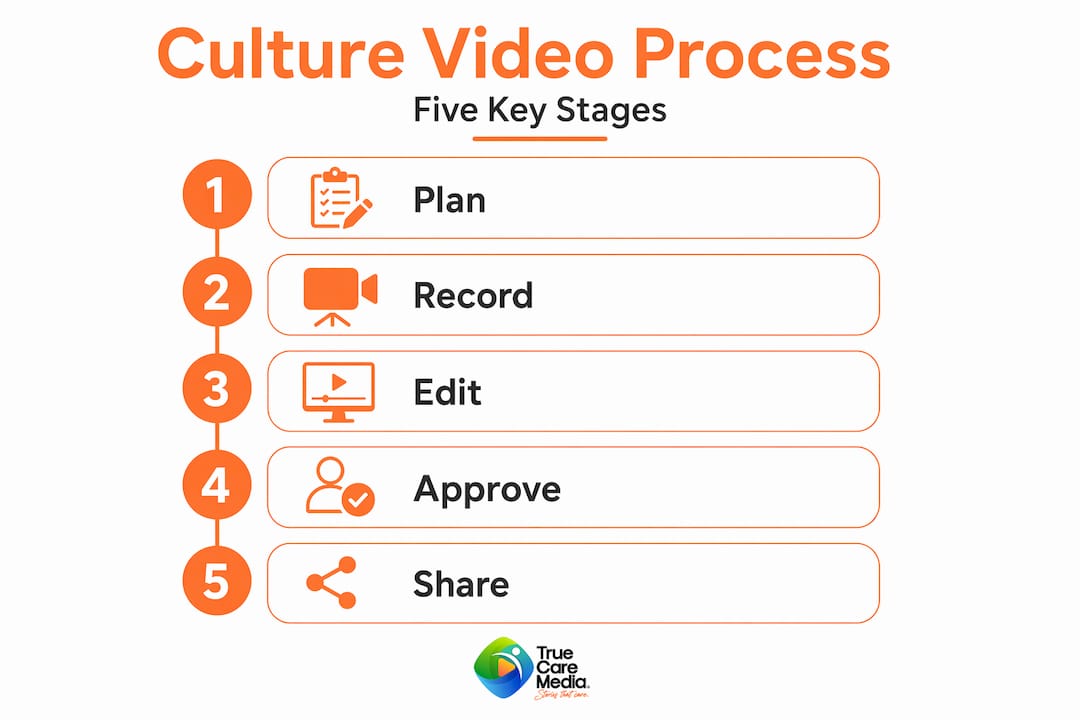
Here’s a practical sequence for producing culture videos that work in healthcare settings:
- Write a clear brief aligned with culture goals. Define what behavioural or attitudinal outcome you want viewers to leave with. “We want staff to feel proud to work here” is a starting point. “We want clinical staff to understand our new open disclosure approach and trust leadership’s commitment to it” is a brief you can actually film.
- Build a detailed storyboard before anyone picks up a camera. Frimley Health NHS Foundation Trust’s internal strategy film was shot across three hospital sites in two days. That’s only possible with meticulous storyboard-led planning that maps every shot to a specific location and scene.
- Coordinate site clearances and schedule around patient care. Filming in a ward means working with nurse unit managers to identify windows that won’t disrupt care. Treat this as non-negotiable from the first planning meeting.
- Obtain informed consent in advance. Every staff member and any patient who appears on camera needs a completed, specific release form. This isn’t a box-ticking exercise. It’s the foundation of an ethical production.
- Manage on-set privacy actively. Camera angles must be designed to exclude patient identifiers. Whiteboards, medication charts, wristbands, and monitor screens all need to stay out of frame or be cleared before shooting.
- Post-production compliance review. Before any video is distributed, it should go through a legal and compliance check. Blur any identifiable information that slipped through. Add captions for accessibility. Confirm metadata doesn’t carry embedded location data linked to specific patient areas.
Common video formats in hospital culture programmes include weekly internal shows, onboarding films for new staff, strategy communications, recognition videos, and patient safety education content.
Pro Tip: Film more than you think you need. In clinical settings, you often get one window to capture an authentic moment in a specific location. Building a buffer of usable footage reduces your risk of having to return for costly re-shoots.
Ethics and compliance in hospital culture videos
Healthcare video production carries legal and ethical weight that most other industries simply don’t encounter. The compliance obligations are specific, and the consequences of getting them wrong extend beyond legal liability into broken trust with the staff and patients you’re trying to celebrate.
HIPAA-compliant production workflows treat privacy as a design principle, not an afterthought. That means building consent, clearance, and review processes into the production timeline from day one, not retrofitting them at the edit stage.
Critical ethical and compliance practices include:
- Securing specific, written releases for every person who appears in footage, with clarity on where and how the content will be used.
- Giving participants the right to review their story before publication and to withdraw consent if they are uncomfortable with the final product.
- Working with legal and compliance teams throughout production, not just at the end.
- Designing camera angles and set positioning to prevent accidental capture of protected health information.
- Avoiding sensationalised storytelling that reduces patients or staff to a diagnosis or a dramatic moment.
Ethical healthcare storytelling also demands awareness of social determinants of health. A patient story that unintentionally amplifies vulnerability without consent or context can cause real harm, regardless of how well-intentioned the video production was.
“Participants in healthcare stories carry real risk. The production team’s job is to make that risk as small as possible while preserving the authenticity that makes the story worth telling.”
For a deeper understanding of building participant-centred narratives in healthcare settings, this principle of earned trust is foundational to every ethical production decision.
Technology and workflows that scale culture video production
One of the most underappreciated aspects of understanding what hospital culture videos are is the operational infrastructure required to produce them at scale. A single well-made video achieves little if the organisation can’t maintain a regular cadence of relevant, current content.
This is where modern technology workflows change the equation significantly.
| Approach | Without technology | With templated workflows |
|---|---|---|
| Video production cycle | Days to weeks per asset | Hours per asset with templated formats |
| Brand consistency | Variable, dependent on producer | Enforced through locked templates |
| Asset reuse | Manual, often duplicated effort | Searchable centralised library |
| Campaign volume | Limited by production bandwidth | Multiple versions from a single shoot |
Wellstar Health System’s use of AI-enabled video automation reduced video creation time by up to 88%, enabling the team to produce multiple campaign-ready videos from a single shoot. That kind of efficiency matters enormously in a healthcare environment where communications teams are small and content demands are growing.
Centralised, searchable video libraries also prevent the common hospital problem of siloed content. The same footage of a nursing team demonstrating a protocol can feed a training resource, a recruitment video, and a values communication piece, all from a single approved asset.
Hospital culture training resources benefit directly from this kind of infrastructure. Content created for a leadership communication can be clipped, reformatted, and redistributed as an onboarding module or a department-specific awareness piece without commissioning a new shoot.
Pro Tip: Before investing in a video management platform, audit your existing footage library. Most hospitals are sitting on hundreds of hours of approved, compliant footage that has never been repurposed. That’s your fastest and cheapest content pipeline.
Measuring hospital culture video impact
Producing culture videos without measuring their effect is like running a clinical trial without tracking outcomes. The hospital culture video impact you’re looking for is real, but it requires deliberate measurement to confirm and improve.
Key metrics worth tracking include:
- Viewership and completion rates. How many staff watched, and how many made it to the end? Drop-off data tells you where a video loses its audience.
- Staff feedback and qualitative surveys. Short pulse surveys after a video release capture sentiment and self-reported behaviour change. These are especially useful for safety culture communications.
- Patient safety culture survey data. Tying video communication initiatives to established safety culture instruments like the AHRQ Hospital Survey on Patient Safety Culture gives you longitudinal data on whether messaging is landing.
- Retention indicators. Track turnover rates in departments that have been specifically featured in or targeted by culture video programmes.
The role of leaders in following through on the commitments made in culture videos cannot be overstated. When a video promises a new approach to psychological safety or open communication and nothing changes operationally, staff engagement with future videos drops sharply. The video isn’t the problem. The credibility gap is.
Continuous iteration based on feedback is what separates organisations that sustain culture improvement through video from those that produce a compelling piece once and wonder why the effect fades.
My take on what really makes culture videos work
I’ve sat in a lot of briefings where healthcare administrators describe their culture video as a project with a start and end date. That framing is the single biggest predictor of limited impact.
What I’ve observed consistently is that the organisations where culture videos actually shift behaviour treat them as an ongoing dialogue, not a deliverable. Orlando Health’s weekly show works precisely because it shows up regularly, responds to what staff are experiencing, and delivers content with genuine energy. It earns attention because it respects attention.
The other thing I’ve learned is that compliance and creativity are not in opposition. The hospitals that produce the most compelling culture videos are often the ones with the tightest ethical frameworks. When staff and patients trust that their story will be handled with integrity, they give you access to moments that scripted content can never replicate.
The challenge for healthcare administrators is to champion this work from inside the organisation, not just commission it from outside. That means involving clinical leads in the brief, sharing early cuts with staff before finalising, and committing to the follow-through that makes the video’s message credible. For practical context on storytelling ethics that applies directly to this work, the principles behind aged care storytelling video translate cleanly into hospital culture settings.
Video is not a communications shortcut. It’s a commitment.
— Mishal
How Com can help you create culture videos that work
If you’re a healthcare administrator or communications lead ready to move beyond one-off video projects, Com specialises in exactly this kind of work. We build video and storytelling programmes for healthcare and allied health organisations that are designed to last, not just look good at launch.

Our approach combines production discipline with deep respect for clinical environments and compliance requirements. From strategic planning and scripting through to filming, editing, and post-production compliance review, we manage the complexity so your team doesn’t have to. Whether you’re producing your first internal culture video or scaling an existing programme, our work in hospital patient experience videos and healthcare video production demonstrates what’s possible when storytelling is built on trust. Get in touch with Com to explore what a tailored culture video programme looks like for your organisation.
FAQ
What are hospital culture videos used for?
Hospital culture videos are used to communicate organisational values, reinforce safety protocols, support staff onboarding, and sustain engagement across large, distributed workforces. They function as internal communication tools as much as external ones.
How long does it take to produce a hospital culture video?
Production timelines vary by complexity, but a well-planned internal strategy film can be storyboarded and filmed across multiple hospital sites in as little as two days. Post-production, including compliance review and captioning, typically adds one to two weeks.
How do clinic culture videos help with staff recruitment?
Clinic culture videos attract staff by showing authentic, unscripted perspectives from existing team members, which candidates find far more credible than written job descriptions. Genuine peer accounts of workplace culture are among the strongest recruitment signals a healthcare organisation can offer.
What compliance obligations apply to hospital culture videos?
HIPAA and privacy obligations apply to any audio or visual content captured in a clinical setting. This includes obtaining specific written consent from all identifiable participants, designing shots to exclude protected health information, and completing a legal review before distribution.
How do you measure whether a hospital culture video is working?
Track viewership and completion rates, gather qualitative staff feedback through short surveys, and monitor patient safety culture survey scores over time. The most reliable indicator of impact is whether leaders are following through on the commitments the video communicates.