
Lived experience content is defined as first-person narrative that communicates what it genuinely feels like to navigate a health condition, disability, or support system from the inside. The term “lived expertise,” now recognised across health sectors in 2026, positions these personal insights as formal knowledge equal to clinical data. Personal narratives are retained approximately 22 times more effectively than isolated facts due to neural coupling. That single finding reframes the entire conversation about why lived experience content matters for mental health advocates and content creators. When you understand the mechanism, you stop treating personal stories as soft extras and start treating them as the most powerful communication tool you have.
Why lived experience content matters for empathy in mental health
Stories engage multiple brain centres simultaneously. When a person reads or hears a vivid personal narrative, their brain activates language processing, sensory regions, and emotional circuits at the same time. Clinical data activates only the language centre. That neurological difference explains why a statistic about depression rates rarely changes behaviour, but a person’s account of losing their job, their relationships, and their sense of self often does.
Personal stories reduce distance, enabling empathy by allowing listeners to emotionally identify with the storyteller. This transition from distance to closeness is the mechanism behind genuine understanding, not just awareness. Awareness means knowing a problem exists. Understanding means feeling its weight. Mental health communication that stops at awareness rarely shifts attitudes or reduces stigma. Stories that create closeness do both.
The complexity revealed through personal narrative also matters. A person’s account of why they avoided seeking help for two years, the shame, the cost, the fear of being misunderstood, communicates something no clinical summary can. That complexity is what makes lived experience content irreplaceable in mental health advocacy.

Pro Tip: Oversimplified narratives that skip the messy middle do more harm than good. A story that jumps from struggle to recovery without showing the confusion in between feels dishonest. Preserve the complexity, and your audience will trust both the story and the storyteller.
Is lived experience the same as lived expertise?
Lived experience and lived expertise are related but distinct. Lived experience refers to the personal knowledge gained from going through something. Lived expertise is the formal recognition of that knowledge as a valid, equitable component of clinical outcomes and policy decisions. The distinction matters because it changes how organisations engage with people who have that knowledge.
Treating lived experience as expertise means including it in research design, not just as a quote in a report. Failure to include lived experience in research design creates epistemic injustice, a term from philosophy that describes what happens when a person’s knowledge is dismissed because of who they are rather than what they know. In mental health contexts, this plays out constantly. People with direct experience of psychosis, eating disorders, or trauma are consulted after decisions are made rather than before.
Co-creation is the standard that corrects this. Co-creation means lived experience contributors shape the research question, the methodology, and the communication strategy, not just review a finished product. The HIV prevention field offers a clear example. When public health messaging was adjusted based on the lived expertise of affected communities, uptake improved and trust in health authorities increased. That outcome was not achievable through clinical expertise alone.
| Contribution type | Scientific expertise | Lived expertise |
|---|---|---|
| Source of knowledge | Controlled research and clinical training | Direct personal experience of a condition or system |
| Strength | Generalisable findings across populations | Contextual depth and emotional truth |
| Risk if excluded | Findings may lack real-world relevance | Epistemic injustice and reduced community trust |
| Best application | Treatment protocols and population data | Communication, policy design, and service co-design |
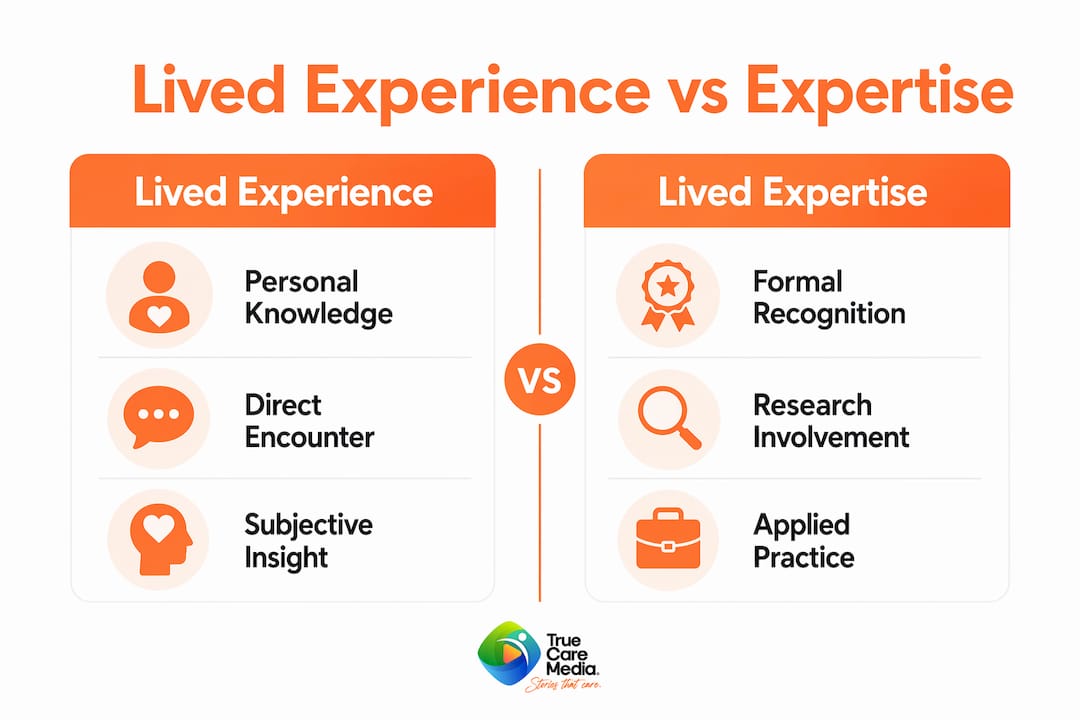
Understanding content marketing in healthcare increasingly requires recognising both columns of that table as non-negotiable inputs.
What are the ethical responsibilities in lived experience storytelling?
Ethical storytelling distinguishes honouring a story from exploiting it. The difference comes down to purpose and power. Ethical storytelling focuses on the blueprint of overcoming obstacles rather than using pain as “emotional confetti,” a term that describes the practice of extracting suffering for audience impact without serving the storyteller’s dignity or agency.
Power imbalances are real in this space. When an organisation invites someone to share their mental health story, that person is often in a more vulnerable position than the organisation. Consent must be ongoing, not a one-time signature. Storytellers need to know how their story will be used, who will see it, and how to withdraw it if they change their mind. Emotional safety is not a nice-to-have. It is a duty of care.
Advisory boards with lived experience improve contextual relevance, ethical safeguards, and equity in mental health research. They also shift power dynamics in a meaningful way. Meaningful engagement demands sustained collaboration and emotional safety to prevent tokenism. A person invited to one meeting and never consulted again has not been included. They have been used.
Authenticity also requires including failure. Authentic lived experience content requires inclusion of failures and trial-and-error, not just polished successes, to build trust. Perfection reads as untrustworthy. Audiences in mental health contexts are often people who have struggled, and they recognise a sanitised story immediately.
Pro Tip: Before publishing any lived experience story, ask the storyteller to review the final version in the context it will appear, including the headline, surrounding content, and platform. What feels respectful in a long-form article can feel exploitative as a social media caption.
How can content creators use lived experience narratives effectively?
The most authentic stories often already exist inside your organisation. Internal communications such as support threads, case notes, and team conversations hold the raw material for genuine narratives. The challenge is not finding stories. It is recognising them and shaping them with care.
Balancing narrative with context is the skill that separates impactful content from anecdote. A story without context can mislead. A person’s account of a medication side effect, without clinical framing, can discourage others from seeking treatment. The goal is to let the personal narrative carry the emotional truth while surrounding it with enough context to guide the audience toward understanding, not just feeling.
Stories move people from awareness to action by humanising abstract issues. That movement is the measure of effective lived experience content. If your audience finishes a piece knowing more but feeling nothing, the story has not done its job. If they finish it ready to seek help, refer a friend, or change how they work, it has.
The format you choose shapes what the story can do. The table below summarises best practices across common content formats.
| Format | Best practice | What to avoid |
|---|---|---|
| Video | Centre the storyteller’s voice; use minimal narration | Overproducing to the point of losing authenticity |
| Written article | Include specific details and unresolved complexity | Wrapping every story in a tidy resolution |
| Social media | Use direct quotes and real images where consented | Cropping stories to fit character limits without context |
| Podcast | Allow pauses and emotion; do not over-edit | Cutting out hesitation that signals genuine reflection |
Involving people with lived experience as co-creators rather than subjects changes the quality of every format. Provider storytelling builds loyalty precisely because it signals that an organisation trusts its community enough to let them speak. That trust is visible to audiences, and it is what separates content that converts from content that is simply consumed.
Lived experience narratives provide brands and advocates an authenticity advantage that AI-generated content cannot replicate. In 2026, that advantage is the strongest differentiator available to mental health advocates and NDIS providers working in a crowded content space. The patient outcome storytelling guide from Com offers a practical framework for integrating real stories into health communication without sacrificing clinical credibility.
Key takeaways
Lived experience content is the most effective tool mental health advocates have for building genuine empathy, reducing stigma, and driving meaningful action in support services.
| Point | Details |
|---|---|
| Narrative retention advantage | Personal stories are retained far more effectively than raw facts, making them the strongest communication format available. |
| Lived expertise is formal knowledge | Recognise lived experience as expertise equal to clinical data, not as a supplementary quote or case study. |
| Co-creation prevents tokenism | Include lived experience contributors in research design and content strategy from the start, not after decisions are made. |
| Ethical storytelling requires dignity | Focus on resilience and complexity rather than extracting pain for emotional impact. |
| Authenticity beats polish | Including failure and unresolved complexity builds more trust than a perfectly resolved narrative. |
The part most content creators get wrong
I have worked alongside mental health advocates and NDIS providers long enough to see the same mistake repeated. Organisations invite someone to share their story, record it beautifully, publish it once, and move on. The storyteller is thanked. The content performs well for a week. Then nothing changes in how the organisation actually works.
That pattern is the gap between using lived experience and genuinely valuing it. The recognition of lived expertise as formal knowledge is growing in 2026, but the practice of treating it that way inside organisations is still catching up. I have seen advisory boards formed with genuine intent collapse because the emotional safety infrastructure was not there. People shared difficult things and then felt exposed when the content went live without their final review.
The content creators I respect most treat lived experience contributors as collaborators with ongoing rights, not sources with a one-time release form. They build relationships before they build content. They share drafts. They ask hard questions about purpose. And they are willing to not publish a story if the conditions are not right. That restraint is what earns the trust that makes the next story possible.
The responsibility is real, and it is worth taking seriously. The clinic storytelling strategy that works long-term is always the one built on genuine respect for the people at the centre of it.
— Mishal
How Com supports lived experience storytelling in health advocacy
Com helps NDIS providers and allied health brands communicate the real impact of their work through video, photography, and storytelling built around the people they serve.
Lived experience narratives require more than a camera and a release form. They require a production approach that prioritises dignity, context, and authenticity at every stage. Com’s healthcare storytelling services are designed specifically for mental health advocates and disability support providers who want to build genuine trust with their communities. Whether you are creating video content for aged care, photography for disability advocacy, or a broader content strategy, Com brings the experience to do it with care.
FAQ
What is lived experience content in mental health?
Lived experience content is first-person narrative from people who have directly experienced a mental health condition, disability, or support system. It communicates emotional truth and contextual complexity that clinical data alone cannot convey.
Why do personal narratives outperform statistics in health communication?
Personal narratives engage multiple brain centres simultaneously, while statistics activate only language processing. This neurological difference means stories are retained far more effectively and are more likely to shift attitudes and behaviour.
What is the difference between lived experience and lived expertise?
Lived experience is the personal knowledge gained from going through something. Lived expertise is the formal recognition of that knowledge as equal to scientific or clinical expertise in research, policy, and service design.
How do you avoid tokenism when including lived experience in content?
Tokenism occurs when lived experience contributors are consulted after decisions are made rather than included as co-creators from the start. Advisory boards with lived experience and sustained collaboration with emotional safety built in are the standard for genuine inclusion.
What makes lived experience content ethical?
Ethical lived experience content focuses on resilience and dignity rather than extracting pain for emotional impact. It requires ongoing consent, final review rights for the storyteller, and a clear purpose that serves the person sharing, not just the audience receiving.