
Carer-facing content is targeted information and resources designed specifically to support, inform, and empower caregivers in their daily role. The caregiver population is growing 45% faster than the general population, creating a critical and underserved audience that generic health content simply does not reach. For NDIS providers and allied health organisations, producing content that speaks directly to carers is no longer optional. It is the foundation of effective communication, trust, and care quality.
Why carer-facing content matters: meeting real caregiver needs
Caregivers do not search for abstract health information. They search for answers to immediate, practical problems at 2 AM when a person in their care is distressed and they do not know what to do next. Content aligned with these urgent queries outperforms generic educational material in both engagement and trust. The importance of carer content lies precisely in this alignment between what caregivers need and what organisations actually publish.
The “jobs-to-be-done” framework, widely used in content strategy, defines this principle clearly. Caregivers arrive at your content with a specific task in mind. Failure to address that task directly results in poor engagement and lost trust. Organisations that publish problem-oriented content, such as step-by-step guides, FAQs, and real-scenario walkthroughs, consistently see stronger caregiver engagement than those publishing broad awareness articles.

Caregiver stress is a measurable clinical concern, not a soft metric. High-quality, transparent communication between providers and family caregivers significantly reduces caregiver stress and unmet care needs for older adults. That finding carries direct implications for content strategy: every piece of information you publish is either reducing or adding to a carer’s burden.
The benefits of carer-facing communication extend beyond the individual. When caregivers feel informed, they make better decisions, ask better questions, and participate more actively in care planning. That participation improves outcomes for the people they support.
- Problem-oriented content addresses specific tasks: medication management, behaviour responses, appointment preparation.
- Digital updates and FAQs reduce repetitive phone calls and give carers answers on their own schedule.
- Peer storytelling validates caregiver experience and builds emotional connection with your organisation.
- Episodic content formats maintain long-term engagement by following a carer’s situation over time.
Pro Tip: Map your content calendar to the most common questions your intake and support coordinators receive. Those questions are your highest-value content topics.
How does effective communication improve care outcomes?
Clear communication between providers and carers is a direct pathway to better care coordination. Caregiver-provider communication quality shows a strong, positive correlation with reduced unmet care needs for older adults, with effect sizes demonstrating clinical significance. That means the quality of your written and digital communication has a measurable effect on whether a person in care receives what they actually need.
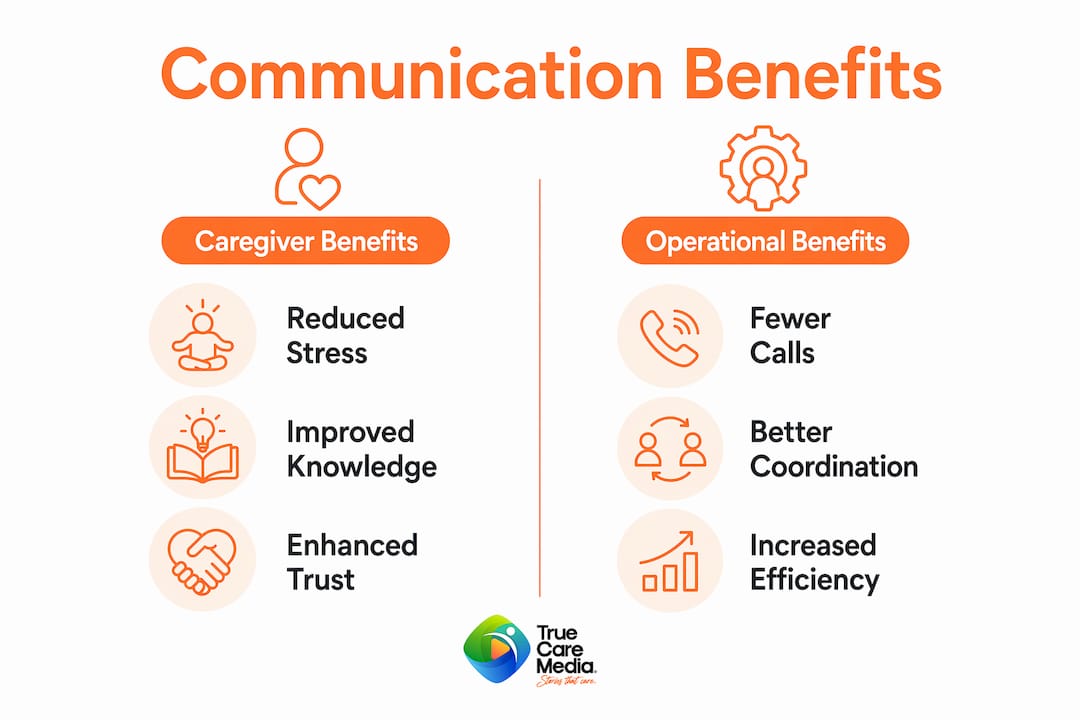
Digital tools play a central role in this. User-friendly digital communication tools in care settings improve rapport and shared decision-making while reducing family anxiety compared to traditional communication methods. They are particularly cost-effective for routine informational updates, freeing up staff time for higher-stakes conversations that require human contact.
Secure, read-only access to care notes and daily logs is one of the most practical applications of this principle. Real-time mobile app logging enhances handover quality and family trust, and reduces the volume of reactive phone calls to care teams. Families who can see what happened during a visit do not need to call and ask. That single shift in communication infrastructure reduces workload and builds confidence simultaneously.
The table below compares common communication modes and their typical impact on caregiver outcomes.
| Communication mode | Caregiver benefit | Operational benefit |
|---|---|---|
| Secure digital care notes | Real-time reassurance, reduced anxiety | Fewer reactive phone calls |
| Video updates and walkthroughs | Builds familiarity and trust | Reduces onboarding questions |
| FAQs and written guides | Immediate answers to common problems | Lowers support coordinator workload |
| Peer storytelling content | Emotional validation and engagement | Strengthens organisational reputation |
Pro Tip: Audit your current communication touchpoints. If families are calling your office for the same information repeatedly, that is a content gap, not a relationship problem.
What are the best practices for creating carer-facing content?
Authenticity is the single most important quality in carer-facing content. Authentic caregiver-facing content balances professional guidance with peer storytelling to maintain long-term engagement and validation. Organisations that publish only clinical or policy-driven content miss the emotional register that caregivers respond to. Those that publish only personal stories without professional grounding lose credibility.
The most effective content combines both. A participant-centred storytelling approach pairs a real caregiver’s experience with clear, practical guidance from a qualified professional. This format answers the emotional question (“Am I doing this right?”) and the practical question (“What do I do next?”) in the same piece.
Avoiding common pitfalls matters as much as following best practices. The most frequent mistakes organisations make include:
- Publishing content that is too academic or policy-focused for a carer audience.
- Using generic stock photography that does not reflect the real diversity of caregiving situations.
- Producing content in long-form only, without shorter formats for carers with limited reading time.
- Failing to update content when care guidelines or NDIS policies change.
- Ignoring long-tail search demand, where caregiver-focused keywords convert at 2.5 times the rate of broad industry terms.
Different content formats serve different purposes. Short video updates build familiarity and trust quickly. Written FAQs serve carers who need a specific answer fast. Episodic storytelling content builds ongoing engagement over weeks and months. Video content for home care providers works particularly well for demonstrating care environments and introducing staff, reducing the anxiety families feel before a care arrangement begins.
The Royal College of Speech and Language Therapists identifies a clear principle: content must enable caregivers with practical tools and self-monitoring strategies for self-advocacy. Content that informs without enabling action falls short of this standard.
How carer-facing content enhances engagement and organisational efficiency
The operational benefits of strong carer-facing content are concrete and measurable. Organisations that invest in transparent care communication through secure digital infrastructure report reduced reactive communication and improved internal team efficiency. That is a direct return on a content investment.
Caregiver confidence is a key outcome. When carers understand what is happening in a care arrangement, they feel more capable and less anxious. That confidence translates into better participation in care planning, clearer communication with support coordinators, and stronger adherence to agreed care approaches. Training that improves communication clarity enhances caregiver confidence and engagement in care coordination, and well-designed content functions as a form of ongoing training.
The broader benefits of carer-focused messaging for organisations include:
- Reduced call volume from families seeking routine updates, freeing staff for complex support tasks.
- Stronger trust built through consistent, transparent communication that reflects genuine care quality.
- Improved compliance with NDIS and aged care regulatory communication standards.
- Higher caregiver satisfaction, which correlates with positive reviews, referrals, and organisational reputation.
- Better care adherence, as informed carers are more likely to follow agreed care plans and flag concerns early.
Organisations that treat carer-facing content as a communication infrastructure investment, rather than a marketing expense, see these benefits compound over time. The role of visual storytelling in aged care is a strong example of how content strategy and operational outcomes connect directly.
Key takeaways
Carer-facing content reduces caregiver stress, improves care coordination, and builds organisational trust when it targets specific caregiver needs with authentic, problem-oriented communication.
| Point | Details |
|---|---|
| Target specific caregiver needs | Problem-oriented content outperforms generic material in engagement and trust. |
| Use digital tools for real-time updates | Secure care notes and app-based logging reduce reactive calls and build family confidence. |
| Combine professional guidance with peer stories | Authentic content balances clinical accuracy with emotional validation for long-term engagement. |
| Measure communication gaps | Repeated family phone calls signal content gaps that structured updates can close. |
| Invest in content as infrastructure | Consistent carer-facing content improves compliance, satisfaction, and care adherence over time. |
The content mistake I see most often
Most organisations I work with produce content for carers as an afterthought. They have a polished website for referrers and a detailed service brochure for participants, but the carer-facing material is a single PDF last updated three years ago. That gap is not a resource problem. It is a prioritisation problem.
The organisations that get this right treat carers as a distinct audience with distinct needs, not as a secondary audience who will read the participant content and fill in the gaps. They ask: “What does a carer need to know at the moment they are most stressed?” Then they build content around that answer.
What I have also observed is that the format matters as much as the content itself. A carer reading a care update at 11 PM on a phone does not want a 1,200-word article. They want a clear, structured note with three bullet points and a contact number. Getting the format right for the context is the difference between content that reassures and content that gets ignored.
The future of carer-facing content is personalised and digital. Organisations that build infrastructure now, including secure family portals, short-form video updates, and problem-specific written guides, will be significantly better positioned as regulatory expectations around communication transparency continue to rise. Carers are not a passive audience. They are active participants in care, and your content should treat them that way.
— Mishal
How Com supports carer-facing content for care organisations
Com helps NDIS providers and allied health brands build the kind of content that carers actually engage with: authentic video, photography, and storytelling that reflects real care environments and real people.
If your organisation is investing in caregiver communication, the role of video in aged care marketing is a practical starting point for understanding how visual content strengthens carer trust and reduces communication friction. Com also produces family decision-making video content that gives carers the clarity they need when choosing or continuing a care arrangement. Every piece of content Com creates is built around the specific questions carers are actually asking.
FAQ
What is carer-facing content?
Carer-facing content is targeted information, resources, and communication designed specifically for family members and informal caregivers who support people in care arrangements. It addresses practical caregiving tasks, emotional concerns, and care coordination questions.
Why is carer information essential for NDIS providers?
Clear, accessible carer information reduces unmet care needs, lowers caregiver stress, and improves participation in care planning. Research shows that communication quality between providers and carers directly correlates with better outcomes for older adults and people with disability.
What content formats work best for caregivers?
Short video updates, structured care notes, problem-specific FAQs, and peer storytelling content each serve different caregiver needs. Caregiver-focused keywords convert at 2.5 times the rate of broad industry terms, which means specific, task-oriented formats consistently outperform general awareness content.
How does carer-facing content reduce organisational workload?
Secure digital updates and structured care notes reduce the volume of reactive family phone calls. When carers can access real-time information about a care visit, they do not need to contact the office for routine reassurance, freeing staff for complex support tasks.
How often should organisations update carer-facing content?
Content should be reviewed whenever NDIS guidelines, care policies, or service offerings change. Routine communication content, such as care notes and digital updates, should be delivered in real time or as close to it as the care model allows.