
Resident spotlight video production ethics is defined as the practice of producing community-focused video content in care settings with full informed consent, transparent disclosure, and a commitment to resident dignity above all other production goals. For health and community leaders working with NDIS providers, aged care facilities, or allied health services, the stakes are high. Residents are often vulnerable, and the footage you create will shape how families, funders, and the broader public perceive your organisation. Getting this right means building consent processes that hold up legally, applying trauma-informed interviewing techniques, and meeting 2026 platform and regulatory standards around AI-generated content. This guide covers every stage of that process.
What are the essential informed consent steps for resident spotlight videos?

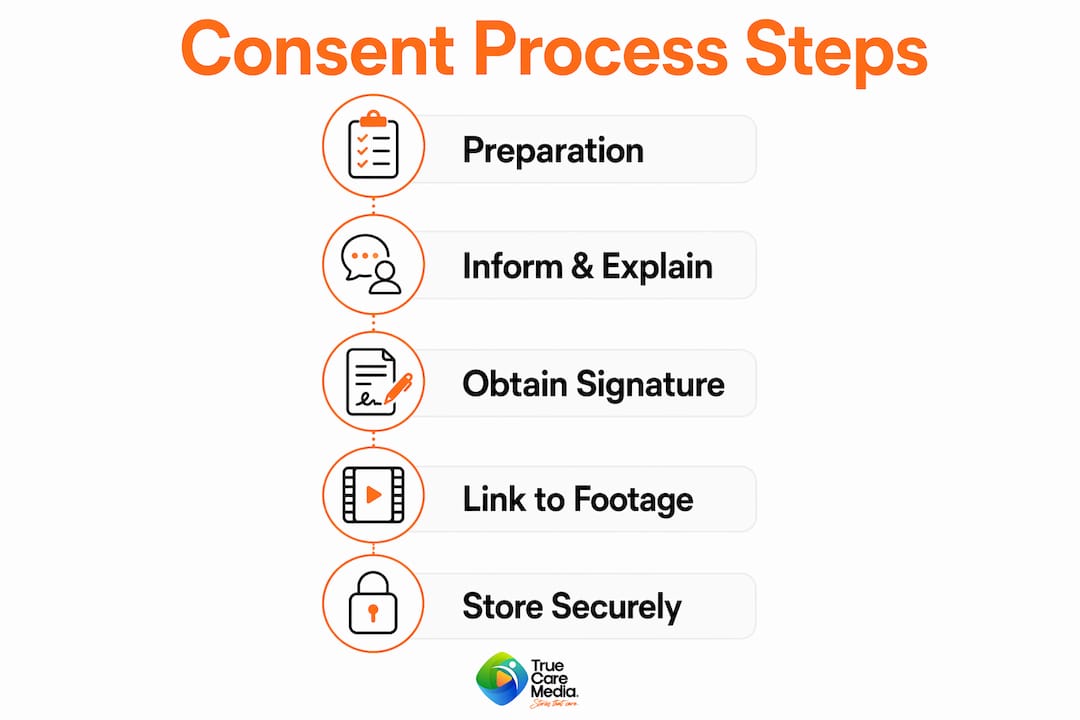
Informed consent is the foundation of ethical filming in care settings, and verbal agreement alone does not meet the standard required in 2026. Verbal consent alone is legally weak. Signed, physical or digital consent manifests linked to raw footage are critical for audit readiness in sensitive care stories. That means your consent process must be documented, specific, and traceable.
Standard 2026 release documents commonly include eight mandatory fields: a description of how the footage will be used, acknowledgment of sensitive topics covered, compensation terms, usage rights, limits on use, withdrawal terms, a mental health support contact, and data handling protocols. Each field serves a protective function for both the resident and your organisation.
A thorough consent process for resident spotlight videos includes the following steps:
- Provide written release forms in plain language, covering all eight fields above, including any AI processing or monetisation of the content
- Record on-camera verbal consent at the very start of filming. On-camera verbal consent recorded at filming start is strong evidence of participant agreement and supports legal defence if disputes arise
- Confirm participation is entirely voluntary and offer mental health resources before filming begins
- Communicate the withdrawal window clearly. Withdrawal timelines commonly allow participants to revoke consent within 30 days post-signing, after which content is typically locked to support distribution stability
- Offer privacy options upfront, including face blurring, voice alteration, or silhouette presentation, so residents can participate with the level of exposure they choose
Pro Tip: Keep signed consent manifests linked directly to the corresponding raw footage files in your project management system. If an audit or dispute arises months after publication, this linkage is the difference between a resolved issue and a serious compliance failure.
How to ethically disclose and manage AI-generated content in resident videos
AI transparency is no longer optional in healthcare video production. Platforms like YouTube and TikTok require explicit disclosure when videos include AI-generated voices or visuals representing real people, to prevent misinformation and maintain trust. Failing to disclose exposes your organisation to platform penalties, audience backlash, and potential legal liability under frameworks like the EU AI Act.
The disclosure obligation applies across a wider range of scenarios than most producers realise:
- Synthetic voice narration or voice cloning, even when used to assist a resident with a speech difficulty
- AI-assisted background replacement or scene enhancement that alters the original environment
- Deepfake-style lip-sync corrections or facial smoothing that changes a resident’s natural appearance
- AI-generated subtitles or translated audio tracks presented as the resident’s own words
Ethical AI creators adopt platform-specific disclosure matrices because rules vary across YouTube, TikTok, Instagram, and other channels. A single disclosure statement in the video description may satisfy one platform but not another. Build a disclosure checklist into your post-production workflow for every platform you publish to.
When AI is used for accessibility purposes, such as voice cloning to help a resident with motor neurone disease narrate their own story, the framing matters. Careful AI framing as assistive technology rather than generative content reduces audience backlash and regulatory risk in healthcare videos. A disclosure like “This resident’s voice has been recreated using AI to support their communication needs, with their full consent” is specific, respectful, and legally defensible.
“Ethical editing means viewers should know what is real or synthetic to avoid misleading impressions.” This principle, drawn from AI ethics and attribution guidance, applies directly to resident spotlights where authenticity is the entire point of the content.
For further context on how AI disclosure intersects with healthcare video production workflows in 2026, the standards have shifted considerably from even two years ago.
What interviewing practices ensure respectful, trauma-informed resident spotlights?
Trauma-informed interviewing is the recognised industry standard for filming community stories involving vulnerable individuals, and it differs substantially from standard documentary or marketing interview techniques. The core principle is that the resident controls the boundaries of the conversation at all times, not the producer or the brief.
Trauma-informed interviewing involves allowing participants to control their own boundaries, avoiding graphic or sensational content, and providing mental health support during and after filming. This is not just an ethical preference. It directly affects the quality and credibility of the content you produce.
Practical techniques for respectful resident interviews include:
- Use open-ended questions and make it explicit that residents can skip any question or stop the interview at any point without consequence
- Avoid framing questions around hardship, loss, or medical history unless the resident introduces those topics themselves
- Prioritise context over dramatic detail. A resident describing their daily routine with warmth tells a more powerful story than one recounting a crisis moment under pressure
- Use anonymisation techniques, including voice masking, face blurring, or silhouette framing, when residents want to share their story without full identification
- Include visible trigger warnings and mental health support resources in the final video, particularly when content touches on grief, illness, or trauma
- Edit to protect emotional safety. Remove moments where a resident appears distressed, confused, or pressured, even if the footage is technically usable
Pro Tip: Keep your crew as small as possible during resident interviews. A single camera operator and interviewer creates a far less intimidating environment than a full production team. Transparency about what the camera is capturing, and why, also reduces anxiety significantly.
A diverse production team reduces unconscious bias and leads to more nuanced, empathetic community storytelling. If your team does not reflect the backgrounds of the residents you are filming, consider bringing in a cultural liaison or community consultant before production begins.
How to implement a review and accountability process for spotlight video ethics
A structured review process is what separates organisations that occasionally get ethics right from those that get it right consistently. The four-step framework below is drawn from current best practice in community spotlight video guidelines.
A formal four-step review system covering purpose validation, consent verification, synthetic disclosure, and independent accountability sign-off is advised to uphold ethics in community spotlight videos. Each step must be completed before publication, not after.
- Purpose validation: Confirm the video serves the resident’s interests and the community’s understanding, not just the organisation’s marketing goals. Ask whether the resident would be proud of how they are represented.
- Consent verification: Cross-check that signed consent forms are on file, linked to the correct footage, and cover every use case planned for the content, including social media clips and paid promotion.
- Synthetic disclosure review: Confirm that all AI-generated or AI-assisted elements are disclosed accurately on every platform where the video will be published.
- Independent accountability sign-off: An independent rights reviewer, distinct from the editor or social media lead, must approve the final cut. This person’s sole responsibility is participant protection, not production quality.
The difference between informal and formal review workflows is significant in practice:
| Workflow type | Key characteristics |
|---|---|
| Informal review | Editor self-checks consent; no independent sign-off; disclosure added if remembered |
| Formal review | Four-step checklist; independent reviewer; consent manifest linked to footage; disclosure verified per platform |
| Informal review | No audit log; disputes resolved case by case; no defined withdrawal process |
| Formal review | Immutable audit logs; defined withdrawal window; metadata tagging for all synthetic elements |
Immutable logs tracing the provenance of every media asset strengthen ethical accountability and defend against future scrutiny or legal challenge. Build this logging into your editing software workflow, not as an afterthought.
What are best practices for post-publication resident rights management?
Publishing a resident spotlight video is not the end of your ethical obligations. It is the beginning of an ongoing relationship with the person you have featured, and your processes need to reflect that.
Post-publication rights management covers several critical areas:
- Communicate the withdrawal window before filming, not after. Residents who understand their right to request removal are more likely to participate willingly and less likely to feel exploited later
- Establish a clear internal procedure for handling removal requests, including who receives the request, the timeline for action, and how the content is modified or taken down across all platforms
- Offer anonymisation as an alternative to full removal. A resident who later feels uncomfortable may be satisfied with face blurring or voice alteration rather than complete deletion
- Provide a named contact person and mental health support resources in writing to every resident featured, so they have a clear path to raise concerns after the video is published
- Store raw footage securely. Secure storage with end-to-end encryption and audit logs for raw footage and biometric data is critical to meet 2026 privacy regulations and participant trust requirements. Define a retention period and stick to it.
Pro Tip: Create a one-page internal document that maps every published resident spotlight to its consent form, withdrawal deadline, storage location, and assigned contact person. Review this document quarterly and act on any expired withdrawal windows or unresolved requests immediately.
Transparency about editorial intent through metadata, trigger warnings, and explicit descriptions enhances audience trust and platform compliance. Platforms reward responsible content presentation, particularly with sensitive subjects, which directly affects monetisation eligibility and reach.
Key takeaways
Ethical resident spotlight video production requires documented consent, transparent AI disclosure, trauma-informed interviewing, a formal four-step review process, and active post-publication rights management to protect resident dignity and organisational credibility.
| Point | Details |
|---|---|
| Consent must be documented | Signed manifests linked to raw footage are legally required; verbal consent alone does not meet 2026 standards. |
| AI use requires specific disclosure | Every platform has distinct rules; build a platform-specific disclosure matrix into your post-production workflow. |
| Trauma-informed interviewing is standard | Residents control the boundaries; small crews, open questions, and anonymisation options are non-negotiable. |
| Formal review prevents ethical breaches | A four-step process with an independent rights reviewer is the difference between compliance and exposure. |
| Post-publication obligations are ongoing | Secure storage, named contacts, and clear removal procedures protect residents and your organisation after publishing. |
Why ethics in resident videos is more than a compliance exercise
I have worked on community spotlight content across aged care, disability services, and allied health settings for long enough to see the full cycle of what happens when ethics are treated as a checklist rather than a commitment. The organisations that get this right are not the ones with the longest consent forms. They are the ones where the production team genuinely believes the resident’s story matters more than the final cut.
The shift I have noticed most sharply in recent years is around AI transparency. Two years ago, a subtle voice enhancement or background clean-up was considered a technical edit, not an ethical decision. That has changed. Residents and their families are now asking directly whether AI was used, and they deserve a straight answer. The organisations that frame AI use honestly, particularly when it serves accessibility needs, consistently build more trust than those that stay silent and hope no one notices.
The other lesson I keep returning to is the value of the post-publication relationship. Most ethical frameworks focus on what happens before and during filming. The period after a video goes live is where I have seen the most harm done, usually through inaction. A resident who changes their mind deserves a fast, respectful response, not a bureaucratic delay. Building that responsiveness into your workflow before you need it is the mark of a genuinely ethical production practice.
For health and community leaders, the practical takeaway is this: treat your resident spotlight ethics framework as a living document, not a one-time sign-off. Review it annually, update it when platform rules change, and make sure every person involved in production understands why each step exists. Ethics in this space is not a constraint on good storytelling. It is what makes the story worth telling.
— Mishal
Produce resident spotlight videos that build lasting trust
Com works with NDIS providers and allied health organisations to produce resident spotlight content that meets the highest ethical standards, from consent design through to post-publication rights management. If you are responsible for aged care video marketing and want production workflows that protect residents and strengthen community trust, Com’s team brings both the technical expertise and the ethical rigour your organisation needs.
Whether you are starting from scratch or reviewing an existing process, Com’s guides on family decision-making video content offer practical frameworks for producing compliant, resident-centred content. Every project is built around the principle that authentic, respectful storytelling is the most effective form of healthcare marketing available.
FAQ
What does informed consent require for resident spotlight videos?
Informed consent for resident spotlight videos requires a signed release form covering use cases, AI processing, withdrawal terms, and mental health support contacts, plus on-camera verbal consent recorded at the start of filming. Written consent forms in 2026 include eight mandatory fields to meet current transparency and participant protection standards.
How should AI-generated content be disclosed in care setting videos?
Every AI-generated or AI-assisted element, including synthetic voices, background replacements, and translated audio, must be disclosed clearly on screen and in the video description for each platform. Platform-specific disclosure matrices are necessary because YouTube, TikTok, and Instagram each apply different rules.
Can a resident withdraw consent after a spotlight video is published?
Yes. Withdrawal timelines commonly allow residents to revoke consent within 30 days of signing, and organisations should maintain a clear internal removal procedure for requests received after that window. Anonymisation, such as face blurring or voice alteration, is a practical alternative to full content removal.
What is a trauma-informed approach to resident interviews?
Trauma-informed interviewing means residents control the boundaries of the conversation, can stop or skip questions at any time, and are not asked to revisit distressing experiences without their explicit direction. This approach reduces harm, increases content credibility, and reflects the ethical standard expected in care settings.
Why does an independent rights reviewer matter in the production process?
An independent rights reviewer, separate from the editor or social media lead, focuses solely on participant protection rather than production quality. This separation is what makes a formal four-step review genuinely protective rather than a self-assessed formality.