
Most NDIS service managers understand that storytelling matters. What fewer realise is that simply collecting participant stories and sharing them in reports or social media posts is not participant-centred at all. The real shift happens when participants become active co-creators, shaping what is shared, how it is framed, and who gets to see it. That shift changes everything, from participant engagement and organisational trust to the very culture of your service. This guide explains what participant-centred storytelling genuinely means, why it matters for NDIS practice, and how to put it into action safely and ethically.
Table of Contents
- Defining participant-centred storytelling
- How participant-centred storytelling supports person-centred care
- Safety, consent, and power: What NDIS leaders must prioritise
- Bringing participant-centred storytelling into organisational practice
- What most articles miss: The power and pitfalls of narrative-based care
- Why real participant-centred storytelling demands more than good intentions
- Take participant-centred storytelling further with True Care Media
- Frequently asked questions
Key Takeaways
| Point | Details |
|---|---|
| Co-creation is central | Stories are developed with participants, not just about them, giving agency in every stage. |
| Trust and safety matter | Consent, psychological safety, and participant control are vital for positive storytelling. |
| Process, not event | Participant-centred storytelling is ongoing and adaptable, not a one-off interview or task. |
| Organisational alignment | Effective storytelling supports NDIS person-centred care and strengthens relationships. |
Defining participant-centred storytelling
There is a common misconception in the disability sector that storytelling means gathering quotes, filming video testimonials, and publishing them to demonstrate impact. While those activities have their place, they often treat participants as sources rather than partners. The result is content that may look compelling on a website but does little to deepen engagement or build genuine trust.
Participant-centred storytelling is fundamentally different. As the participatory storytelling framework describes, it is a co-creation approach where participants are treated as the source of meaning and are actively involved in how their stories are gathered, shaped, and, critically, used. This is not a minor adjustment in language. It is a structural shift in who holds power over narrative.
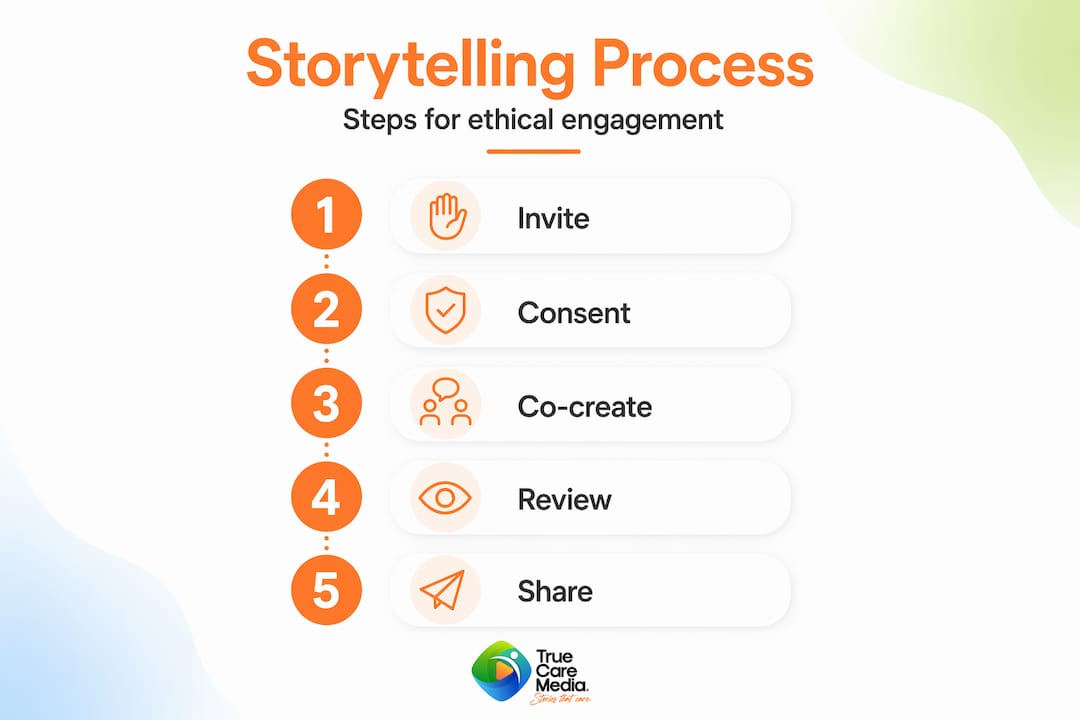
In practice, this means the participant is involved at every stage:
- Gathering: The participant decides what to share, how much detail to include, and in what format, whether written, spoken, or visual.
- Shaping: The participant reviews drafts, corrects misrepresentations, and adds context that professionals might miss.
- Approving: Final sign-off sits with the participant, not the communications team or service manager.
- Using: The participant understands and agrees to exactly how their story will appear, who will see it, and for what purpose.
This process creates something profoundly different from standard content collection. It creates meaning in healthcare environments because participants feel genuinely heard rather than used. For NDIS organisations, this directly translates into stronger engagement, higher participant satisfaction, and richer, more authentic stories that resonate with funders, families, and the broader community.
How participant-centred storytelling supports person-centred care
The NDIS is built on person-centred values: dignity, individual choice, and respect for each participant’s unique life context. Participant-centred storytelling is a natural extension of those values into your organisation’s communications and culture.
The person-centred practice evidence published by the NDIS Quality and Safeguards Commission confirms that in disability and person-centred care contexts, participant-centred storytelling aligns with person-centred practice by using the person’s own experiences, values, preferences, and life context to guide decisions. That alignment is not coincidental. It reflects a shared belief that people with disability are experts in their own lives.
Here is how the three approaches compare in practice:
| Approach | Who controls the story | Primary purpose | Participant role |
|---|---|---|---|
| Traditional storytelling | Organisation | Reporting and marketing | Subject or source |
| Person-centred storytelling | Organisation with input | Service improvement | Contributor |
| Participant-centred storytelling | Participant and organisation jointly | Co-creation and advocacy | Co-creator and reviewer |
The contrast is stark. Traditional storytelling positions participants as objects of the narrative. Participant-centred storytelling positions them as its authors.
“When participants see their own words, values, and priorities accurately reflected in an organisation’s storytelling, it signals that the organisation genuinely sees them as individuals rather than cases.”
This has measurable effects on how participants experience your service. When people feel genuinely seen, they are more likely to engage proactively with their plans, communicate openly with support workers, and advocate for themselves within the NDIS system.
Pro Tip: Before launching any storytelling initiative, create psychologically safe storytelling environments by running a brief orientation session with participants. Explain the full process, emphasise their right to say no, and share examples of how previous stories have been used. This builds trust before you ask anyone to be vulnerable.

Safety, consent, and power: What NDIS leaders must prioritise
A participant-centred approach is not just a philosophical position. It demands concrete processes that protect participants at every stage. The safety in storytelling framework is clear that participant-centred storytelling requires consent, participant agency and control over the use of stories, and time to build trust, especially when there may be safety or power-related risks.
Power imbalances are a live issue in NDIS contexts. Participants may feel that declining to share their story could affect their plan, their relationship with a support worker, or their standing within a service. Even when organisations have no such intention, the perception of pressure can compromise true consent. This is why robust, ongoing consent processes are non-negotiable.
Key requirements for safe storytelling practice include:
- Informed, specific consent: Participants should understand exactly what their story will be used for before agreeing. Vague consent forms covering “future marketing purposes” do not meet this standard.
- Ongoing agency: Consent is not a one-off signature. Participants must be able to review, amend, or withdraw their story at any point, without consequences.
- Right of withdrawal: Any participant can withdraw their story entirely, including after publication, if circumstances change.
- Safety planning: For participants with trauma histories, a clear safety plan should be in place before and after story-sharing sessions.
- Supported decision-making: Where a participant has communication support needs, appropriate supports must be in place during the consent and sharing process.
Here is a practical framework for managing consent across the storytelling cycle:
| Stage | Consent requirement | Who is responsible |
|---|---|---|
| Initial invitation | Informed written or verbal consent | Service manager or facilitator |
| Story gathering | Confirmation of boundaries and scope | Facilitator |
| Draft review | Participant sign-off on accuracy | Participant and communications lead |
| Publication approval | Final consent for specific platform use | Participant |
| Ongoing use | Annual or event-triggered review | Service manager |
Pro Tip: Include a plain-language summary of safe story sharing methods in your participant welcome pack. A single-page overview of the storytelling process, their rights, and how to withdraw at any time, helps normalise consent as a continuous conversation rather than a bureaucratic hurdle.
Bringing participant-centred storytelling into organisational practice
Theory is essential, but implementation is where participant-centred storytelling either delivers or fails. The good news is that organisations do not need to start from scratch. Evidence-based models already exist, and they can be adapted to suit your participant cohort, service model, and resource level.
The participant safeguarding co-design workshops run by People with Disability Australia demonstrate what genuine implementation looks like. These workshops operationalise participant-centred storytelling through facilitated co-design that includes psychological safety supports, trauma-informed practice, disability-affirming facilitation, and meaningful participant representation in decision-making. The result is storytelling that is both safe and powerful.
Here is a step-by-step approach for NDIS service managers:
- Map your participant cohort. Understand the diversity of communication needs, cultural backgrounds, trauma histories, and preferences within your participant group before designing any storytelling initiative.
- Co-design the process. Involve a small group of participants in designing the storytelling framework itself. What formats feel comfortable? What topics feel off-limits? What would make the process feel genuinely safe?
- Train your facilitators. Anyone facilitating story-sharing sessions needs training in trauma-informed practice, disability-affirming communication, and supported decision-making. This is not optional.
- Build in psychological support. Identify wellbeing supports available before, during, and after sessions. This might include having a support worker present, providing debrief options, or having a counsellor available by phone.
- Create a feedback loop. After each storytelling cycle, ask participants how the process felt. Was it safe? Did they feel in control? Would they do it again? Use that feedback to improve the next cycle.
- Review use regularly. Stories have a shelf life. Review how participant stories are being used every six to twelve months and confirm participants are still comfortable with ongoing use.
Embedding storytelling workshop strategies into your annual service planning means storytelling becomes an organisational capability rather than a one-off project. That consistency builds trust over time, both with current participants and with new ones who observe how the organisation treats people’s narratives.
Pro Tip: Pair each storytelling initiative with a clear internal policy that specifies who can approve the use of participant stories, how long stories remain active in your content library, and what happens when a participant withdraws consent. Policy clarity protects both participants and staff.
What most articles miss: The power and pitfalls of narrative-based care
The benefits of narrative-centred approaches in healthcare and disability services are well documented. The research on narrative care published in a recent scoping review confirms that storytelling is used to support trust and understanding by centring personal narratives rather than only biomedical or administrative facts. For NDIS organisations, this means storytelling is not just a communications tool. It is a care practice.
When done well, participant-centred storytelling delivers:
- Deeper trust between participants and service providers, because participants feel genuinely known.
- Better goal-setting in NDIS plans, because the stories that surface reveal what actually matters to participants beyond standard planning questions.
- Stronger organisational culture, as staff who regularly engage with participant narratives develop greater empathy and person-centred instincts.
- More compelling external communications that reflect authentic lived experience rather than polished corporate language.
- Improved participant wellbeing, because the act of sharing one’s story in a supported environment can itself be therapeutic and affirming.
But pitfalls are equally real. The most common failure mode is story extraction: organisations collect compelling participant stories, use them for marketing or funding reports, and move on. The participant receives nothing in return and may feel their vulnerability was used for institutional benefit. This erodes exactly the trust storytelling is meant to build.
Other risks include:
- Blurred methodology: Conflating therapy, advocacy, and marketing storytelling without being transparent with participants about which is happening.
- Lack of ongoing consent: Using stories published two or three years ago without checking whether participants are still comfortable with their continued circulation.
- Digital storytelling risks: Publishing participant stories online creates permanent, searchable records. Some participants may not fully understand this at the time of consent. Others may later face safety risks from having their story publicly associated with disability or specific support needs.
The meaning in storytelling for healthcare context reminds us that narrative care must be approached with as much rigour as any clinical intervention. Organisations that treat it casually risk doing harm, even with good intentions.
Why real participant-centred storytelling demands more than good intentions
Here is something that does not appear in most articles on this topic: organisations regularly believe they are doing participant-centred storytelling when they are actually doing something much closer to brand storytelling with participant faces attached. The distinction matters enormously.
We have seen organisations invest significantly in high-quality video production, participant consent forms, and brand guidelines, and still produce content that makes participants feel like props in someone else’s narrative. Why? Because the process, not just the output, determines whether storytelling is genuinely participant-centred. If participants were not involved in shaping the questions, reviewing the framing, or approving the final message, the product is not co-created. It is extracted.
The risk of power imbalance is especially acute when organisations assume that giving participants the opportunity to share automatically means they have genuine agency. In reality, participants living with disability often navigate complex dynamics with service providers. Saying no to a storytelling request may feel risky, even when organisations sincerely intend the opposite.
This is why healthcare storytelling nuance must be built into the design of every storytelling programme from the beginning. Ongoing consent is not a compliance checkbox. It is an ongoing relationship between an organisation and the people it serves. The moment it becomes bureaucratic rather than relational, it loses its meaning.
Sustainable participant-centred storytelling requires regular review, genuine flexibility, and the courage to pause a storytelling programme when participants signal that something is not working. That kind of responsiveness is what transforms an initiative into a practice.
Take participant-centred storytelling further with True Care Media
Building a genuine participant-centred storytelling practice takes more than good intentions. It takes expertise in facilitation, consent frameworks, and disability-affirming communication. That is exactly what we do.
At True Care Media, we help NDIS providers and allied health organisations develop storytelling strategies that are safe, ethical, and genuinely participant-led. From designing consent processes and facilitating co-design workshops to producing video and photography that reflects authentic lived experience, we bring both the technical expertise and the values-based approach that NDIS services need. If you are ready to move from extracting stories to truly co-creating them, explore our participant-centred storytelling support and see how we can help your organisation build trust that lasts.
Frequently asked questions
How does participant-centred storytelling differ from traditional storytelling in NDIS settings?
Participant-centred storytelling actively involves participants as co-creators with real agency over how their stories are gathered, shaped, and shared. Traditional storytelling typically extracts stories for reporting or marketing purposes without giving participants meaningful control over the narrative.
What are the key risks to avoid with participant-centred storytelling?
The main risks include power imbalances, breaches of consent, and unsafe public sharing. As the safety in storytelling framework notes, organisations must address these risks through structured consent and safety planning rather than assuming more voice is always safe.
How can organisations ensure stories are used ethically?
Organisations should implement ongoing consent processes that give participants the right to review, amend, or withdraw their story at any time. Keeping participants in genuine control of how their stories are used is the foundation of ethical practice.
What practical support do participants need when sharing stories?
Participants need psychological safety supports before, during, and after story-sharing sessions. This is best provided through facilitated, trauma-informed, disability-affirming workshops where wellbeing is built into the design rather than treated as an afterthought.