Most NDIS providers treat brand videos as promotional tools and nothing more. That misses the point entirely. Understanding how disability brand videos work means recognising them as trust-building instruments that communicate your values, demonstrate your genuine commitment to participants, and open your services to people who might otherwise never find you. Done poorly, these videos can feel exploitative or tokenistic. Done well, they create real connection. This guide covers exactly what makes them work: accessibility standards, authentic storytelling, legal obligations, and the practical steps to get it right.
Table of Contents
- Why accessible and authentic videos matter for NDIS providers
- Key accessibility standards and legal requirements for disability brand videos
- Common pitfalls and pro tips for creating effective disability brand videos
- How authentic storytelling builds trust and engagement in disability videos
- Practical steps to plan, produce, and distribute impactful disability brand videos
- The overlooked truths about disability brand videos for NDIS providers
- How True Care Media helps NDIS providers create trusted brand videos
- Frequently asked questions
Key Takeaways
| Point | Details |
|---|---|
| Accessibility is essential | Complying with WCAG 2.2 and legal rules ensures videos reach and include all viewers effectively. |
| Authentic storytelling builds trust | Real participant stories with consent create genuine connections stronger than generic imagery. |
| Avoid misleading claims | NDIS providers must be factual to uphold ethics and avoid legal risks in branding videos. |
| Plan for accessibility in production | Manual captioning, keyboard support, and audio descriptions need proper time and expertise. |
| Accessible videos improve engagement | Videos with captions and transcripts achieve higher open and click rates and boost SEO. |
Why accessible and authentic videos matter for NDIS providers
Starting with accessibility and authenticity is not a philosophical choice. It is the foundation of every effective disability brand video.
When you produce a video without captions, audio descriptions, or keyboard-accessible players, you are excluding a significant portion of the very audience you are trying to reach. That is not just a missed opportunity. For NDIS providers, whose participants frequently live with hearing loss, vision impairment, or cognitive differences, inaccessible content actively contradicts your brand promise. Accessible videos reach far more people, and the data backs this up clearly.
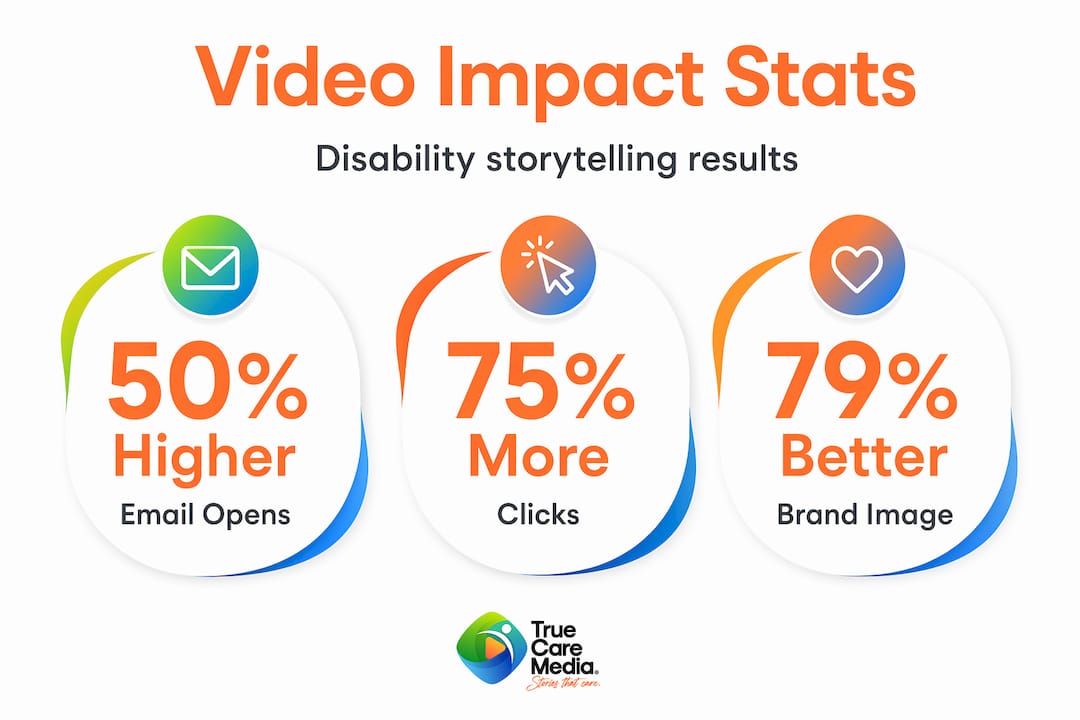
Short videos with real patients, captions, and transcripts increased email open rates by 50% and click-through rates by 75%. Accessibility is not an add-on. It is your distribution strategy.
Authenticity is equally non-negotiable. When providers rely on generic disability stock imagery, viewers notice. Participants notice most of all. Real people, sharing real experiences with documented consent, produce content that feels genuine rather than manufactured. That distinction is the difference between a video someone shares and one they scroll past.
There is also a practical SEO benefit. Transcripts and captions give search engines readable text to index. This means your hospital patient experience videos and service explainers are more likely to surface in organic search when someone is actively looking for support.
Key reasons authenticity and accessibility matter:
- Captions and transcripts serve people with hearing loss, non-native speakers, and viewers in loud or silent environments
- Real participant stories build the emotional credibility that stock footage never achieves
- Accessible video players support users relying on keyboard navigation or screen readers
- Genuine representation signals that your organisation actually understands disability, not just markets to it
“Disability representation in media is not about ticking a box. It is about showing people they exist in your world, not as props, but as the whole reason your organisation exists.”
Key accessibility standards and legal requirements for disability brand videos
Having established why accessibility matters, the next step is understanding the specific standards and rules that govern how you create and publish these videos.
WCAG 2.2 requires synchronized captions at Level A and audio descriptions at Level AA for all prerecorded videos. These are not optional enhancements. They are baseline expectations for any organisation publishing video content, and for NDIS providers, they carry extra weight given your participant base.

The legal obligations extend further. NDIS providers must obtain explicit written consent before featuring participants in any video or using their testimonials in brand communications. This is not simply good practice. It is required under the NDIS Code of Conduct and the Australian Privacy Act 1988.
There is also the matter of claims. Providers frequently make statements in videos that imply government endorsement or guaranteed outcomes. Under Australian Consumer Law, terms like “NDIS approved” are misleading and carry real compliance risk. Understanding the legal and ethical considerations for NDIS video is essential before any camera rolls.
Follow these steps to meet compliance requirements before publishing:
- Review WCAG 2.2 Level A and AA criteria for prerecorded video content
- Draft and have participants sign a written consent form covering all intended uses of the footage
- Have a legal review of any claims in your script, particularly around service outcomes or NDIS endorsement
- Test your video player for full keyboard navigation support
- Add a complete written transcript and synchronised captions before publishing
- Audit existing videos against current standards and update where needed
Pro Tip: Build consent conversations into your pre-production planning, not as a final step. Participants who feel genuinely consulted from the start are more willing to share openly on camera, which directly improves the quality of your content.
Common pitfalls and pro tips for creating effective disability brand videos
With the rules clear, knowing the common mistakes helps you avoid wasted budget and poor outcomes.
The single most widespread mistake is trusting auto-generated captions without thorough review. Automatic YouTube captions need manual editing because they frequently misidentify words, miss punctuation, and fail to synchronise correctly with speech. For NDIS content, where clarity directly affects participant understanding, this matters enormously. A caption error that garbles a service description or misnames a condition can erode trust immediately.
A second pitfall is treating participants as subjects rather than collaborators. When providers hand a participant a pre-written script, the result looks and sounds exactly like that. Involving participants in co-creating their own story, even loosely, produces content that feels lived-in and honest. This approach also aligns with best practice in aged care storytelling videos, where genuine narrative consistently outperforms polished corporate messaging.
Common mistakes to avoid in disability marketing videos:
- Publishing videos with unedited, auto-generated captions
- Using generic stock images of people with disabilities instead of real service footage
- Making compliance an afterthought rather than part of the production brief
- Avoiding disability representation altogether out of fear of getting it wrong
- Underfunding the editing and post-production phase where accessibility features are added
- Neglecting to test video players on screen reader and keyboard-only setups
Pro Tip: Allocate at least 20% of your video production budget specifically to post-production accessibility work. Captions, audio description, and transcript editing all take time. Providers who budget for this produce compliant content on schedule. Those who do not usually end up publishing inaccessible videos and fixing them retroactively at greater cost.
How authentic storytelling builds trust and engagement in disability videos
Knowing how to avoid pitfalls leads directly to understanding why storytelling, done authentically, is the most powerful tool in your video content kit.
Authentic stories featuring real people resonate in a way that scripted testimonials or animated explainers simply cannot replicate. The reason is not emotional manipulation. It is recognition. When a potential participant or their family member sees someone whose experience mirrors their own, they feel seen. That feeling of being understood is precisely what drives enquiry and enrolment. It is the impact of disability brand messaging working at its most effective level.
The data supports long-form authenticity too. Cancer Research UK’s documentary improved brand perception by 79%, demonstrating that patients and audiences respond to genuine, extended stories rather than polished soundbites. You do not need a feature-length film. Even a three-minute video that shows a real person’s day, their relationship with a support worker, and their own words about what quality care feels like will outperform a two-minute corporate overview every time.
Apple’s approach to disability representation through authentic film reinforces this point. When brands centre the actual experiences of people with disabilities rather than using them as inspirational props, the content lands differently. It builds trust rather than pity.
| Authentic storytelling | Generic disability messaging |
|---|---|
| Real participant, real words | Actor or stock footage |
| Shows daily life and specific services | Abstract claims about care quality |
| Viewer feels recognised | Viewer feels marketed to |
| Drives enquiry from genuine fit | Attracts misaligned expectations |
| Builds long-term brand trust | Creates short-term impression |
For engaging disability video content that stands out through storytelling, the guiding principle is simple. Start with the person, not the service. The service earns its mention by being part of that person’s story.
Practical steps to plan, produce, and distribute impactful disability brand videos
After understanding storytelling benefits, you need a clear process to translate that understanding into a compliant, effective video.
Video accessibility improvements aligned with SEO best practices can increase potential reach by 20% and improve rankings by 15%. Building accessibility into production, rather than retrofitting it, is how you capture those gains without blowing the budget.
Follow this ordered process for every disability brand video you produce:
- Define goals and audience: Identify who the video is for, what action you want them to take, and which services or values you are communicating
- Script with participant involvement: Collaborate on the narrative rather than writing it for them. Guide, do not dictate
- Secure legal written consent: Complete consent documentation before filming begins, covering all intended platforms and uses
- Produce with accessibility in mind: Plan for captions, audio description narration, and visible on-screen text from day one
- Edit captions manually: Review and correct every caption line before publishing
- Distribute via accessible channels: Publish on platforms with keyboard-navigable players and include full transcripts on the same page
- Audit regularly: Revisit published videos annually as WCAG standards evolve
The benefits for NDIS admissions teams are well documented. Video reduces the number of questions potential participants ask before making contact, because the video has already answered them. That efficiency directly improves conversion and shortens the enrolment process.
| Compliance element | Requirement | Priority |
|---|---|---|
| Synchronised captions | WCAG 2.2 Level A | Essential |
| Audio descriptions | WCAG 2.2 Level AA | Essential |
| Written transcript | Accessibility and SEO | High |
| Keyboard navigation | WCAG 2.2 Level A | Essential |
| Written participant consent | NDIS Code of Conduct | Legally required |
| Factual, non-misleading claims | Australian Consumer Law | Legally required |
Pro Tip: Host your transcript as plain HTML text on the same page as your video, not as a downloadable PDF. Search engines crawl inline text, not PDF attachments. Your accessibility investment becomes an SEO asset the moment you publish it correctly.
The overlooked truths about disability brand videos for NDIS providers
Here is what most providers get wrong, not from bad intentions, but from underestimating the depth of what these videos actually require.
The first overlooked truth is that generic disability imagery does not just fail aesthetically. It actively signals to participants that your organisation has not engaged with the reality of their lives. Real participant stories, with all their specificity, texture, and imperfection, are not a risk to manage. They are your strongest asset.
The second is that authenticity and legal rigour are not opposing forces. Providers sometimes treat consent processes as bureaucratic friction that slows down good storytelling. In practice, the opposite is true. When participants understand exactly how their story will be used, and feel respected in that process, they open up more. The legal requirement and the human requirement are the same requirement.
The third overlooked truth is that accessibility is not a technical checklist. It is a mindset. Providers who approach accessibility as a box to tick before publishing typically produce content that just barely meets the minimum standard. Providers who treat inclusion as the point of the whole exercise produce videos that people actually share, talk about, and act on. That distinction shows in the engagement numbers and in the trust people extend to your brand.
Finally, the cost and time required to do this properly is consistently underestimated. Manual caption editing, audio description scripting, consent management, and accessibility testing all take real hours. Providers who plan for this investment produce compliant content on time. Those who discover these requirements at the editing stage face delays, cost blowouts, and sometimes publish non-compliant content anyway. The insights from NDIS admissions video production consistently show that organisations who treat video as a serious production investment see the strongest returns in participant enquiry and enrolment.
How True Care Media helps NDIS providers create trusted brand videos
Creating a disability brand video that genuinely works takes more than good intentions and a camera.
True Care Media specialises in accessible, authentic video content for NDIS providers and allied health organisations. Every project is built around real participant stories, documented consent, and full compliance with WCAG 2.2 and NDIS Code of Conduct requirements. From strategy and scripting through to storytelling video production and multi-channel distribution, we manage the entire process so your team can focus on delivering great care. Whether you are starting from scratch or auditing existing content, our approach ensures your videos are compliant, credible, and genuinely worth watching. Explore what we do at True Care Media and see how we help providers like you build lasting trust through video. You can also learn more about how NDIS admissions teams use video to improve enrolment outcomes.
Frequently asked questions
What accessibility features are legally required for disability brand videos?
WCAG 2.2 requires synchronized captions at Level A and audio descriptions at Level AA for all prerecorded videos, and your video player must support full keyboard navigation.
Do I need consent to feature participants in NDIS brand videos?
Yes. NDIS providers must obtain explicit written consent before featuring participants or using testimonials, as required by the NDIS Code of Conduct and the Australian Privacy Act 1988.
Can NDIS providers claim their video content is ‘NDIS approved’?
No. Under ACCC guidance for NDIS providers, claiming “NDIS approved” or guaranteed outcomes in videos breaches Australian Consumer Law and risks serious compliance consequences.
How do accessible videos improve engagement and reach?
Short videos with captions and transcripts have shown up to 50% higher email open rates and 75% higher click-through rates, while also improving SEO through better search engine indexing of your content.
What are common mistakes to avoid when making disability brand videos?
The most damaging mistakes are publishing unedited automatic captions, using generic stock imagery, skipping written consent, making misleading claims, and neglecting keyboard navigation and audio descriptions.