
A working healthcare content calendar has three moving parts: a 12-month map of relevant awareness dates, a realistic publishing cadence per channel, and a clinical sign-off checkpoint before anything goes live. Most practices only build the first part. Start today by filling in just the next three months with dates, one content hook each, and a named clinician to approve the copy before it’s scheduled.
TL;DR:
- Building a healthcare content calendar requires a 12-month awareness date map, a realistic publishing schedule, and clinical sign-off integrated into the workflow.
- Focus on key dates relevant to your patient base and use a pillar and cluster SEO strategy to build topical depth over time, improving search visibility gradually.
- Incorporate sign-off steps early, including clinician review, patient consent, and PHI redaction, to avoid post-publishing rework or compliance issues.
- Batch content creation through dedicated filming days, producing multiple assets from one shoot for use across social, website, and waiting-room channels over months.
- Prioritize quality and relevance by selecting only meaningful awareness dates for your practice, rather than trying to cover every observance, ensuring content efforts are targeted and effective.
Table of Contents
- Why awareness dates matter for a healthcare content calendar
- Building the framework: goals, channels, cadence and taxonomy
- A 12-month calendar of key health dates and content ideas
- Choosing formats and campaign ideas for each calendar moment
- Building clinical sign-off into the calendar workflow
- Sustaining the calendar through batching and repurposing
- Templates and tools to run the calendar day to day
- What practitioner experience adds to calendar planning
- What most healthcare calendars get wrong
- A production partner for calendar-ready healthcare content
- Sources
- FAQ
Why awareness dates matter for a healthcare content calendar
Awareness dates give you a built-in reason to talk about a topic your audience already cares about, on a day search interest and social conversation both spike. That timing does the persuasion work a cold pitch can’t. A post about bowel screening lands differently during Bowel Cancer Awareness Month than it does on a random Tuesday in July.
The mistake most clinics make is chasing every date on the calendar. Relevance to your patient base matters more than volume. A paediatric allied health clinic gains little from posting about prostate health, no matter how well-timed the observance is.
What actually pays off is consistency. A pillar and cluster approach tied to a steady publishing rhythm compounds SEO value over months, not days, because search engines reward topical depth built up over time rather than one-off bursts. The practical upside for marketing teams:
- Predictable content demand means less scrambling for last-minute ideas
- Search visibility improves gradually as topic clusters mature
- Patient enquiries tend to rise around well-promoted screening or prevention dates
- Staff can plan clinician availability for interviews or filming well in advance
Building the framework: goals, channels, cadence and taxonomy
A calendar without a goal attached to each quarter turns into a content dumping ground. Before you fill in a single date, decide what each quarter is actually for.
- Set one or two primary goals per quarter. Pick from awareness, patient education, appointment conversion, or retention. Trying to do all four every month dilutes the message.
- Map channels to purpose. Your website carries the full clinical explainer as the pillar asset. Social media exists to amplify it in bite-sized form, not to carry the full clinical weight alone.
- Set cadence by practice size. A solo allied health provider might sustain one blog post and three social posts a month. A multi-site aged care group can usually manage weekly blog output and daily social touches without burning out its marketing team.
- Build a simple taxonomy. Group topics under four or five pillars, such as prevention, treatment explainers, patient stories, and staff/workplace culture, so two campaigns never compete for the same keyword.
Pro Tip: Assign each pillar a colour in your calendar tool. When you scan a month and one colour dominates, you know your content mix has drifted and needs rebalancing before it goes out.
Cadence targets work best as a range rather than a fixed number. A baseline of several social posts per week keeps a practice visible without demanding daily production. A higher target of multiple posts weekly, paired with regular long-form content, is realistic for practices with a marketing coordinator and a regular hospital social media routine already in place. The taxonomy step matters more than it sounds: without it, two staff members can accidentally write competing posts on the same topic in the same month, splitting search relevance instead of building it.
A 12-month calendar of key health dates and content ideas
Here’s a working month-by-month starting point. Verify every date against the NSW Health events calendar before locking it in, since observance dates shift occasionally and vary between years.
- January: Healthy Weight Week — a weight management explainer paired with a clear appointment call to action.
- February: Heart Research Month — a clinician-led explainer on early warning signs.
- March: World Kidney Day — a patient-friendly breakdown of risk factors and screening options.
- April: World Health Day — a broader practice-values piece, good for a founder or clinical director profile.
- May: Mental Health Month lead-in — a myth-busting series building toward the full campaign in October.
- June: Men’s Health Week — a short video series featuring male clinicians discussing preventative checks.
- July: NAIDOC Week — culturally led content developed with community input, never produced without consultation.
- August: Homelessness Prevention Week — a community-facing piece on accessible care pathways.
- September: Dementia Action Week — a family-focused explainer on early signs and support options.
- October: Mental Health Month — the full campaign the May teaser built toward, including a patient story if consent allows.
- November: Diabetes Awareness Month — a screening drive paired with a clinician Q&A.
- December: Healthy holidays — practical, low-clinical content on managing routines and medication over the break.
For multi-post campaigns, sequence in three beats: tease the topic a week out, publish the full explainer on the observance date, then follow with a direct appointment call to action three to five days later. Running all three in a single post wastes the lead-up interest.
A simple caption template for a typical awareness post: “[Observance name] is [date]. Here’s what [condition/topic] actually looks like in practice, and when to see someone about it. [One clinical fact]. Book a check at [link] if this sounds familiar.”
Choosing formats and campaign ideas for each calendar moment
Not every awareness date deserves the same treatment. A screening-drive date suits a short video with a direct booking link. A myth-busting topic suits a quick clip a clinician can record in one take. A complex condition explainer needs the full website article, because sixty seconds of video can’t carry the nuance a patient needs before a real decision.
Match format to the moment rather than defaulting to whatever’s easiest to produce:
- Long-form website guides for conditions requiring genuine clinical explanation
- Short vertical video for myth-busting or quick tips, suited to Reels and Stories
- Patient story formats for retention-focused months, always with signed consent
- Clinician explainer videos for screening drives, filmed once and cut into multiple lengths
- Waiting-room loop content repurposed from the same shoot, for practices with screens in reception
An awareness week is a good candidate for a short daily series across five days. A single observance day suits one strong piece released with a lead-up tease. A screening drive benefits from pairing a website guide with a short video that drives straight to booking, rather than splitting attention across five different formats at once.
Building clinical sign-off into the calendar workflow
Compliance can’t be a final check squeezed in before publishing. It has to sit inside the calendar as a structural step, the same way a filming date or a caption draft does, because treating sign-off as a late add-on is exactly how unusable content gets produced and then scrapped.
- Ideation: confirm the topic against the taxonomy and check no other campaign is already covering it.
- Draft: write the copy or script, flagging any clinical claim that needs verification.
- Clinician review: a licensed clinician checks accuracy and appropriateness, not just spelling.
- Consent verification: confirm a signed model release exists for any identifiable patient, and check the file is attached to the calendar entry.
- PHI redaction check: a privacy officer confirms no protected health information appears in visuals, captions or metadata.
- Scheduling: only once every prior step is signed off does the post move into the queue.
Review AHPRA’s advertising guidelines before drafting anything involving clinical claims, testimonials or before-and-after imagery. Non-compliant video advertising has cost clinics fines running into tens of thousands of dollars, so this checkpoint isn’t optional paperwork.
Pro Tip: Add a “sign-off status” column directly in the calendar spreadsheet, not in a separate email thread. If the status field isn’t green, the post doesn’t move to scheduling, full stop.
Sustaining the calendar through batching and repurposing
Daily content production burns out even well-resourced marketing teams. The fix is batching: one dedicated filming day can realistically produce ten to fifteen short videos, giving you months of raw material from a single shoot day rather than constant one-off sessions.
On a filming day, capture the same message in a few visual variants (different backgrounds, a vertical and horizontal crop, a version with and without on-screen text) so one script yields several usable assets. Then spread the output across a six to eight week distribution plan that keeps consent tracking and PHI checks manageable instead of approving everything in one rushed batch.
One long asset should feed several smaller ones:
- A full clinical explainer video splits into three or four short clips for social
- The same footage becomes a blog embed, a newsletter feature and a waiting-room loop
- Quotes from a patient story (with consent) become standalone graphic captions
- A staff interview becomes both a recruitment asset and a patient-facing trust piece
Templates and tools to run the calendar day to day
Your calendar template needs specific fields, not just a date and a topic. At minimum: date, campaign name, channel, content owner, production status, clinical sign-off status, and a link to the signed consent file.
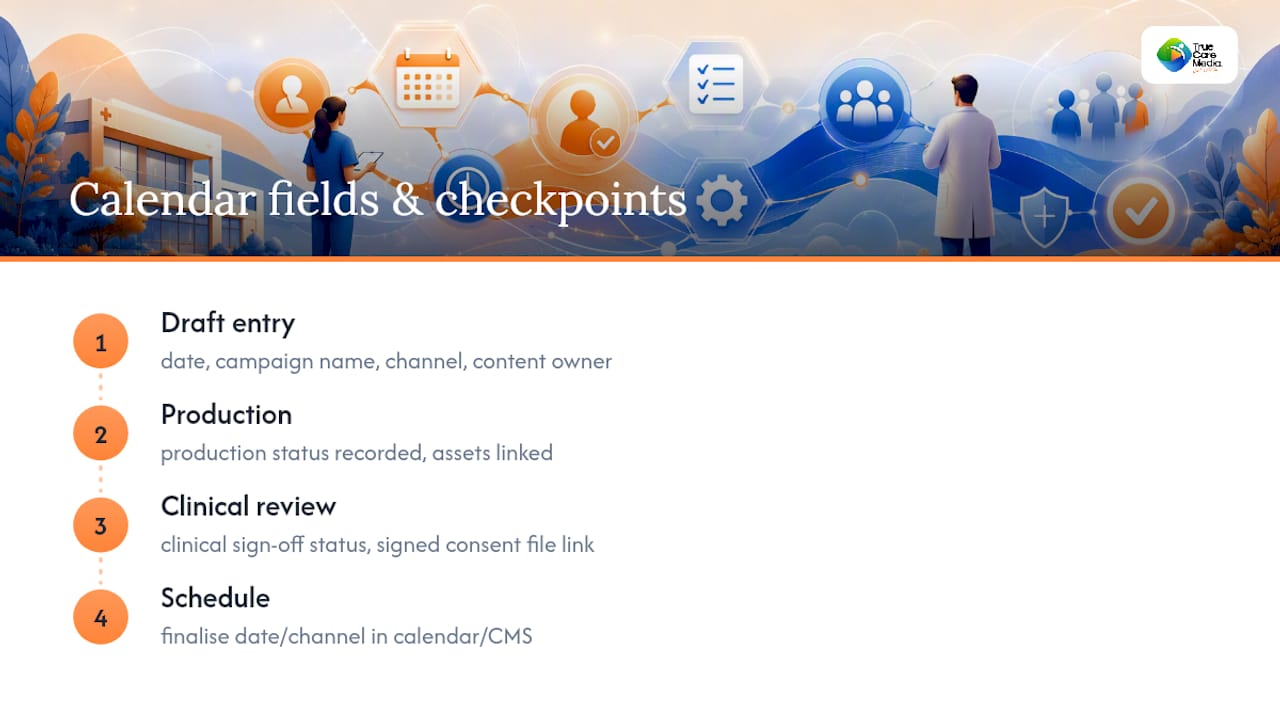
A shared spreadsheet works fine for a single-site practice. Multi-site organisations usually need a calendar app or a CMS scheduling module that lets each location filter to its own entries without losing the master compliance view. Toolkit resources with pre-built sample messages and sized graphics cut production time significantly for teams managing several locations on the same observance dates. For broader digital planning context, it’s worth checking current digital marketing trends each year to keep format choices current.
What practitioner experience adds to calendar planning
PHI-aware event recaps, built around a six to eight week distribution window, routinely stretch a single filming day into six months of usable content. Photography and short video slot into the calendar as scheduled assets with the same sign-off checkpoints as written content, never as an afterthought bolted on after the copy is approved.
What most healthcare calendars get wrong
The advice most guides give treats compliance as a bottleneck to work around. It isn’t. Treated as a structural checkpoint, sign-off is what lets a practice publish confidently without pulling posts after the fact.
Where the conventional advice really falls down is volume worship. Marketing teams get told to post daily, then burn out chasing dates that mean nothing to their actual patient base. A paediatric clinic doesn’t need to touch every date on a national health calendar. It needs four or five that genuinely serve its families, produced properly, with clinical sign-off baked in from the start rather than bolted on at the end.
If you take one thing from this, prioritise the sign-off workflow before you touch the pretty calendar template. A gorgeous 12-month grid with no clinician checkpoint is a liability dressed up as a plan. Get the compliance structure right first, then let the creative formats and awareness dates fill in around it, not the other way round.
— Mishal
A production partner for calendar-ready healthcare content
Building the calendar is the easy part. Filming, editing and repurposing enough material to fill it every month, without burning out your team or breaching consent rules, is where most in-house efforts stall. Content production companies often work with healthcare providers, producing content in batches designed to slot straight into a 12-month calendar rather than arriving as one-off pieces you then have to schedule yourself.

A typical engagement pairs a photography or video package with a distribution plan, so a single shoot day feeds several months of social, website and waiting-room content. If you’re comparing production partners, ask directly how they handle PHI redaction, model release tracking, and whether clinical sign-off happens before or after filming, not after editing is finished. That order matters more than most vendors let on.
If your organisation runs residential care, professional photography built for that setting is a practical place to start filling your calendar with consistent, consent-safe imagery. Get in touch to discuss which package fits your publishing rhythm.
Sources
Verify dates against the NSW health events calendar, the UN observances list, and cross-check cultural dates via the multicultural affairs calendar.
This article is general information, not a substitute for advice from a qualified doctor. Consult a qualified healthcare professional about your own circumstances before acting on anything here.
- 2026 Health Events Calendar – Your Health Link
- Healthcare content calendar & SEO planning
- 2026 Health Center Calendar Toolkit
FAQ
How Far Ahead Should a Healthcare Content Calendar Be Planned?
Three months of detailed planning with clinical sign-off locked in, sitting inside a rolling 12-month awareness date map you review quarterly, works well for most practices.
What’s the Minimum Publishing Cadence for a Small Clinic?
A baseline of two social posts a week plus one long-form piece a month is sustainable for most solo or small allied health practices without extra staff.
Who Needs to Sign Off on Healthcare Content Before It Goes Live?
A licensed clinician for accuracy, a privacy officer for PHI redaction, and confirmation of a signed model release for any identifiable patient before scheduling.
How Do You Repurpose One Video Shoot Into a Month of Content?
Split a single long clinical video into several short clips for social, a blog embed, a newsletter feature and a waiting-room loop, distributed over six to eight weeks.
Should Every National Health Awareness Day Be on Our Calendar?
No. Select only the dates genuinely relevant to your patient base rather than posting on every observance, since relevance drives engagement more than volume does.