
Hospital social media is the strategic use of social platforms to educate patients, build community trust, and extend clinical communication beyond the clinic walls. Understanding how hospital social media works is no longer optional for healthcare marketers. About 36% of Americans report using social media at least sometimes to find health information. That figure means hospitals that stay silent on social platforms cede authority to unverified sources. The most effective hospital social media strategy treats these channels as a clinical communication extension, not a marketing afterthought, and builds every post around patient education, community engagement, and strict regulatory compliance.
How hospital social media works as a clinical communication channel
Hospital social media functions as a structured, compliance-governed publishing system. Every post serves a defined purpose: educating patients, correcting health misinformation, or building trust in the provider team. The 80/20 content rule governs the content mix across most high-performing hospital accounts. Following the 80/20 rule means 80% of posts are educational or community-focused, while only 20% are promotional. This ratio keeps audiences engaged without triggering the distrust that comes from constant self-promotion.
Platforms like Facebook, Instagram, and YouTube each serve a distinct role in a hospital’s communication mix. Facebook Groups support ongoing community dialogue and chronic condition management. Instagram Reels reach younger demographics with short, visual health education. YouTube hosts longer procedure explainers and provider interviews that patients watch before appointments. Choosing the right platform for each content type is not a creative decision. It is a clinical communication decision grounded in where your patient population actually spends time.

Social media builds E-E-A-T by putting doctors’ faces and voices in front of patients before they ever walk through the door. That visibility reduces anxiety and increases appointment conversion rates. Patients who recognise a provider from a video feel less apprehensive during their first consultation. This is the core mechanism behind using social media in hospitals: familiarity builds trust, and trust drives care-seeking behaviour.
What content formats perform best on hospital social platforms?
Short-form video is the top ROI opportunity for hospital social media in 2026. Videos of providers explaining medical topics consistently outperform static images and text posts across every major platform. This is not a trend. It is a structural shift in how patients consume health information online.
The content types that perform best include:
- Myth-busting posts: Short videos or graphics correcting common health misconceptions, such as vaccine safety or medication interactions.
- Procedure explainers: A surgeon walking through what to expect before a knee replacement reduces patient anxiety and pre-operative cancellations.
- Seasonal health tips: Flu season reminders, sun safety in summer, and allergy management posts align with patient needs in real time.
- Provider spotlights: A 60-second video of a cardiologist describing their approach to patient care humanises the team and builds credibility.
- Q&A sessions: Live or pre-recorded question-and-answer formats on Instagram or Facebook drive high engagement and position the hospital as an accessible authority.
Patient education content is the safest and most effective category for healthcare social media. It reduces patient anxiety, strengthens trust, and carries the lowest compliance risk when produced correctly. Authentic storytelling, including real patient journeys shared with written consent, adds emotional depth that generic health tips cannot replicate. For practical guidance on formats, telehealth video content approaches translate directly to hospital social media planning.
Pro Tip: Film provider spotlight videos in clinical settings rather than studios. The familiar environment signals authenticity and makes patients feel the content is genuine, not scripted.
How do hospitals manage HIPAA compliance on social media?
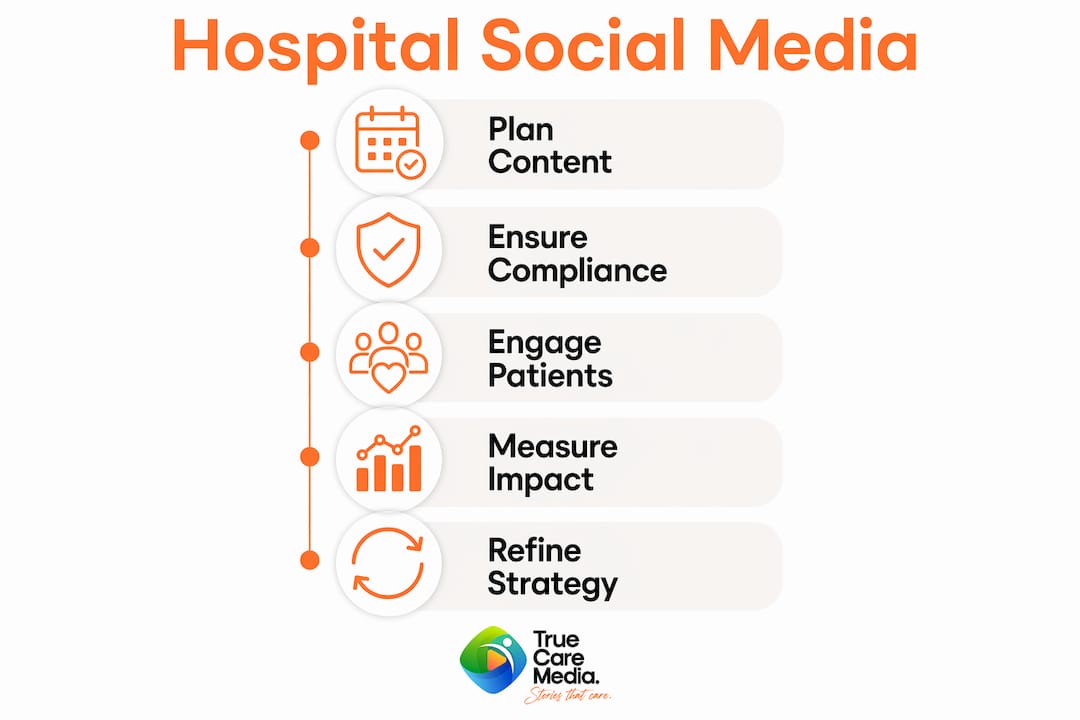
HIPAA compliance is the non-negotiable foundation of every hospital social media programme. Protected Health Information (PHI) includes any detail that could identify a patient: name, photo, diagnosis, location, or treatment date. A single non-compliant post can trigger federal investigation and significant financial penalties. A compliance-first workflow means every post passes clinical and legal review before it is published.
The standard compliance workflow in a hospital social media team follows these steps:
- Content creation: The marketing team drafts the post, using generic scenarios or consented patient stories only.
- Clinical review: A clinician checks the post for medical accuracy and flags any language that could be misinterpreted as personal medical advice.
- Legal review: The legal or compliance team confirms no PHI is present and that the content meets HIPAA and relevant state or territory regulations.
- Approval and scheduling: Only after both reviews does the content move to the publishing queue.
- Staff training: All team members who create or share content complete documented social media training annually.
The most common compliance failures come from well-meaning staff responding to patient comments in ways that inadvertently confirm a care relationship. A response like “We’re glad your procedure went well” constitutes a PHI disclosure if the patient’s identity is visible. Documented social media policies must cover comment moderation, direct message handling, and staff personal account conduct.
Pro Tip: Create a library of pre-approved comment responses for your moderation team. This removes the risk of improvised replies that accidentally disclose patient information.
What operational workflows support hospital social media teams?
Effective hospital social media management requires structured governance, not just a content calendar. Multi-layered approval workflows that include clinical, legal, and marketing review reduce risk and maintain content accuracy. Without these workflows, even well-intentioned posts can create compliance exposure or spread inaccurate health information.
Multi-location health systems face an additional challenge: balancing brand consistency with local community relevance. Centralised content templates combined with local customisation options solve this problem. The central marketing team produces brand-compliant templates covering approved topics, visual standards, and messaging frameworks. Local hospital teams then adapt these templates with location-specific details, local provider names, and community events. This approach maintains compliance while allowing each facility to speak to its own community.
| Workflow element | Centralised approach | Localised approach |
|---|---|---|
| Brand voice and visual standards | Set by central marketing team | Applied consistently across all locations |
| Content topics and approval | Governed by central clinical and legal review | Local teams select from pre-approved topic library |
| Community engagement | Broad health education campaigns | Local events, provider spotlights, community partnerships |
| Compliance oversight | Central policy and training | Local managers enforce documented protocols |
Staff social media advocacy programmes with trained clinicians sharing pre-approved content significantly expand organic reach. This approach boosts credibility because content shared by a named doctor carries more authority than content shared by an institutional account. It also reduces the resource burden on the central marketing team. For healthcare marketers building this kind of programme, educational video content designed for staff sharing is one of the highest-return investments available.
How do hospitals measure social media success?
Healthcare social media measurement focuses on trust, education reach, and patient acquisition rather than direct sales metrics. This distinction matters because a hospital’s social media goal is not to sell a product. It is to build the kind of credibility that makes a patient choose your facility when they need care.
The metrics that matter most for hospital social media teams include:
- Video views and completion rates: High completion rates on provider explainer videos signal genuine patient interest, not passive scrolling.
- Comment quality: Substantive questions in the comments indicate the content is reaching people who are actively considering care.
- Direct messages: Patients who send direct messages after viewing content are often close to booking an appointment.
- Appointment bookings linked to social campaigns: Tracking UTM parameters on social media calls to action connects content performance to actual patient acquisition.
- Response time to reviews and comments: Patients value transparency and responsiveness on social platforms more than promotional content. Fast, professional responses to negative reviews demonstrate accountability.
Paid social advertising on Facebook and Instagram allows hospitals to target local patient demographics by age, postcode, and health interest categories. This targeting capability makes paid social one of the most cost-effective tools for reaching patients who are actively searching for specific services. Combining organic educational content with targeted paid campaigns creates a full-funnel approach that builds awareness and drives appointments simultaneously. For deeper analysis of how social media ROI connects to broader brand authority, HealthHue covers evaluation frameworks worth reviewing.
Why most hospitals still get social media wrong
Most hospital social media accounts fail for one reason: they treat the channel as a marketing bulletin board. Posts announce new equipment, celebrate award wins, and promote fundraising events. None of that content serves the patient. Informative, interactive, and personalised content drives follower interaction and strengthens patient trust. Generic institutional announcements do neither.
The hospitals that get this right think like media organisations. They ask: what does a patient with Type 2 diabetes need to know this week? What question does a parent ask before their child’s first MRI? What fear does a 60-year-old have about cardiac surgery that a 90-second video from a cardiologist could address? That patient-first editorial mindset is what separates accounts that build genuine community from accounts that accumulate followers who never engage.
Short-form video is where I see the biggest gap between what hospitals produce and what actually works. Most provider spotlight videos are filmed in a boardroom, scripted to the point of stiffness, and edited with stock music that signals “corporate content.” Patients switch off within three seconds. The videos that perform are filmed in the ward, the consulting room, or the car park. They feel real because they are real. Compliance does not require sterility. It requires accuracy and consent. Those are very different things.
The other mistake I see constantly is treating compliance as a reason to say nothing. Every post gets watered down until it contains no useful information. A post that says “speak to your doctor about your health” is not compliant content. It is wasted content. The compliance framework exists to protect patients, not to prevent communication. Hospitals that understand this distinction produce content that is both safe and genuinely useful.
— Mishal
How Com helps hospitals tell better stories on social media
Hospital social media works best when the content is built on real stories, real faces, and real expertise. Com specialises in video and storytelling for healthcare providers, producing content that is both compliant and genuinely engaging for patients.
Whether your team needs provider spotlight videos, patient education content, or a full social media content strategy, Com brings the production quality and healthcare communication expertise to make it work. The team understands the compliance requirements that govern healthcare content and builds those considerations into every production. For healthcare marketers ready to build a social media presence that patients actually trust, video marketing for healthcare is the place to start.
Key takeaways
Hospital social media works when it functions as a compliance-governed clinical communication channel, not a promotional tool, with educational content, structured approval workflows, and authentic video driving measurable patient trust and engagement.
| Point | Details |
|---|---|
| Educational content dominates | Follow the 80/20 rule: 80% educational and community content, 20% promotional. |
| Short-form video leads ROI | Provider explainer videos outperform static content and reduce patient anxiety before appointments. |
| Compliance is non-negotiable | Every post requires clinical and legal review to avoid HIPAA violations and protect patient privacy. |
| Structured workflows reduce risk | Multi-tiered approval processes and documented staff training are the foundation of safe publishing. |
| Measure trust, not just traffic | Track video completion rates, comment quality, and appointment bookings linked to social campaigns. |
FAQ
What is hospital social media used for?
Hospital social media is used to educate patients, correct health misinformation, build community trust, and extend clinical communication beyond the facility. The most effective accounts prioritise patient education over promotional content.
How do hospitals stay HIPAA compliant on social media?
Hospitals stay compliant by implementing multi-step approval workflows that include clinical and legal review before any content is published. Staff must complete documented social media training and follow strict policies on comment moderation and direct message handling.
What type of content gets the most engagement on hospital social media?
Short-form video, particularly provider explainers and myth-busting posts, consistently generates the highest engagement. Educational video content reduces patient anxiety and builds the kind of trust that drives appointment bookings.
How do multi-location hospitals manage social media consistently?
Multi-location systems use centralised brand templates that local teams customise with location-specific details. This approach maintains compliance and brand standards while allowing each facility to engage its own community authentically.
How do hospitals measure social media ROI?
Hospitals measure ROI through video completion rates, comment quality, direct messages, and appointment bookings tracked via UTM parameters on social media calls to action. Trust and education reach are the primary success indicators, not direct sales volume.