
Yes, video works for healthcare compliance training, but only when it’s built as short, role-specific modules linked to LMS assessments and audit reporting. On its own, a video proves nothing. Paired with a completion record, a pass mark and a refresher schedule, it becomes the evidence your auditor actually wants to see against the NSQHS standards.
Start here:
- Map your 3 to 5 mandatory topics (infection control, incident reporting, medication safety, consent) to short modules.
- Connect every module to LMS enrolment, so completion and scores flow into one reportable record.
- Check each module against the relevant framework, whether that’s NSQHS, aged care quality standards, or the NDIS provider training guide.
Pro Tip: If you can only fix one thing this quarter, fix the LMS link, not the video quality. An auditor cares more about a timestamped completion record than a polished animation.
Key Takeaways
Compliance training videos only satisfy healthcare audit requirements when they’re short, role-specific, written to a low reading level, and linked to LMS-tracked assessments and completion records.
| Point | Details |
|---|---|
| Video alone isn’t evidence | Pair every module with an LMS-recorded completion, score and timestamp for auditors. |
| Match format to risk | Use scenario-based videos for judgement calls and procedure demos for clinical accuracy. |
| Write to a low reading level | A plain-language script under roughly 8 minutes reduces seat time without cutting content. |
| Metadata is non-negotiable | Version numbers and clinical sign-off dates prevent disputes over which module staff actually saw. |
| Specialists reduce inconsistency risk | Com produces clinically reviewed, LMS-packaged training videos for hospitals, aged care and NDIS providers. |
Table of Contents
- Types of compliance training videos and when to use each
- How do you design compliance videos people actually remember?
- What should your LMS prove when the auditor calls?
- Should you build compliance videos in-house or outsource them?
- What do real hospital and NDIS compliance video projects look like?
- How do you brief a compliance training video from scratch?
- Where compliance video projects usually go wrong
- Get compliance videos your LMS and auditors will both accept
- Sources
Types of compliance training videos and when to use each
Not every compliance topic needs the same treatment. Microlearning modules, usually two to five minutes, suit high-frequency refreshers like hand hygiene or PPE use. Scenario-based videos work best for judgement calls, like recognising a deteriorating patient or handling a consent dispute, because they force a decision rather than passive viewing. Procedure demos film the actual steps of a clinical task, useful for medication administration or wound care where visual accuracy matters more than narrative. Explainer summaries condense a policy change or new regulation into a short brief for staff who need the headline, not the detail.
Match format to risk. Incident reporting and privacy or consent training tend to work well as scenario-based videos with a decision point. Infection control and medication safety usually suit procedure demos filmed to the actual clinical standard your facility follows.
For LMS compatibility, keep deliverables to:
- MP4 files under 500MB per module for reliable streaming.
- Burned-in or SRT captions for every video, no exceptions.
- A transcript file alongside each module for accessibility and audit review.
How do you design compliance videos people actually remember?
Cognitive load kills retention faster than boring content does. HealthStream’s courseware guidance recommends writing scripts to roughly a 5th-grade reading level, which sounds low for a clinical audience until you remember staff are watching this between patients, not studying for an exam. Plain language isn’t dumbing down content, it’s removing the friction between the message and the memory.
Five design moves make the biggest difference:
- Cut every module to under 8 minutes. Split longer topics into a short series rather than one long sit.
- Add a pre-assessment. Staff who already know the material can test out and reclaim their time.
- Add a post-assessment with a real pass mark, not a tick-box quiz that everyone passes regardless.
- Caption everything and supply a full transcript, plus audio description where a visual step carries the compliance meaning.
- Set a refresher cadence by risk level, annual for low-risk topics, six-monthly for anything tied to patient safety incidents.
Pro Tip: Build role-based learning paths instead of one generic course for everyone. A wardsperson doesn’t need the same medication safety depth as a registered nurse, and forcing them through it wastes seat time and annoys both groups.
Simple visuals beat clever ones here. A clean diagram of a workflow will out-teach a stylised animation every time, because the viewer’s brain isn’t working to decode the metaphor.
What should your LMS prove when the auditor calls?
Video content is only half the compliance story. The system tracking it has to produce evidence on demand, ideally within a day, not a week of chasing spreadsheets.
Require your LMS to deliver:
- Automated enrolment tied to role, so new starters land in the right modules without manual entry.
- Individually issued completion certificates with a timestamp and the learner’s verified identity.
- Recorded assessment scores, not just a pass/fail flag.
- Exportable reports in a format your quality team can hand straight to a surveyor.
Course metadata matters more than most compliance officers realise, as detailed in quality assurance in healthcare. Every module needs a version number, a review date and a clinical sign-off record attached, because an auditor’s first question after “was this completed” is usually “which version did they see.” Some organisations are now supplementing static tracking with AI-driven monitoring that flags training gaps before an audit forces the issue, rather than discovering them during a surprise visit.
Should you build compliance videos in-house or outsource them?
The honest answer depends on what’s on screen. Clinical procedure demos, patient-safety scenarios and anything requiring behaviour-change storytelling generally need a specialist, because getting the clinical detail wrong on video is worse than not having the video at all. In-house production earns its keep for small refreshers, policy update briefs, or rapid turnarounds where a manager can film a two-minute update between shifts.

The risk with in-house builds isn’t quality, it’s consistency. Different managers filming different modules over a few years produces a library with no shared visual language, inconsistent captioning, and metadata that varies by whoever made it. Specialist producers tend to deliver better audit resilience for exactly this reason, because they apply one process across every module.
Before commissioning a specialist, ask about:
- Their clinical review process and who signs off content before release.
- Delivery formats: SCORM or xAPI packaging for your LMS, not just a raw video file.
- Accessibility as standard, not an add-on quote.
- Any evidence of past impact, completion rates, or assessment improvement from prior projects.
Pro Tip: Ask a vendor how they handle a regulation change six months after delivery. If updating one module means re-filming the whole series, you’ve bought a liability, not an asset.
What do real hospital and NDIS compliance video projects look like?
Compliance video work looks different depending on the setting, but the same principles hold. A hospital training video project built for clinical educators typically starts with a skills gap identified by the education team, moves through clinical sign-off, and ends with a module packaged for direct LMS upload.
- Hospital procedure training: filmed demonstrations paired with an assessment bank, reducing repeat classroom sessions for routine skills refreshers.
- Treatment process explainer videos: used both for patient understanding and as an internal training reference for new staff explaining the same procedure.
- NDIS explainer content: role-specific modules covering support worker obligations, mapped against workforce capability guidance rather than generic disability awareness content.
The reusable part of these projects isn’t the footage, it’s the structure: a defined learning objective, a short script at a controlled reading level, and an assessment bank built before filming starts, not bolted on afterwards.
How do you brief a compliance training video from scratch?
A weak brief produces a video that looks fine and proves nothing. Work through this before you contact anyone:
- Write the learning objective first. State exactly what the learner must be able to do afterwards, and to what standard.
- Name the target roles and mandatory outcomes. A module for allied health assistants shouldn’t be identical to one for registered clinicians.
- Set the assessment threshold (commonly 80% pass) and decide whether it’s summative or just a comprehension check.
- Specify captioning, transcripts and SCORM or xAPI packaging in the brief itself, not as an afterthought during delivery.
- Set a clinical sign-off timeline and lock version control before filming, so nobody’s reviewing a video that’s already three edits out of date.
- Define your KPIs: completion rate, pass rate, and refresher cadence, agreed before production starts, not after the invoice arrives.
Pro Tip: Build your delivery acceptance checklist into the brief, not the final invoice. Ask for the raw files, transcripts, metadata and an exportable evidence report as contract deliverables, not favours.
Producers experienced in healthcare video production will usually have this checklist ready before you ask for it, which is a fair signal of whether they’ve done this before.
Where compliance video projects usually go wrong
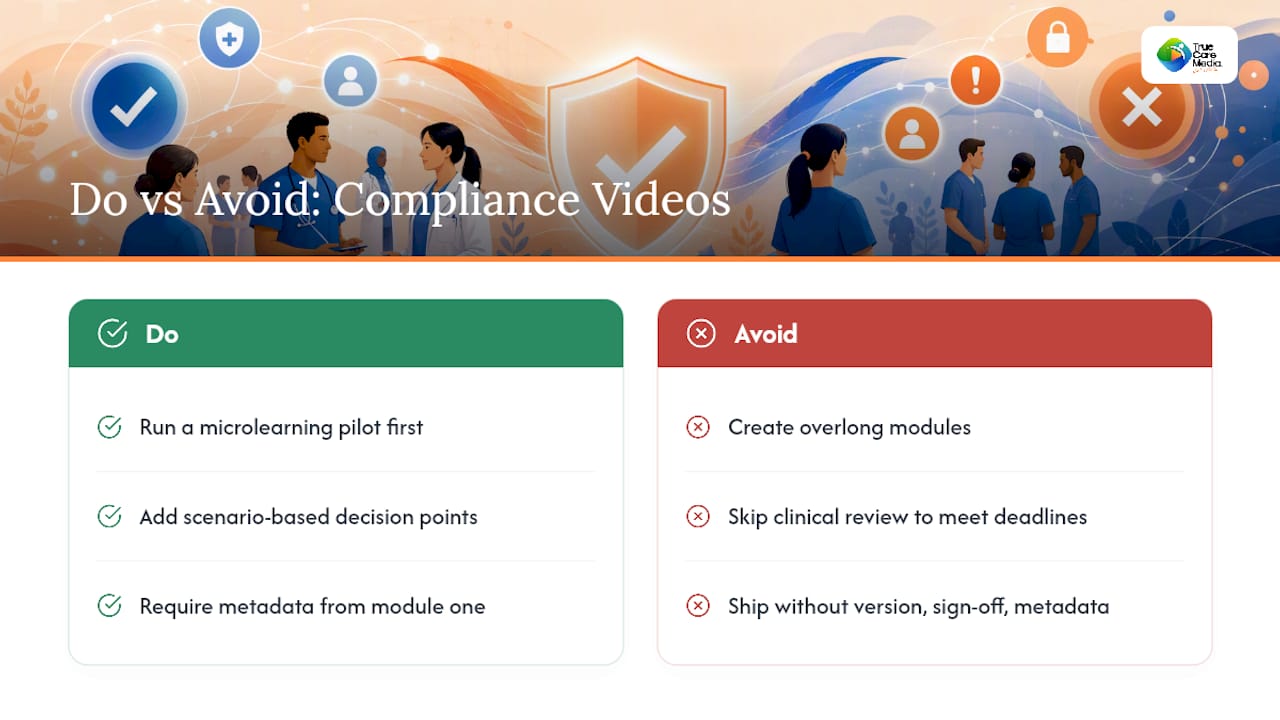
Most failures aren’t about production quality, they’re about discipline. Overlong modules lose staff before the assessment even loads. Skipping clinical review to hit a deadline is the single riskiest shortcut in this entire process, because it’s the one an auditor will find first. Missing metadata, no version number, no sign-off date, turns a perfectly good video into an unusable record the moment someone asks “which version was this.”
The wins that actually move the needle are unglamorous: run one microlearning pilot before committing to a full library, add a scenario-based decision point to your highest-risk module, and make metadata mandatory from module one rather than retrofitting it later.
— Mishal
Get compliance videos your LMS and auditors will both accept
If you’d rather not build a video library piecemeal across different managers and formats, Com produces training video content specifically for healthcare, aged care, and NDIS providers, handling clinical scripting, filming, and LMS packaging as one process rather than three separate headaches.

Every project includes captioning and transcripts as standard, a clinical sign-off step before delivery, and files packaged ready for your LMS rather than a raw video dropped in your inbox with no metadata attached. For NDIS providers specifically, Com’s explainer video guidance for providers covers how role-specific modules map against workforce capability requirements. If your next audit cycle is closer than your training library is ready, get in touch to scope a module set and see how it fits your existing LMS reporting.
Sources
- Compliance courseware | HealthStream
- NSQHS standards | Australian Commission on Safety and Quality in Health Care
- Training for capability: a guide for NDIS providers
- AI’s role in compliance monitoring for healthcare | Censinet