
Transition to care content is media, video, photography, testimonial and training pieces, made for care organisations to explain, support or promote a person’s move into care services. Commissioners should expect three things from a well-made piece: a clear referral pathway the viewer can act on, a family or participant who feels genuinely informed rather than sold to, and a safer handover for the staff who pick up the case next.
This isn’t generic marketing collateral. Content built for a transition moment has to work under real constraints, NDIS funding rules, consent obligations, accessibility needs, while still doing the basic job of building trust.
- Referral clarity: the viewer knows exactly what to do next and who to contact.
- Informed decision-making: families and participants understand the setting, the process and realistic timelines before they commit.
- Staff continuity: training and orientation pieces reduce handover errors between teams.
Key Takeaways
Transition to care content works when it pairs a clear referral pathway with documented consent and accessible delivery, not when it simply looks polished.
| Point | Details |
|---|---|
| Start with the decision | Match format to the specific decision (pre-admission, consent, orientation, training) before choosing video style. |
| Consent is written, not verbal | Document use, duration and withdrawal rights before any filming begins. |
| Bundle formats from one shoot | A single production day can deliver an explainer, cutdowns, training footage and a photography set together. |
| Measure engagement and operations together | Track completion rate alongside enquiry volume to prove the content is driving real decisions. |
| Brief an experienced supplier | True Care Media builds consent, accessibility and NDIS-specific compliance into every commissioned project from the outset. |
Table of Contents
- What is transition to care content for, and who needs it?
- Which format suits which stage of the transition?
- What core elements does every piece need?
- How do you brief and budget a transition-to-care shoot?
- How do you measure whether the content is working?
- What are the biggest risks in commissioning this content?
- How does an experienced supplier approach this work?
- How True Care Media supports your next commissioning brief
- Useful sources for commissioning and compliance review
- Frequently asked questions
What is transition to care content for, and who needs it?
Different people watching the same video need different things from it. A participant deciding whether to move into supported accommodation wants to see the physical space and the people who’ll support them day to day. A family member weighing up a residential care option wants proof points, staff qualifications, safety measures, real testimonials, not a highlight reel. Referrers and clinicians want accuracy they can stand behind when they recommend a service. Frontline staff need training content that actually reduces mistakes during handover, not a polished brand film repurposed as onboarding.
The use cases cluster around a handful of moments: the pre-admission decision, consent conversations before a shoot or before a move, orientation to a new physical setting, and staff training or handover.
- Participants: want to see the environment and the people, not just hear about them.
- Families/decision-makers: want evidence, credentials and honest expectations.
- Referrers/clinicians: want accuracy they’re comfortable recommending.
- Frontline staff: want practical, repeatable training material.
For NDIS providers specifically, participant choice sits at the centre of everything. Content has to respect that the participant is making the decision, not being steered towards one, while still meeting accessibility standards that make the choice genuinely informed.
Which format suits which stage of the transition?
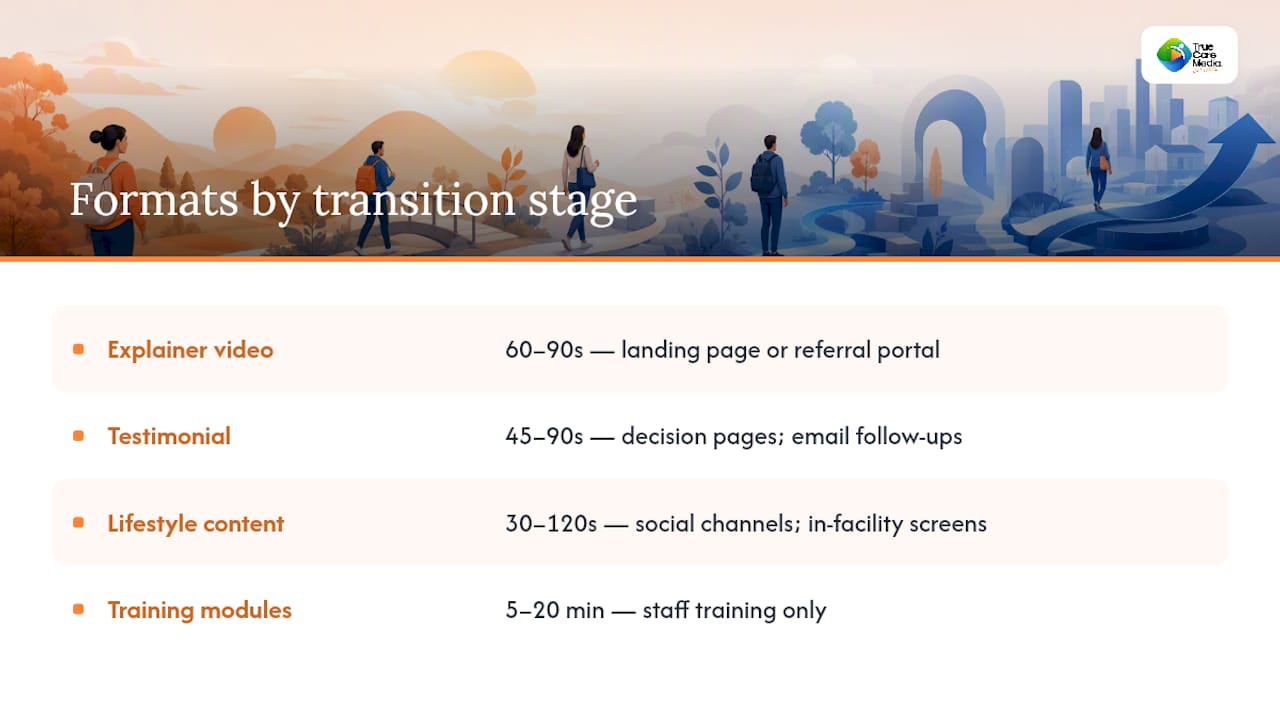
Pick the format by what decision it needs to support, not by what looks impressive. An explainer video (60 to 90 seconds) answers “what happens here and how do I start?” and belongs on a website landing page or referral portal. A testimonial (45 to 90 seconds) builds trust at the point a family is comparing providers, and works best in email follow-ups or on a decision page. Lifestyle content (30 to 120 seconds) shows daily life in a setting and performs well on social channels and in-facility screens. Training modules (5 to 20 minutes) exist purely for staff and shouldn’t be dressed up as marketing. Photography, hero shots, staff portraits, room and common-area images, underpins everything else and gets reused more than any single video.
A single shoot day can usually generate several of these at once. Booking one photography and video session that covers a hero explainer, a testimonial, a handful of lifestyle cutdowns and a fresh photography library is far more efficient than commissioning each format separately, and it’s the approach Punchy Studio’s guidance on video for aged care providers points to when it recommends regular, authentic updates over one-off productions.
What core elements does every piece need?
Every asset needs a message map before anyone picks up a camera: the primary claim, who it’s speaking to, what happens next (a referral link, a phone number, a booking form), and any disclaimer the claim needs. Skip this step and you end up with a beautifully shot video nobody can act on.
Consent is non-negotiable and needs to be documented in writing, covering how the footage will be used, whether the participant is being paid, and how they can request a review or withdrawal later. Ethical brand storytelling guidance for healthcare marketing is blunt about this: storytelling isn’t a substitute for compliance, it has to be built into the production workflow from day one.

Accessibility checks matter just as much: captions on every video, an Auslan or interpreter option where the audience needs it, plain-language scripts, and legible typography and contrast on stills for people with low vision.
Pro Tip: Build a dedicated ‘participant care plan’ step into the production schedule, a short pre-shoot conversation covering breaks, triggers and comfort signals. It costs fifteen minutes and avoids costly re-shoots or, worse, real distress on the day.
Cultural safety and trauma-informed practice round it out:
- Language and imagery that reflect the participant’s own culture and preferences, not a generic stock aesthetic.
- Trigger warnings where content touches on illness, loss or difficult transitions.
- A visible option to pause or stop filming at any point, communicated before the camera rolls.
How do you brief and budget a transition-to-care shoot?
A workable brief covers purpose, audience, key messages, any mandatory compliance lines, who’s appearing on camera, consent and privacy requirements, KPIs, and where the finished assets will live. Skip any of these and the supplier will be guessing, which usually shows up as delays or a reshoot.
- Define the purpose and audience before contacting a supplier, one paragraph is enough.
- List mandatory lines (funding disclaimers, NDIS terminology requirements, brand guidelines).
- Confirm who’s appearing and secure preliminary consent before scheduling.
- Set KPIs and distribution channels upfront so the edit is built for where it’ll live.
- Approve a timeline that allows for the realities of working with vulnerable participants.
| Stage | Typical lead time |
|---|---|
| Discovery and briefing | 1–2 weeks |
| Scripting and consent | 1–2 weeks |
| Shoot day(s) | 1 day, sometimes split across two |
| Edit and internal review | 2–3 weeks |
| Approvals and delivery | 1 week |
Budget bands vary with scope: a single explainer video sits at the lower end, a testimonial bundle with two or three subjects costs more, and a full day’s shoot producing multi-format deliverables (video plus a photography library) sits at the top. Interpreter costs, on-site clinical supervision and accessibility production (captioning, Auslan) are the line items that most often get forgotten at brief stage, so budget for them upfront. Approval usually needs sign-off from the participant, family where relevant, a clinical lead, legal or compliance, and the communications team commissioning the work.
How do you measure whether the content is working?
Engagement metrics tell you if people are watching: completion rate and average watch time are the basics. Behavioural metrics tell you if it’s working: enquiry rate, referral conversions, and, for internal training pieces, faster orientation completion. PriceWeber’s healthcare storytelling research recommends tracking both engagement and operational metrics together, since a video that gets watched but generates no enquiries isn’t actually doing its job.
One shoot should generate more than one asset. A single day of filming can typically be repurposed into:
- Two or three short social cutdowns from the same footage.
- A dedicated training module built from the longer interview or process footage.
- Still images pulled for in-facility screens and printed materials.
- A cut-down version for referral portals with different messaging emphasis.
Small teams without a dedicated analytics setup can still A/B test messaging cheaply, run two email subject lines to different family segments, or trial two landing page thumbnails, and just watch which drives more click-throughs over a fortnight.
What are the biggest risks in commissioning this content?
The most common failure is consent that’s verbal, vague, or collected under time pressure. Close behind it: content that promises outcomes the service can’t guarantee, imagery that doesn’t reflect the diversity of the people actually being supported, and videos with no captions or accessible alternative.
- Consent gaps — mitigate with a written consent form specifying use, duration and withdrawal rights, agreed before filming starts.
- Participant fatigue — mitigate with shorter shoot days and built-in breaks, planned into the schedule, not improvised on the day.
- Misleading claims — mitigate with clinical or compliance sign-off on every script before the shoot.
- Inaccessible assets — mitigate with a captioning and Auslan review as a mandatory delivery checkpoint, not an afterthought.
The legal and ethical thread running through all of this is simple: consent and accuracy aren’t features you bolt onto content afterwards, they’re what makes the content usable at all.
How does an experienced supplier approach this work?
Take two common briefs. A provider helping someone move into supported independent living commissions a short lifestyle video plus a photography set: the outcome is a family that can visualise the actual space before the participant moves in, which shortens the decision-making conversation. A private hospital supporting family decision-making for residential aged care placement commissions a testimonial bundle featuring two existing residents’ families: the outcome is fewer repeat phone enquiries, because the video answers the questions families were calling to ask.
An experienced production approach generally runs through:
- Discovery, understanding the setting, the audience and the decision the content needs to support.
- Consent and risk planning, before a single frame is shot.
- Participant-centred filming, paced around the people involved, not the crew’s schedule.
- Fast turnaround edits, so families aren’t waiting weeks for something they need now.
- Accessible deliverables as standard, captions and alt formats included, not quoted separately.
Deliverables for each brief typically include a hero video, two or three cutdowns, caption files, a photography set and signed permission forms, all handed over as one package.
A note from the content team
Families making a transition decision are often frightened and exhausted, and that shapes every choice we make on set, from pacing to who’s in the room. Good planning protects people; it isn’t red tape.
How True Care Media supports your next commissioning brief
True Care Media exists for exactly this brief: video production, photography, testimonial videos, training modules and content planning built specifically around NDIS, allied health, aged care and home care organisations, not adapted from a generic corporate marketing template.

Every project follows the same commissioning discipline covered above: documented consent before filming, accessibility deliverables (captions, plain-language scripts) included as standard rather than quoted as an add-on, and a production schedule that respects the pace vulnerable participants actually need. That’s a meaningfully different starting point from briefing a general agency and then explaining NDIS terminology, consent obligations and accessibility standards from scratch.
If your team is weighing up a family decision-making video, a testimonial bundle, or a full-day shoot covering multiple formats, the practical next step is to look at how True Care Media approaches family decision-making video content and get a quote scoped against your own timeline and budget bands.
Useful sources for commissioning and compliance review
- NDIS guide to residential aged care clarifies what NDIS funding can and can’t cover during a transition.
- NDIS provider guidance on alternatives to residential aged care outlines funded supports relevant to messaging about options.
- The Australian Journal of Social Issues study on young people in residential aged care shows why content should set realistic, not overpromised, timelines.
- The policy analysis of the aged care and NDIS interface explains system boundaries worth reflecting in disclaimers.
Frequently asked questions
What is transition to care content, in one sentence?
It’s media, video, photography, testimonials and training pieces, commissioned by care organisations to explain, support or promote a person’s move into a care service.
Who typically commissions this kind of content?
Marketing, communications and operations teams at NDIS providers, allied health clinics, aged care and home care providers, and private hospitals.
What’s the minimum viable version of a transition-to-care asset?
A short, well-captioned explainer video paired with a basic photography set covering the setting and staff, both built on documented consent.
How long does a typical project take from brief to delivery?
Around five to eight weeks end to end, allowing for discovery, consent, the shoot itself, editing and multi-stakeholder approvals.
Does this content need clinical or compliance sign-off?
Yes. Any claim about outcomes, funding or service scope should go through clinical or compliance review before the final edit is approved.