
A memory care content strategy is the set of educational articles, videos, and operational transparency posts a provider publishes to guide anxious families through a decision that usually takes months, not days. Get it right and three things happen at once: families arrive at their first call already trusting you, your tour requests come pre-qualified, and your cost per move-in drops because you’re not chasing cold leads through paid ads alone. The strategy has one job. Answer the fears families are too ashamed to ask about out loud.
Key Takeaways
A memory care content strategy succeeds when it prioritises operational transparency and empathy-first education over lifestyle marketing to build family trust and generate qualified tours.
| Point | Details |
|---|---|
| Lead with operational detail | Publish night staffing, elopement prevention, and medication management content openly rather than gating it. |
| Match content to the journey | Map early research, crisis, evaluation, and tour stages to distinct content formats and channels. |
| Prioritise organic and referrals | Rely on content and referrals for the lowest cost per move-in, reserving paid search for crisis-stage keywords. |
| Track content-assisted tours | Use UTM tagging and a CRM tour-source question, not just traffic volume, to judge performance. |
| Commission professional visual proof | Com produces the video and photography bundles memory care providers need to show, not just tell, families they can trust. |
Table of Contents
- What is memory care content strategy and why does it matter now?
- How does memory care marketing differ from assisted living?
- Who is searching, and what does their decision journey look like?
- What core content types actually convert for memory care?
- What messaging builds trust with grieving families?
- Which channels and tactics actually generate qualified tours?
- What does a realistic 90-day content launch look like?
- What compliance and consent rules apply to memory care content?
- Which KPIs actually tell you the content strategy is working?
- How does professional video and photography build trust fast?
- What is the messaging framework behind trustworthy memory care copy?
- How do you actually launch this strategy step by step?
- What tools help you produce, schedule, and measure this content?
- What do most providers get wrong first?
- How Com helps you turn this strategy into finished content
- Frequently asked questions
- Sources
What is memory care content strategy and why does it matter now?
Families researching memory care rarely make a decision in one sitting. They circle the topic for weeks, often starting the search at 2am after a difficult night with a parent, and they return to it repeatedly before ever picking up the phone. That long, emotionally loaded research cycle is exactly why generic senior-living marketing falls flat here, and why operational transparency consistently outperforms glossy lifestyle content.
Content plays a different role than paid ads or referrals in this mix. Referrals convert fastest because trust is already established through a clinician or social worker. Organic content builds that same trust from scratch, at scale, for families who have no referral source at all. An effective strategy blends both, with paid search reserved for crisis-stage keywords where a family needs a bed within days.
What content needs to do in that window:
- Answer safety and medication questions before a tour is ever booked.
- Show real staff and real routines, not stock photography.
- Remove the guilt families feel by naming it directly, then offering practical next steps.
How does memory care marketing differ from assisted living?
Assisted living marketing sells independence and lifestyle. Memory care marketing sells safety, dignity, and relief from a fear most families won’t say aloud: “What happens if Mum wanders at night?” That single difference changes almost everything about tone, content priority, and compliance load.
Assisted living families ask: What activities are on offer? Is there a gym? Can residents come and go freely?
Memory care families ask: Will staff notice if she gets up at 3am? What’s your fall protocol? How do you handle aggression during sundowning?
Generic phrases like “resort-style living” or “vibrant community” actively damage trust in memory care content, because they signal the writer hasn’t sat with a family in crisis. Families searching for memory care information are typically exhausted, guilt-ridden adult children managing a parent’s decline. Speak to that reality, not to a brochure fantasy.
Pro Tip: Write every headline as if a tired adult child is reading it at midnight after a bad phone call from their mother. If the line wouldn’t reassure them in that moment, cut it.
Who is searching, and what does their decision journey look like?
Three audiences drive most memory care enquiries, and each searches differently. Adult children make up the bulk of researchers and tend to search broad, emotional terms early, then narrow to operational specifics. Spouses search less often but convert faster because the need is usually more immediate. Clinical referrers (GPs, hospital discharge planners, geriatric care managers) search for compliance and credential specifics they can pass on to families.
The journey itself moves through four fairly predictable stages:
- Early research — vague, emotional searches like “signs it’s time for memory care” or “how do I know mum can’t live alone anymore.”
- Crisis — urgent, local searches like “memory care beds available near me” after a fall or hospital discharge.
- Evaluation — comparison searches like “memory care vs assisted living cost” or “[facility name] reviews.”
- Tour — logistics searches like “what to bring to a memory care tour” or “questions to ask memory care facility.”
Match content format to each stage rather than publishing one generic style throughout:
- Early research needs longform educational guides and symptom checklists.
- Crisis stage needs fast-loading, mobile-first pages with phone numbers above the fold.
- Evaluation needs comparison pages, FAQs, and detailed operational posts.
- Tour stage needs video walkthroughs, staff bios, and printable checklists.
What core content types actually convert for memory care?
The strongest-performing memory care content isn’t polished lifestyle marketing. It’s plainly written operational detail that answers the questions families are afraid to ask a salesperson directly. Detailed posts on night staffing ratios, elopement prevention, and what happens in the first 72 hours after move-in consistently produce more qualified leads than photo-heavy lifestyle pages.
Build your content library around these core types:
- Educational longform guides (“Understanding Sundowning: A Family Guide,” “The Stages of Dementia and What Changes at Each One”).
- Operational transparency posts (“Our Night Staffing Ratios Explained,” “How We Prevent Elopement Without Restricting Dignity”).
- Comparison pages (“Memory Care vs Assisted Living: Which Does Your Parent Need?”).
- FAQs addressing medication management, visiting hours, and behavioural incidents.
- Staff profile pages showing credentials and tenure, not just headshots.
- Testimonial and virtual tour video, filmed on location rather than stock footage.
Sample early-research headlines: “10 Signs It Might Be Time for Memory Care,” “What Is Sundowning and Why Does It Happen at Dusk?”, “How to Talk to a Parent About Moving Into Memory Care.”
Sample high-intent headlines: “What Our Overnight Staffing Actually Looks Like,” “Elopement Prevention: Our Three-Layer System Explained,” “First 72 Hours: What to Expect After Move-In.”
For media, a short 90 second testimonial reel, a three-video bundle covering tour, testimonial and FAQ, and genuine photography of daily programming and routines do more for trust than any brochure copy.

Common question families ask directly: “Can I see the facility before booking a tour?” Answer this with an embedded virtual tour video on the same page, not a form gate.
What messaging builds trust with grieving families?
Every sentence of memory care copy should pass one test: does it acknowledge how hard this decision is before it explains anything else? Empathy-first language, combined with plain factual detail, is what separates trustworthy content from marketing noise.
Do:
- Name the guilt directly (“Choosing memory care doesn’t mean you’ve failed her.”).
- Lead with safety and staffing specifics, not amenities.
- Use plain language over clinical jargon.
Don’t:
- Open with “resort-style” or “five-star” framing.
- Promise outcomes you can’t guarantee (“we’ll always know exactly where she is”).
- Bury operational detail behind a contact form.
A sample opener for a night-staffing post: “It’s 2am and you’re awake wondering if she’s safe. That question is exactly why our overnight team follows a documented 15 minute check schedule, and here’s how it works.”
Before publishing any testimonial or resident image, confirm written consent is on file from the resident or their legal decision maker, note whether the consent covers web, social, and paid use separately, and store it with an expiry or review date.
Pro Tip: Read every draft aloud to someone outside marketing. If it sounds like it was written for a shareholder report instead of a frightened adult child, rewrite the opening paragraph.
Which channels and tactics actually generate qualified tours?
Prioritise channels in this order: organic search and content first, because it carries the lowest cost per move-in over time; professional referrals second, because conversion rates are highest there; social content third, aimed at adult children rather than the resident; paid search last, reserved for crisis-stage keywords.
Split your paid and organic effort deliberately:
- Run PPC on urgent, local, high-intent terms (“memory care bed available [suburb]”) where waiting for organic rankings would cost you the enquiry.
- Let organic content own early-research and evaluation-stage keywords, where families spend weeks reading before ever calling.
- Retarget site visitors who read an operational post but didn’t book a tour, since they’re often mid-journey rather than lost.
For video distribution and outreach:
- Publish the primary video on the relevant service page, not just social media.
- Repurpose it into a 60 second reel and a transcript-based blog post.
- Share it directly with referral partners (GPs, hospital discharge teams, aged care assessors) as a resource, not a pitch.
- Run a quarterly caregiver workshop and film a short recap for future nurture content.
What does a realistic 90-day content launch look like?
A 90-day launch gives you time to build the essential library without burning out your team. Weeks 1 to 4 focus on foundational pages: your core educational guides, one operational transparency post, and staff profile pages. Weeks 5 to 8 add the comparison page, FAQ hub, and your first testimonial video. Weeks 9 to 12 layer in a second operational post, a virtual tour video, and your first caregiver workshop write-up.
For a typical content and video bundle, expect this production sequence:
- Brief and consent collection (roughly one week).
- Filming day, covering testimonial, tour footage, and staff interviews in one shoot.
- Editing and review (one to two weeks).
- Publishing across web, social, and referral partner channels.
Budget expectations vary widely by scope, but a useful way to think about it: a low band covers photography and a single short video; a medium band adds a three-video bundle and a content calendar; a premium band includes quarterly refreshes and workshop filming. Whatever the tier, prioritise operational content early. It’s the fastest lever for lead quality, not the last thing you get to once the “nice to have” content is done.
What compliance and consent rules apply to memory care content?
Every photo, video, or testimonial featuring a resident needs documented consent from the resident or their legal decision maker before publication, and that consent should specify web, social, and paid use separately since a family may approve one and not the other. Store consent forms with a review date, and remove content immediately if a family withdraws permission.
On clinical claims, stick to a simple rule: describe what you do, not what you guarantee. A safe example: “Our care team follows structured overnight check protocols designed to reduce risk, though no environment can eliminate all risk of a fall or wandering incident.” That single sentence protects you from overpromising while still being reassuring.
Aged-care advertising rules and privacy law vary by jurisdiction, so check your local regulator’s current advertising and privacy guidelines before publishing testimonials, staff credentials, or claims about clinical outcomes.
Pro Tip: Keep a consent register separate from your CRM. If a family asks you to remove a photo two years later, you need to find it in minutes, not days.
Which KPIs actually tell you the content strategy is working?
Traffic numbers tell you almost nothing on their own. Track organic leads by source, cost per lead (CPL) by channel, tour conversion rate, and what percentage of tours were “content-assisted” (meaning the family read at least one blog post or watched a video before calling).
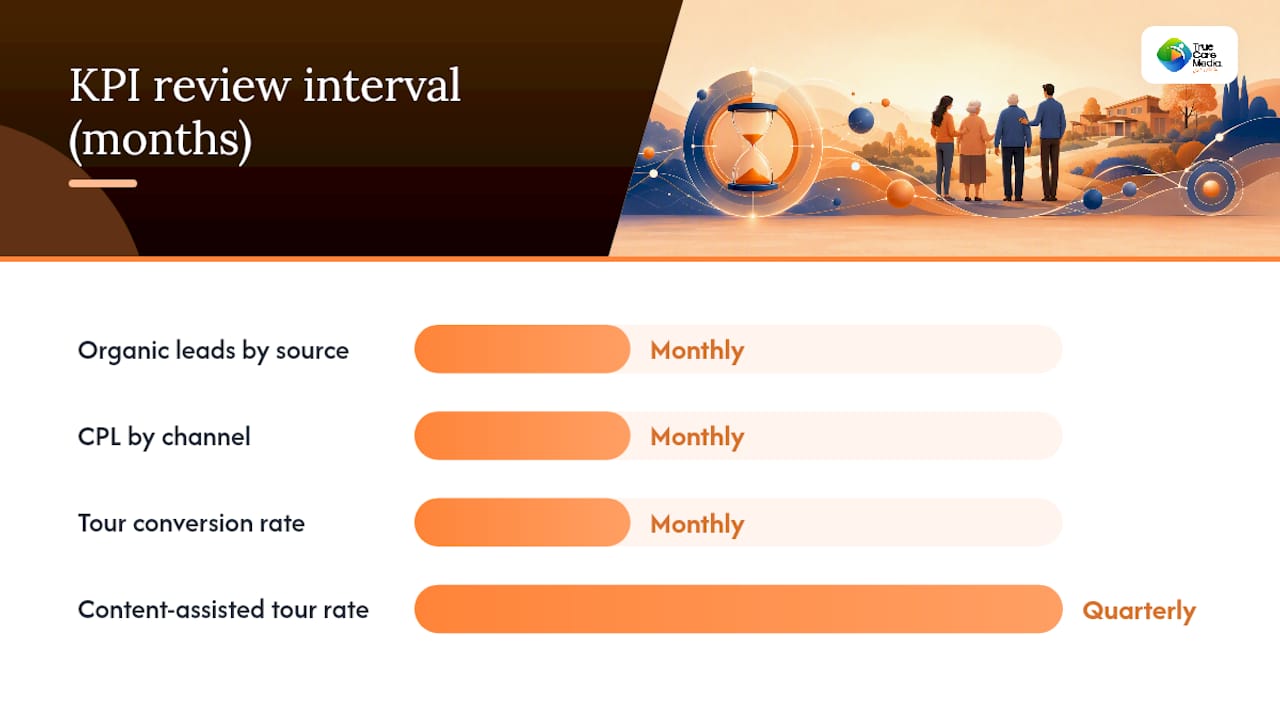
Build a simple attribution setup: UTM tag every campaign link, tag CRM entries by first-touch source, and add one question to your tour booking form: “What did you read or watch before contacting us?”
| Metric | Review frequency |
|---|---|
| Organic leads by source | Monthly |
| Cost per lead by channel | Monthly |
| Tour conversion rate | Monthly |
| Content-assisted tour rate | Quarterly |
Review this dashboard monthly with whoever owns tour follow-up, not just marketing, since front-desk staff often know which posts families mention on the phone.
How does professional video and photography build trust fast?
A single well-produced video answers more family anxiety than ten blog posts, because it shows what words can only describe. Before any shoot, confirm consent is signed, plan B-roll of ordinary daily moments rather than staged activities, and make sure staff credentials appear on screen, not just in a caption.
A practical three-video bundle covers most family questions in one shoot: a virtual tour showing the physical environment and safety features, a family testimonial addressing the emotional decision, and a short staff FAQ clip answering the three questions your front desk hears most often. Publish each on its relevant page, then repurpose clips into social captions and referral partner resources.
Pro Tip: In every caption or video description mentioning a resident, note that footage was used with family consent. It’s a small line that quietly reassures other families watching.
What is the messaging framework behind trustworthy memory care copy?
Every piece of content should carry three layers: an emotional acknowledgment, a factual answer, and a next step. Skip any layer and the copy either feels cold or feels like a sales pitch.
Layer one, acknowledgment: Name the fear or guilt directly. “Deciding your father needs more care than you can give at home is one of the hardest calls a family makes.”
Layer two, factual answer: Answer the specific operational question without hedging. “Our medication management team performs a documented check at every shift change, cross-referenced against the resident’s care plan.”
Layer three, next step: Give a low-pressure action, not a hard sell. “If you’d like to see how this works day to day, our virtual tour walks through a typical morning.”
Tone guidelines to keep consistent across every writer on your team: write at a conversational, plain-English level (avoid clinical jargon like “cognitive decline trajectory” in favour of “how dementia tends to progress”), use second person (“you” and “your family”) rather than third person (“families”), and never use humour around safety incidents or behavioural symptoms. Consistency matters more than cleverness here. A family reading five pages on your site should feel like the same person wrote all of them, even when three different staff members did.
How do you actually launch this strategy step by step?
Start with an audit, not a content calendar. Review your existing pages against the four-stage decision journey and flag every gap where a family would hit a dead end or a lifestyle-only page.
- Audit existing content against the decision-journey stages and note gaps.
- Draft your messaging framework and get clinical or operations sign-off on factual claims.
- Build your consent process and templates before scheduling any shoot.
- Commission your first three-video bundle and one professional photography session.
- Publish the foundational educational guides and one operational transparency post.
- Set up UTM tracking and the CRM tour-source question before your first campaign goes live.
- Review the dashboard at 30 days and adjust topic priority based on which posts drive tour requests.
Treat this as a living checklist, not a one-off project. Revisit it every quarter as new staff join, new consent forms expire, and new family questions surface in front-desk conversations.
What tools help you produce, schedule, and measure this content?
You don’t need an enterprise marketing stack to run this well, but a few categories of tool matter. For planning and scheduling, a shared editorial calendar (Google Sheets works fine for smaller teams, Airtable or Asana for larger ones) keeps writers, clinical reviewers, and video crews aligned on deadlines.
For analytics, Google Analytics 4 combined with Google Search Console tells you which pages families actually read before converting, while your CRM (whether that’s a purpose-built aged-care CRM or a general tool like HubSpot) should be configured to tag lead source and tour-source answers.
For content creation itself, a documented style guide matters more than any software, since consistency of tone across writers is what makes your site feel trustworthy rather than assembled by committee. For video and photography specifically, working with a specialist provider who understands aged-care consent processes and the operational-transparency angle saves months of trial and error compared to briefing a generalist agency unfamiliar with the sector.
What do most providers get wrong first?
The biggest mistake is gating operational content behind a form, which kills trust exactly when a family needs openness most. Three quick wins for your first 30 days: publish one night-staffing transparency post, build a sundowning FAQ, and film a single testimonial. One provider we’ve observed saw tour requests accelerate simply by making its elopement-prevention page public instead of email-gated. Stop hiding your best trust signals behind lead forms.
How Com helps you turn this strategy into finished content
Com is the production partner for memory care and aged care providers who know what this strategy requires but don’t have a video crew, photographer, and editor sitting in-house. Rather than briefing a generalist agency that treats memory care like any other senior-living account, you work with a team that already understands consent processes, operational-transparency messaging, and why a night-staffing video needs to feel reassuring rather than clinical.

A typical engagement covers a photography session for staff and environment shots, a three-video bundle (virtual tour, family testimonial, staff FAQ), and a content calendar mapping each asset to the family decision journey outlined above. Deliverables are scoped and priced upfront as fixed packages or bespoke projects, so you know the investment before the shoot is booked, and turnaround from brief to published asset typically runs on the same four-to-six week production sequence covered earlier in this guide.
If you’re ready to move from planning to production, request a project brief and Com will scope a bundle around the content gaps your team has already identified.
Frequently asked questions
What is memory care content strategy in simple terms?
It’s a planned mix of educational, operational, and video content designed to educate families, answer their safety concerns, and build enough trust that they book a tour.
How is memory care content different from assisted living content?
Memory care content focuses on safety, staffing, and cognitive decline rather than lifestyle and independence, and carries a heavier compliance and consent load around resident imagery.
What’s the single highest-converting content type for memory care?
Detailed, openly published operational posts, particularly on night staffing and elopement prevention, tend to convert better than lifestyle or gated content.
How long does it take to see results from a memory care content strategy?
Most providers see early tour-conversion improvements within the first 90 days of publishing foundational operational and educational content, with organic search gains building over six to twelve months.
Do I need video, or is written content enough?
Written content builds search visibility, but video and photography close the trust gap faster because families can see real staff, real routines, and real environments before ever visiting in person.
Sources
- Memory Care Marketing: The Complete Guide to Reaching Families and Building Trust | USR Engage
- Memory care programming: engagement guide | The Cordwainer
- What Families Search for When Choosing Memory Care | LLJ Copywriting
- What Is Memory Care Marketing? And How Does It Work? | CCR Growth
- Blog Ideas for Memory Care Facilities | SoftScotch