
Authentic representation is the truthful, respectful portrayal of people and communities that centres their own voices, lived experiences, and creative control. It goes beyond putting a diverse face on screen or in a brochure. The standard requires narrative depth, agency, and power held by those being depicted. For anyone engaged in social justice, diversity, and culture, understanding what authentic representation means is the foundation for recognising when it is done well and when it falls short. This article defines the concept clearly, examines why it matters, and offers practical guidance on how to achieve it.
What does authentic representation mean?
Authentic representation is defined as the accurate and respectful depiction of individuals or communities that avoids distortion, centres lived experience, and gives those represented meaningful creative control. The term comes from broader scholarly work on the politics of representation, which frames representation not as a cosmetic choice but as a question of power. Who tells the story, who shapes the narrative, and who holds authority over how a group is shown all determine whether representation is authentic or performative.
The concept sits at the intersection of cultural studies, social justice, and media theory. Scholars use the term “authentic representation” alongside related phrases like “meaningful inclusion” and “participant-centred storytelling.” All three point to the same core requirement: the people being depicted must not be passive subjects. They must be active participants in how their stories are told.
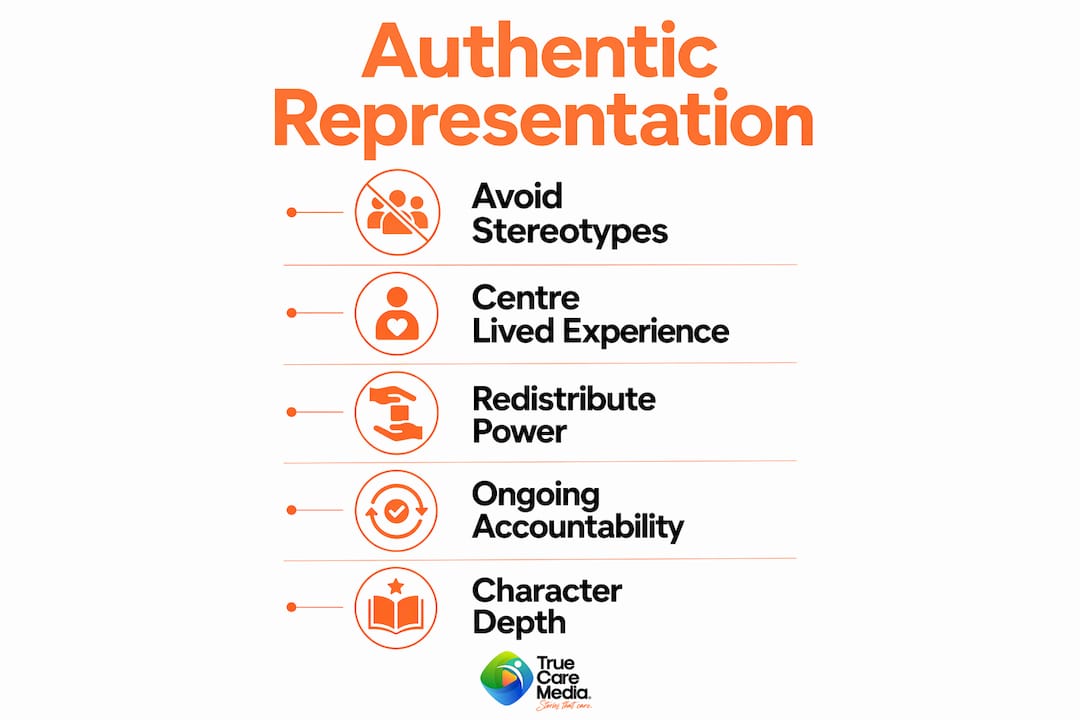
Three markers define authentic representation in practice. First, the portrayal avoids harmful stereotypes and one-dimensional characters. Second, the creative process includes people with direct lived experience. Third, there is ongoing accountability to the community being represented, not a single tick-box decision made at the start of a project.

How is authentic representation different from visibility or tokenism?
Visibility means a group appears in media or public life. Authentic representation means that appearance reflects their actual experience with depth and dignity. The difference is significant. A film can cast a disabled actor in a supporting role and still reduce that character to a single trait. That is visibility without authenticity.
Tokenism goes one step further in the wrong direction. It uses the presence of a marginalised person to signal diversity without giving that person narrative weight, agency, or complexity. Tokenism and performative diversity create the appearance of inclusion while leaving power structures unchanged. Audiences notice. Younger viewers in particular are skilled at detecting when a character exists to satisfy a quota rather than to tell a genuine story.
The table below shows how visibility, tokenism, and authentic representation differ across four key dimensions.
| Dimension | Visibility | Tokenism | Authentic representation |
|---|---|---|---|
| Character depth | Present but shallow | One-dimensional | Nuanced, flawed, growing |
| Creative control | Held by outsiders | Held by outsiders | Shared with or led by community |
| Narrative purpose | Background presence | Diversity signal | Central to the story |
| Community accountability | None | None | Ongoing and collaborative |
Authentic representation also requires redistribution of storytelling power behind the scenes. Writers’ rooms, production teams, and editorial boards need people with lived experience in decision-making roles, not just on screen. A story about First Nations communities written entirely by non-Indigenous writers, no matter how well-intentioned, carries a structural deficit that affects the final product.
Pro Tip: Before assessing any piece of media or content, ask one question: who held creative control? If the answer excludes the community being depicted, the representation is unlikely to be authentic regardless of how it looks on the surface.
Why does authentic representation matter in society and media?
Authentic representation shapes psychological well-being in ways that visibility alone cannot. Studies show that the freedom to imagine oneself positively through media is a key factor in social identity formation. When young people see characters who share their identity portrayed with complexity and dignity, it strengthens their sense of belonging and self-worth. The inverse is also true. Repeated exposure to stereotyped or distorted portrayals erodes self-image and reinforces social exclusion.
The importance of authentic representation is especially pronounced in mental health contexts. Inaccurate portrayals of mental illness in media contribute directly to stigma, which in turn discourages people from seeking help. When mental health conditions are depicted with nuance and humanity, public attitudes shift and help-seeking behaviour increases.
The market case is equally strong. Research from Scholars and Storytellers shows that adolescents rating authentic portrayals of diverse identities predict box office success better than general audience scores. That finding matters because it confirms lived experience as genuine expertise. A teenager who shares a depicted identity is a more reliable judge of authenticity than an outsider, regardless of age or credentials.
The broader cultural effects compound over time. Authentic representation in media:
- Reduces the social acceptability of stereotypes by replacing flat caricatures with complex human beings
- Builds empathy across cultural and social divides by showing shared humanity within different experiences
- Signals to marginalised communities that their stories have value in the public sphere
- Shifts cultural norms by normalising diversity as a fact of life rather than a special category
Meaningful representation nurtures positive relationships across diverse groups and supports genuine societal inclusion. That is not a soft benefit. It is a measurable shift in how communities relate to one another.
What challenges and ethical considerations affect authentic representation?
The biggest challenge in authentic representation is power. Most media and communications industries concentrate creative authority in the hands of people who do not belong to the communities they depict. That structural imbalance produces well-meaning but flawed portrayals, because the creators lack the lived knowledge to catch what they get wrong.
Critically examining an artist’s positionality is the first ethical requirement. Positionality refers to how a creator’s own identity, background, and biases shape what they see and how they tell a story. A photographer documenting a community they do not belong to must ask whether their gaze centres the community’s own understanding of itself or reflects an outsider’s interpretation. The risk of exoticism, where difference is aestheticised rather than humanised, is real and common.
Cultural appropriation is a related risk. It occurs when elements of a marginalised culture are used by outsiders without consent, context, or credit. Appropriation differs from cultural exchange in that it extracts without giving back and often profits from the very communities it excludes from the creative process.
The key ethical requirements for authentic representation are:
- Seek ongoing consent and collaboration with the communities being depicted, not just at the start of a project
- Audit the creative team for lived experience and address gaps before production begins
- Build in review processes where community members can flag inaccuracies or harmful elements
- Accept correction without defensiveness when community feedback identifies a problem
Pro Tip: Consent is not a one-time signature. Build regular check-ins with community representatives into your production timeline so that the final product reflects their ongoing input, not just their initial approval.
How can organisations and creators achieve authentic representation in practice?
Achieving authentic representation requires deliberate process, not good intentions alone. The following steps apply across media, healthcare communications, advocacy, and organisational storytelling.
-
Include people with lived experience in decision-making roles. Hire writers, directors, photographers, and consultants who belong to the communities being depicted. Their presence in the room changes what questions get asked and what details get noticed.
-
Build characters and subjects with complexity. Nuanced, flawed, and growing characters are the hallmark of authentic representation. Avoid reducing a person to their identity category. A character who is Deaf, for example, should have a full inner life, relationships, and contradictions that have nothing to do with their hearing status.
-
Ground the work in cultural specificity. Audiences detect nuances in language, cultural customs, and storytelling that signal respect or its absence. Generic diversity is not authentic diversity. Research the specific community, its history, its internal debates, and its preferred language before production begins.
-
Use participant-centred storytelling methods. In healthcare and advocacy contexts, participant-centred storytelling gives subjects meaningful control over how their stories are framed, what is included, and how the final content is used. This approach directly addresses the power imbalance at the heart of representation.
-
Evaluate authenticity with the right audience. Adolescents with lived experience as young as 13 provide more accurate authenticity assessments than outside critics. Apply this principle broadly: the people most qualified to judge whether a portrayal is authentic are those who share the depicted identity.
-
Commit to ongoing accountability. Authentic representation is not a single production decision. It requires sustained relationships with communities, willingness to revise, and transparency about the process.
In healthcare storytelling specifically, these principles translate directly into patient outcome storytelling practices that respect dignity, avoid distortion, and give patients genuine agency over their own narratives.
Key takeaways
Authentic representation requires creative control by those depicted, ongoing community accountability, and character complexity that goes well beyond surface-level visibility.
| Point | Details |
|---|---|
| Definition is clear | Authentic representation centres lived experience, avoids distortion, and gives communities creative control. |
| Visibility is not enough | Tokenism and surface inclusion leave power structures unchanged and audiences unconvinced. |
| Psychological and market impact | Authentic portrayals support identity formation and predict stronger audience engagement. |
| Ethics require ongoing consent | Collaboration with communities must be continuous, not a single sign-off at the start. |
| Practice demands process | Lived experience in decision-making roles, cultural specificity, and participant-centred methods are non-negotiable. |
Why authentic representation is harder than it looks
I have spent years working with healthcare and disability organisations that genuinely want to tell better stories. Most of them understand representation matters. Where they struggle is in the gap between intention and process.
The most common mistake I see is treating representation as a casting decision. An organisation photographs a person with a disability for their website and considers the job done. But if that person had no say in how the image was framed, what story it told, or how it would be used, the photograph is not authentic representation. It is extraction dressed up as inclusion.
What actually works is slowing down. The organisations that get this right spend time building relationships with the communities they want to depict before a camera is ever switched on. They ask questions, listen to the answers, and let those answers change the brief. That process feels inefficient to people focused on deadlines. In my experience, it is the only thing that produces content that communities recognise as true.
The other thing I have noticed is that authentic representation builds confidence in the people depicted, not just the organisations doing the depicting. When someone sees their story told with accuracy and dignity, it reinforces their sense that their experience has value. That is not a side effect. It is the point.
— Mishal
How Com supports authentic representation in healthcare storytelling
Com works with NDIS providers and allied health brands to create video, photography, and storytelling that centres the people they serve. The work is built on participant-centred methods that give subjects genuine agency over their own narratives, avoiding the distortion and tokenism that undermine trust.

If your organisation is ready to move beyond surface-level inclusion, Com’s approach to psychology practice storytelling and disability advocacy photography offers a practical path forward. Every project starts with the community, not the camera.
FAQ
What is the definition of authentic representation?
Authentic representation is the accurate, respectful portrayal of individuals or communities that centres their lived experience and gives them meaningful creative control over how their story is told.
How is authentic representation different from tokenism?
Tokenism places a marginalised person in a story to signal diversity without giving them narrative depth or agency. Authentic representation requires complexity, creative input from the community, and ongoing accountability.
Why is authentic representation important for young people?
Studies show that seeing oneself depicted with dignity and complexity in media supports positive social identity formation and psychological well-being, particularly during adolescence.
How do audiences recognise authentic representation?
Audiences detect authenticity through nuances in language, cultural customs, and character complexity. Younger viewers with lived experience are especially accurate judges of whether a portrayal is genuine or performative.
Can organisations achieve authentic representation without community involvement?
No. Authentic representation requires ongoing collaboration and consent with the communities being depicted. A single consultation at the start of a project is not sufficient to address the power imbalances involved.