
For private healthcare organisations in Australia, the fastest path to measurable patient trust and conversion is a specialist storytelling agency that combines clinical fluency, full-service production (video and photography), and documented compliance processes. Not a generalist creative shop. Not a PR firm. A partner that understands the difference between a patient testimonial for an aged care facility and a brand awareness video for an NDIS provider, and can produce both to a standard that survives clinical review.
When you hire the right partner, the first 30–60 days should deliver:
- A written strategy brief aligned to your patient acquisition or referral goals
- A sample script and storyboard for your first content piece
- A production plan with milestones, approval windows, and compliance checkpoints
True Care Media is the specialist that fits this brief for Australian private healthcare, serving NDIS providers, allied health clinics, aged care and home care providers, and private hospitals.
Table of Contents
- What outcomes are you actually buying when you hire storytelling services?
- What services must a private healthcare storytelling agency offer?
- What regulatory and compliance competence must agencies demonstrate?
- How do you evaluate and score agencies objectively?
- What do storytelling packages typically cost in Australia?
- What do real storytelling outcomes look like in private healthcare?
- What does the engagement process actually look like?
- What should you do this week to hire the right agency?
- Key takeaways
- Why storytelling for private healthcare demands a different kind of agency
- True Care Media: fixed-fee storytelling for Australian private healthcare
- Useful sources and further reading
What outcomes are you actually buying when you hire storytelling services?
The hiring brief is rarely about content formats. It is about outcomes. Before you shortlist any agency, map your internal goals to the measurable results a specialist can actually deliver.
Private healthcare marketing leads generally seek outcomes such as increased patient enquiries, improved patient trust, shorter decision times for prospective patients and their families, and clinician and staff education.
The link between format and outcome matters here. Patient testimonial videos build trust by showing real outcomes from real people. Explainer videos improve what Stori Health calls learning velocity: the measurable speed at which clinicians and patients move from complex data to understanding and action. Training videos reduce onboarding time. Photography lifts perceived credibility before a prospective patient ever picks up the phone.
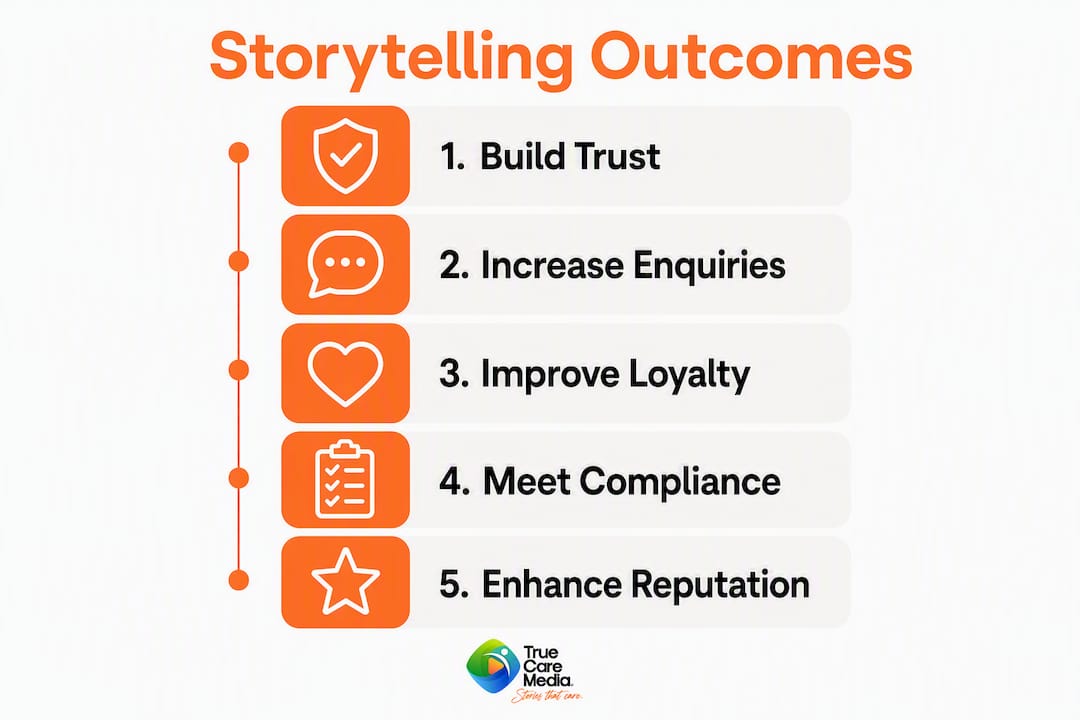
Build these metrics into your brief before you approach any agency. An agency that cannot link their deliverables to your key performance indicators may not be ready to work in regulated healthcare.
What services must a private healthcare storytelling agency offer?
A specialist agency working in private healthcare needs more than a camera and an editor. The full capability set covers production, editorial, clinical oversight, and distribution.
Core services to require:
- Strategic narrative development and brand positioning
- Patient testimonial video production
- Medical and clinical explainer videos
- Professional photography (facility, team, clinical environment)
- Social media reels and short-form content
- Training and onboarding video content
- Scriptwriting, storyboarding, and content planning
- Clinical storytelling for patient-facing and clinician-facing audiences
Stori Health and similar specialists package research, strategy, writing, and design together precisely because healthcare audiences, both clinical and patient, need content that reduces cognitive load rather than adding to it. Industry analysis from Clarity Quest confirms that leading agencies combine creative excellence with scientific and technical rigour to stay compliant and effective.
| Service | Primary outcome | Audience |
|---|---|---|
| Patient testimonial video | Trust, conversion | Prospective patients, families |
| Clinical explainer video | Learning velocity, education | Patients, clinicians, staff |
| Facility photography | Credibility, first impression | Prospective patients, referrers |
| Social reels | Awareness, engagement | Community, referral networks |
| Training video | Onboarding, compliance | Staff, NDIS support workers |
| Brand awareness video | Positioning, recall | Broad healthcare audience |
On team composition: expect a producer, scriptwriter, director, editor, and a dedicated compliance or clinical reviewer. Capability pages from multi-disciplinary agencies like Digitas Health illustrate the standard, listing creative, data and analytics, medical communications, and regulatory competence as distinct roles, not interchangeable ones.
What regulatory and compliance competence must agencies demonstrate?
In Australian private healthcare, compliance is not a checkbox. It is a production discipline. Any agency filming patient stories, NDIS participants, or aged care residents must demonstrate documented processes, not just awareness of the rules.
Compliance checklist for agency evaluation:
- Working knowledge of the Privacy Act 1988 and the Australian Privacy Principles as they apply to health information
- Documented consent processes for recording and publishing patient stories, including written consent forms and withdrawal procedures
- Clinical accuracy review at script and final-cut stages
- Processes equivalent to medical-legal-regulatory (MLR) approval for any content making clinical claims
- Experience with the NDIS Quality and Safeguards Commission’s participant safeguarding obligations
Evidence to request from any agency:
- Sample MLR-style approval log (redacted) showing clinical review at each production stage
- Redacted patient or participant consent forms used in past productions
- Documented credentials of their clinical reviewer (registered clinician, health writer, or equivalent)
- A written process for handling withdrawal of consent post-publication
Pro Tip: When filming vulnerable cohorts, including NDIS participants and aged care residents, require the agency to provide a pre-approved consent script that a support worker or family member can use to explain the process. This reduces risk and speeds up on-site production significantly.
Clarity Quest’s industry analysis frames it plainly: effective healthcare storytelling must balance empathy with clinical accuracy and governance. An agency that treats compliance as a post-production concern rather than a production discipline is a liability.
How do you evaluate and score agencies objectively?
Use a weighted scoring rubric. It removes subjectivity from the shortlisting process and gives you a defensible recommendation for internal stakeholders.
Evaluation criteria and suggested weighting:
- Healthcare sector experience (30%) — years working with private hospitals, NDIS providers, allied health, or aged care; portfolio depth
- Production quality (25%) — technical standard of video and photography; storytelling craft
- Compliance processes (20%) — documented consent, clinical review, and approval workflows
- Measurement and reporting (15%) — ability to report outcomes in business terms (engagement, conversion, NPS)
- Cost transparency (10%) — fixed-fee or clearly scoped packages, no hidden post-production charges
Interview questions to ask every agency:
- Show us a case study with before-and-after metrics from a private healthcare client.
- Walk us through your consent process for filming a patient or NDIS participant.
- Who is your clinical reviewer, and what are their credentials?
- How do you report on content performance after delivery?
- What does your approval process look like between draft and final cut?
Red flags to walk away from:
- No named clinical reviewer on the team
- Case studies with no measurable outcomes
- Reluctance to share consent forms or approval documentation
- Pricing described as “starting from” with no scope attached
- No experience with NDIS, aged care, or private hospital clients
Top agency guides consistently recommend integrating analytics and measurable KPIs into creative programmes. An agency that cannot report outcomes in business terms is not a strategic partner.
What do storytelling packages typically cost in Australia?
These are guidance bands, not quotes. Actual pricing depends on scope, location, talent, and post-production complexity.
| Package tier | Typical inclusions | Estimated investment | Typical turnaround |
|---|---|---|---|
| Entry-level | 1–2 testimonial videos, basic photography session | — | 3–5 weeks |
| Mid-tier | 3–5 videos (mix of testimonial and explainer), photography, social reels | — | 6–10 weeks |
| Full production campaign | Multi-format content suite, brand video, photography, training content, distribution plan | — | 12–20 weeks |
Typical project timeline from brief to delivery:
- Discovery and strategy: 1–2 weeks (stakeholder interviews, narrative brief, audience mapping)
- Scripting and storyboarding: 1–2 weeks (draft, clinical review, client approval)
- Production: 1–3 days on-site filming, 1 week photography
- Post-production: 2–4 weeks (edit, colour grade, sound, graphics)
- Approval and compliance review: 1–2 weeks
- Distribution and handover: 1 week
The MM+M Agency 100 illustrates the scale difference between large network agencies and specialist providers. For most Australian private healthcare organisations, a specialist with deep sector knowledge and a fixed-fee model will outperform a large generalist on both speed and clinical accuracy.
What do real storytelling outcomes look like in private healthcare?
True Care Media’s work across NDIS providers, allied health clinics, and aged care facilities demonstrates the kind of outcomes private healthcare marketing leads should expect from a production-led storytelling partner.
Case example: NDIS provider, Sydney
A registered NDIS provider needed to communicate its support model to prospective participants and their families. True Care Media produced a suite of participant testimonial videos and facility photography. The provider reported a measurable lift in enquiry-to-onboarding conversion and used the content across its website, social channels, and registration documentation.
Case example: Allied health clinic, metropolitan Australia
An allied health group required explainer video content to reduce the volume of pre-appointment phone calls from new patients. Short-form explainer videos covering the intake process and clinical team introductions reduced call volume and improved patient readiness scores at first appointment.
Case example: Aged care provider
A residential aged care facility needed photography and video content to support family decision-making. Storytelling that speaks directly to families shortens the consideration period and builds confidence before a site visit. The facility used the content in paid social campaigns and on its admissions page.
The pattern across all three: content built around real people, real environments, and real outcomes moves prospective patients and families faster than any brochure copy.
What does the engagement process actually look like?
Here is the standard workflow when you hire a specialist like True Care Media. Plan your internal resourcing around these stages.
- Discovery workshop (Week 1): Agency interviews key stakeholders, reviews existing brand assets, and maps content goals to audience segments. Client provides access to clinical leads and marketing materials.
- Strategy and narrative brief (Week 1–2): Agency delivers a written brief covering key messages, content formats, audience journey, and compliance requirements. Client approves before scripting begins.
- Scripting and storyboarding (Week 2–3): Scripts go through clinical review before client approval. Client nominates a single approver to avoid revision loops.
- Production (Week 3–5): On-site filming and photography. Client coordinates access, participant consent, and clinical staff availability.
- Post-production and compliance review (Week 5–8): Edit, graphics, sound. Clinical reviewer signs off on final cut before client approval.
- Distribution and handover (Week 8–9): Final files delivered in agreed formats. Agency provides a distribution brief and performance tracking setup.
Pro Tip: Nominate one internal point of contact with sign-off authority before production starts. Approval by committee adds weeks to every stage. A single approver with a 48-hour turnaround window keeps the project on schedule.
A clinic storytelling strategy guide covers the internal planning steps in more detail if you are preparing a brief for the first time.
What should you do this week to hire the right agency?
The recommendation is clear: shortlist specialist storytelling agencies with documented healthcare sector experience, production capability across video and photography, and compliance processes you can verify before signing.
Immediate next steps:
- Write a one-page internal brief covering your audience, content goals, three measurable KPIs, and a budget range
- Shortlist three agencies using the evaluation criteria above, scoring each on the five weighted dimensions
- Request a discovery workshop and a fixed-fee pilot (one testimonial video or one explainer) before committing to a full campaign
- Ask each agency for a redacted case study with metrics and a sample consent form before the first meeting
True Care Media offers fixed-fee pilot packages for NDIS providers, allied health clinics, aged care facilities, and private hospitals. A discovery workshop is the right first step.
Key takeaways
Specialist private healthcare storytelling agencies that combine clinical fluency, full-service production, and documented compliance processes deliver faster patient trust and measurable conversion than generalist creative agencies.
| Point | Details |
|---|---|
| Specialist over generalist | Agencies with documented healthcare sector experience outperform generalists on compliance and clinical accuracy. |
| Compliance is a production discipline | Require consent documentation, clinical review credentials, and MLR-style approval logs before signing. |
| Outcomes before formats | Map every deliverable to a measurable KPI (conversion rate, NPS, time-to-enquiry) before briefing any agency. |
| Pilot before full campaign | A fixed-fee pilot (one video or photography session) lets you verify quality and process before committing to scale. |
| True Care Media | Serves NDIS providers, allied health, aged care, and private hospitals with fixed-fee video, photography, and storytelling packages. |
Why storytelling for private healthcare demands a different kind of agency
Most marketing agencies understand storytelling in the abstract. Far fewer understand what it means to film an aged care resident with dignity, get clinical sign-off on a script about a complex NDIS support model, or produce a patient testimonial that a private hospital’s legal team will actually approve.
The agencies that get this right share a specific combination: they have worked inside the sector long enough to know the regulatory terrain, they have production capability that does not require outsourcing clinical review to the client, and they report outcomes in the terms that matter to a healthcare marketing lead, not just a creative director.
What most articles on this topic miss is the cost of getting it wrong. A testimonial video that breaches participant privacy, or an explainer that makes an unsubstantiated clinical claim, does not just create a compliance problem. It damages the trust the content was meant to build. The evaluation criteria in this article exist precisely because the downside risk in healthcare storytelling is higher than in almost any other sector.
Provider storytelling that builds loyalty is not a creative exercise. It is a clinical communication discipline that happens to require a camera.
True Care Media: fixed-fee storytelling for Australian private healthcare
True Care Media produces video, photography, and testimonial content specifically for NDIS providers, allied health clinics, aged care facilities, and private hospitals across Australia. The concrete difference from a generalist agency: every project includes clinical review, documented consent processes, and fixed-fee scoping so there are no post-production surprises.

Services include patient testimonial videos, NDIS explainer content, facility photography, social reels, and training video production. For aged care providers specifically, video content that supports family decision-making is one of the highest-converting formats in the sector.
To get started, request a discovery workshop and a fixed-fee pilot package. Visit truecaremedia.com.au to brief the team directly.
Useful sources and further reading
- Clarity Quest: Best Healthcare Marketing Agencies 2026 — industry analysis on agency capabilities, compliance, and measurement standards
- MM+M Agency 100 — industry ranking that sets context for scale and capability differences across agency tiers
- True Care Media: healthcare facility storytelling examples — case examples with outcomes from Australian healthcare facilities
- True Care Media: why healthcare brands need storytelling — foundational resource on storytelling, trust, and compliance in Australian private healthcare
- True Care Media: clinical storytelling in healthcare practice — explanation of clinical storytelling techniques and ethical obligations