
Commission participant-led, trauma-informed storytelling produced by a professional creative partner and governed by the Australian Privacy Principles (OAIC). That is the single most effective approach for Australian palliative care providers seeking to build genuine trust through video and photography. Three actions to take today:
- Brief a trusted vendor such as TrueCare Media who demonstrates healthcare experience, trauma-informed practice, and documented consent protocols.
- Set your trauma-informed consent protocol before any camera enters a clinical space, referencing Palliative Care Australia guidance and the OAIC’s Australian Privacy Principles.
- Schedule a short artist-facilitated pilot session — a single, flexible storytelling session to test your process before committing to a full production.
Before any shoot, confirm all three:
- Clinical lead sign-off on participant suitability and session format
- Legal and privacy check against the Australian Privacy Principles
- Written participant readiness confirmation, with consent reconfirmed on the day
Table of Contents
- What does compassionate storytelling mean in palliative care?
- Consent, privacy, and Australian legal requirements
- How to prepare participants and run trauma-informed interviews
- Production best practices for respectful video and photography
- Ethical distribution and measuring impact
- How to brief and choose a production partner
- Realistic timelines and budgets in Australia
- Australian case studies: what participant-led storytelling looks like
- Key takeaways
- Why the process matters more than the asset
- TrueCare Media: participant-led storytelling for palliative care providers
- Authoritative sources and further reading
What does compassionate storytelling mean in palliative care?
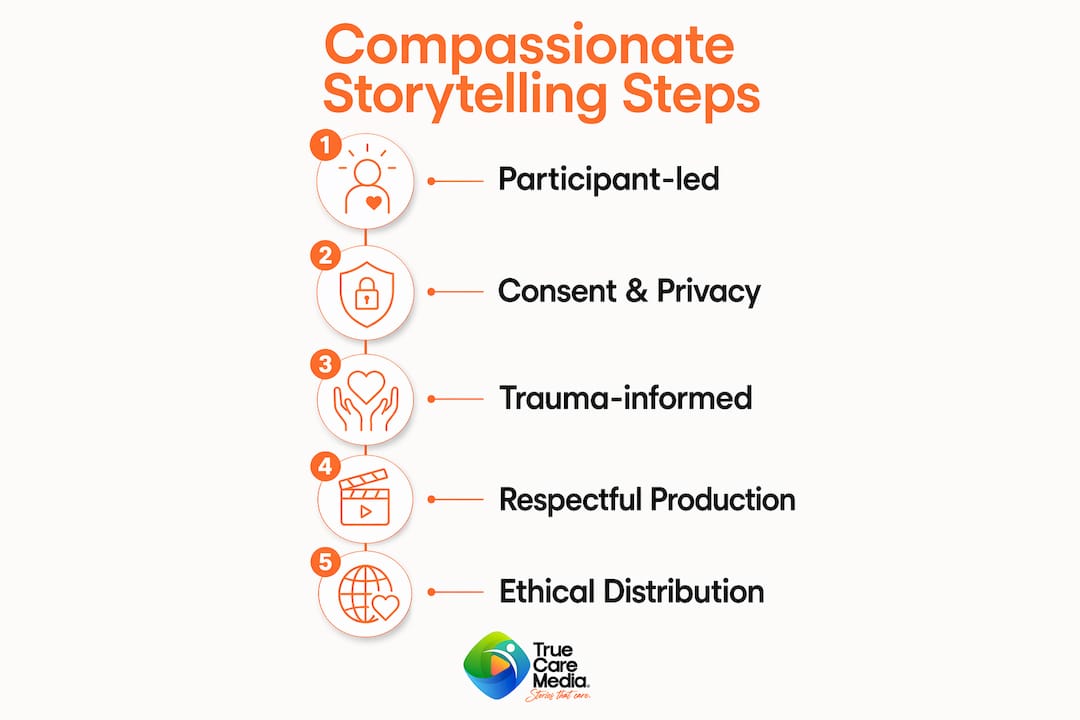
Compassionate storytelling in palliative care is participant-led, process-focused, and reflective rather than promotional. The participant controls what is shared, at what pace, and to what depth. The production team’s job is to create conditions for that to happen safely, not to extract a usable quote.
Narrative medicine, as a discipline, holds that telling a story gives authority to the speaker, while listening requires the willingness to genuinely acknowledge the other person. When that contract is honoured, the result builds trust. When it is engineered for a promotional outcome, it breaks it.
Six principles should govern every production decision:
- Participant agency — the person being filmed leads the session and can stop at any time.
- Trauma-informed practice — facilitators are trained to recognise distress and respond without pressure.
- Cultural safety — approaches are adapted for First Nations and culturally diverse participants.
- Ongoing consent — consent is confirmed before, during, and after the session.
- Purpose limitation — footage is used only for the purpose the participant agreed to.
- Minimal intrusion — crew size, gear, and retakes are kept to the minimum needed.
Research confirms that empathy communication — naming emotions, compassionate witnessing, and multimodal attentiveness — is trainable and measurable. Organisations that demonstrate these behaviours in their public storytelling stand apart from those making vague claims about “care.”
Consent, privacy, and Australian legal requirements
Australian law sets a clear floor. Under the OAIC’s Australian Privacy Principles, any organisation collecting sensitive health information must obtain informed consent, limit use to the stated purpose, store data securely, and allow participants to withdraw consent and request deletion.
Minimum consent form items for a palliative storytelling project:
- Purpose of the recording and how it will be used
- Who will have access (internal staff, public website, social media)
- Storage location, security measures, and retention period
- Process for withdrawing consent and consequences for already-published material
- Anonymisation options (voice alteration, blurred face, pseudonym)
- Third-party use restrictions (media partners, training platforms)
- Signature, date, and a copy provided to the participant
Pro Tip: When working with First Nations participants, consult the relevant community’s cultural authority before designing consent processes. Record cultural permissions separately from standard consent, and seek guidance from the local Aboriginal Community Controlled Health Organisation on appropriate protocols for image and story use.
Palliative Care Australia publishes clinical ethics guidance that complements the OAIC framework. Both should be referenced in your vendor brief and reviewed by your organisation’s legal team before any production begins.
How to prepare participants and run trauma-informed interviews
Artist-facilitated storytelling sessions in palliative units are acceptable, feasible, and emotionally resonant for patients, caregivers, and staff. The key is brief, flexible formats led by the participant, not a script.
A multi-step participant preparation plan:
- Pre-session check — a clinician or social worker confirms the participant is well enough and willing, with no pressure applied.
- Set expectations — explain the session length (typically up to 40 minutes), what will be recorded, and that stopping is always an option.
- Energy and time limits — schedule sessions at the participant’s preferred time; build in a rest break.
- Consent reconfirmation — verbal reconfirmation on the day, before the camera is switched on.
Open, non-leading interview prompts to use:
- “What story do you want to tell today?”
- “Tell me about a time you felt truly seen by the people caring for you.”
- “What would you want someone who hasn’t been through this to understand?”
- “Is there something you’ve been wanting to say that nobody has asked you yet?”
Red flags — pause or stop the session when you observe:
- Visible distress: tears that escalate, shaking, or requests to stop
- Cognitive overload: confusion, repetition, or difficulty tracking the conversation
- Physical fatigue: slumped posture, closed eyes, or slowed speech
- Withdrawal: monosyllabic answers or prolonged silence after an engaged start
When any of these appear, the facilitator stops recording, offers water and a moment of quiet, and checks in directly. If the participant does not wish to continue, the session ends. No footage from a distressed moment is used without explicit, subsequent consent.
Pro Tip: Avoid scripted testimonials entirely. A participant reading from a prepared statement produces content that feels promotional and strips away the authenticity that makes palliative storytelling meaningful for families and clinicians alike.
Production best practices for respectful video and photography
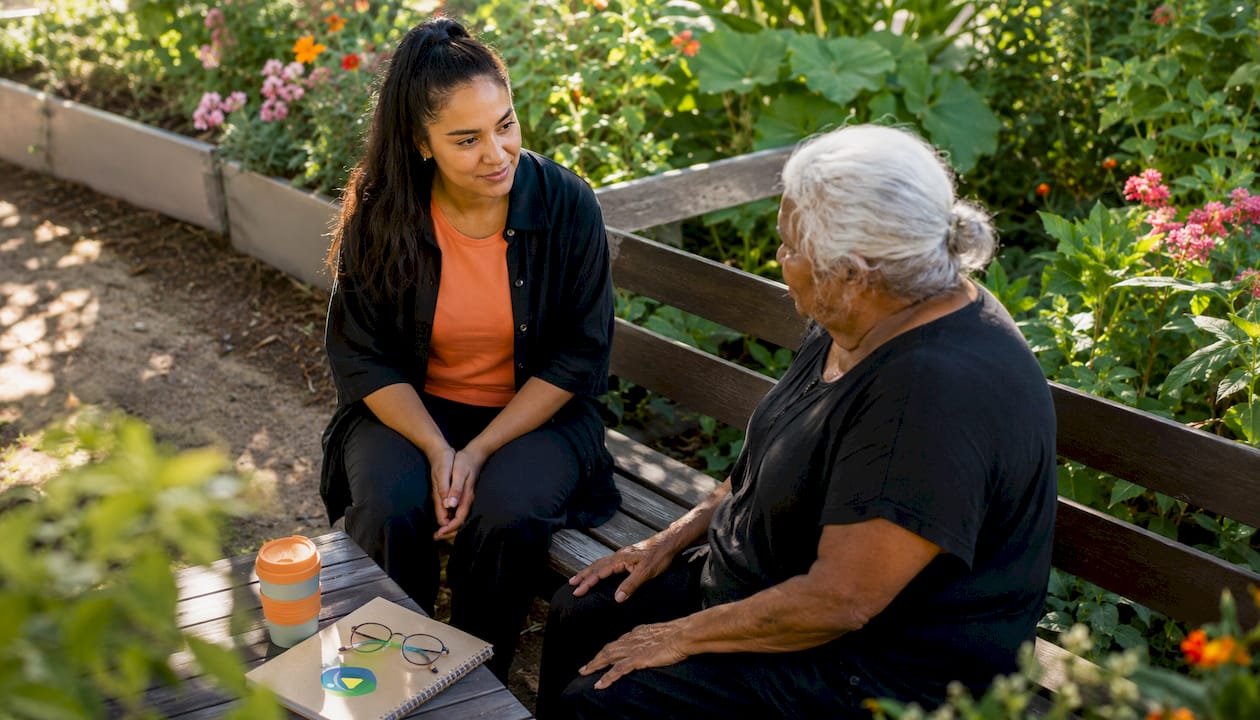
Low-intrusion setups produce better results in palliative settings than full production crews. A flexible, adaptable approach reduces participant fatigue and yields more authentic footage.
Production checklist:
- Crew: maximum two people on set (camera operator and facilitator); no unnecessary observers
- Camera: a single, unobtrusive camera positioned to feel conversational, not confrontational
- Audio: a small lapel microphone or directional mic; test levels before the participant enters the room
- Lighting: soft, natural-looking light that preserves skin tone and dignity; avoid harsh studio setups
- Setting: the participant’s preferred space — their room, a garden, a familiar chair
- Shot selection: mid-shots and close-ups of hands, faces, and meaningful objects; avoid clinical equipment unless the participant chooses to include it
- Anonymity options: confirm in advance whether blurring, voice alteration, or pseudonyms are needed
Accessibility is not optional. Every deliverable should include closed captions, a plain-language written summary, and a transcript. These serve families, staff training programmes, and participants who want to review their own story.
Pro Tip: Plan recording in short blocks with rest breaks between. Minimise retakes — a slightly imperfect take with genuine emotion is always more powerful than a polished re-read. For professional photography, apply the same principle: fewer setups, more presence.
Ethical distribution and measuring impact
Distribute only within the scope the participant consented to. That boundary is not a suggestion.
Appropriate use cases by consent scope:
- Internal staff training and onboarding
- Family decision-making videos for care planning conversations
- Website trust pages and “about our care” sections
- Short social media reels using excerpts the participant specifically approved for public use
- Clinician recruitment content where the participant consented to professional audiences
| KPI | What it measures |
|---|---|
| Video completion rate | Whether the content holds attention to the end |
| Website enquiry uplift | Whether storytelling content drives care enquiries |
| Training completion rate | Whether staff engage with narrative training materials |
| Qualitative trust signals | Family and participant feedback collected post-viewing |
| Referral source tracking | Whether storytelling content appears in referral pathways |
For consented reuse, document each new use case and obtain fresh consent if the purpose changes. Set a clear retention period (typically two to three years for marketing content) and a documented deletion process. Participants retain the right to revoke consent for future use at any time.
How to brief and choose a production partner
Prioritise partners who demonstrate documented experience with participant-led narrative methods, trauma-informed practice, and Australian privacy compliance. Experience in healthcare storytelling is not the same as experience in palliative care specifically — ask for both.
Vendor checklist:
- Evidence of palliative or aged-care storytelling projects (sample work, not just claims)
- References from clinical or healthcare communications leads
- Current police checks for all crew members entering clinical spaces
- Public liability and professional indemnity insurance
- Documented cultural safety training
- Written data security and storage policy aligned with the Australian Privacy Principles
Interview questions to ask shortlisted vendors:
- Walk me through your consent process from first contact to post-production.
- How do you support a participant who becomes distressed during a session?
- Where is footage stored, who has access, and how is it deleted at end of retention?
- What does your crew briefing cover before entering a palliative unit?
- Can you provide a sample consent form and a sample deliverables schedule?
Red flags in vendor proposals:
- Scripted testimonial formats with pre-written questions
- No mention of clinical supervision or distress protocols
- Vague data security statements (“stored securely in the cloud”)
- Crew sizes of four or more for a single participant session
- Deliverables focused on volume rather than participant experience
A sample brief should include: project objectives, target audience, ethics and privacy requirements, deliverables list, timeline with approval milestones, and budget parameters.
Pro Tip: Ask vendors whether they connect with local arts organisations to source storytelling facilitators. Artist-facilitated sessions00812-7/fulltext) reduce clinician burden and consistently produce more authentic outputs than clinician-led formats — a vendor who knows this is already thinking about your participants, not just your brief.
Realistic timelines and budgets in Australia
A well-run palliative storytelling project moves through six phases. Rushing approvals or consent is where projects fail.
Phase timeline:
- Scoping and vendor briefing: 1–2 weeks
- Approvals and consent preparation: 2–3 weeks (clinical ethics, legal review, consent form design)
- Participant preparation and pre-session check: 1 week
- Shoot day(s): 1–2 days per participant or cohort
- Editing, captions, and internal approvals: 2–4 weeks
- Distribution and training integration: ongoing
Budget bands (indicative, AUD):
- Small pilot (one session, one to two deliverables): $3,000–$6,000, covering facilitation, filming, editing, and captions
- Mid-sized campaign (three to five participants, website and social assets): $10,000–$20,000, adding travel, legal review, and accessible formats
- Multi-site programme (longitudinal, multiple facilities): $30,000+, covering repeat sessions, archival management, and training integration
The main cost drivers are creative facilitation, travel to regional or rural facilities, post-production editing, closed captions, and legal review of consent documentation. Smaller pilots are worth the investment: they surface consent and logistics issues before a full campaign budget is committed, and they produce one or two high-quality assets that can demonstrate value to clinical and executive stakeholders.
Australian case studies: what participant-led storytelling looks like
Pilot hospital palliative unit. A metropolitan hospital commissioned a single-session pilot with three participants over two days. The facilitator used the open prompt “What story do you want to tell?” — drawn from published research00812-7/fulltext) on artist-facilitated palliative storytelling — and kept sessions to 25 minutes with breaks. The resulting short video was used on the hospital’s family information page. Family feedback collected informally described the content as “the first thing that made us feel like the unit understood us.”
Aged-care facility legacy stories. A residential aged-care provider worked with a two-person crew to capture legacy stories from six residents over three visits. Residents chose their own settings — a garden, a dining room, a personal room with family photographs. The footage was edited into individual short films given to families as keepsakes, with consented excerpts used in staff onboarding. Training completion rates for the onboarding module that included the stories were higher than for the text-only version. For more on healthcare facility storytelling outcomes, TrueCare Media’s project examples illustrate the range of formats and settings.
Clinician storytelling for recruitment. A home care provider needed to attract palliative care nurses in a competitive market. Rather than a scripted “why I love my job” format, the production team facilitated open conversations with three clinicians about a moment that stayed with them. The resulting reels, used on LinkedIn and the careers page, generated a measurable increase in applications from candidates who cited the videos specifically.
Key takeaways
Participant-led, trauma-informed storytelling governed by the Australian Privacy Principles is the most effective and ethical approach for Australian palliative care providers commissioning video and photography content.
| Point | Details |
|---|---|
| Participant-led approach | Use open prompts and flexible formats; never script testimonials or prioritise production polish over participant comfort. |
| Trauma-informed consent | Obtain written, ongoing consent aligned with the OAIC’s Australian Privacy Principles before, during, and after every session. |
| Low-intrusion production | Keep crews small, use soft natural lighting, and plan short recording blocks with rest breaks. |
| Vendor checklist | Require documented healthcare experience, police checks, cultural safety training, and a written data security policy. |
| Measure ethically | Track completion rates, enquiry uplift, and qualitative trust signals — not reach alone. |
| TrueCare Media | Delivers participant-led, trauma-informed storytelling packages aligned with Australian privacy and clinical standards. |
Why the process matters more than the asset
The most common mistake organisations make is treating palliative storytelling as a content production problem. It is not. It is a relational and ethical process that occasionally produces content as a by-product.
When the process is right — when a participant feels genuinely heard, when the facilitator is trained to sit with silence rather than fill it, when the crew is small enough that the room still feels private — the resulting footage carries something that no amount of post-production can manufacture. Families watching it recognise it immediately. So do clinicians.
The organisations that get the most out of this work are the ones that plan for longitudinal storytelling: repeat, consented touchpoints over time rather than a single “hero” asset. Narrative approaches to serious illness work best when they are woven into ongoing care relationships, not extracted as a one-off production. That is a harder brief to write and a harder budget to approve. It is also the one that builds the kind of trust that actually changes how families choose care.
TrueCare Media: participant-led storytelling for palliative care providers
TrueCare Media delivers participant-led, trauma-informed video and photography services built specifically for Australian palliative care, aged-care, and allied health providers — with every project governed by the Australian Privacy Principles and designed around participant comfort, not production convenience.

Services include pilot storytelling sessions, consented video and photography packages, accessible deliverables (captions, transcripts, plain-language summaries), and narrative training for clinical staff. Every crew member holds a current police check, and cultural safety training is standard across all projects. Whether you need a single aged care video to build family trust or a multi-site longitudinal programme, TrueCare Media can scope and deliver it.
To discuss a pilot project or get a quote, contact TrueCare Media directly through truecaremedia.com.au.
Authoritative sources and further reading
- Palliative Care Australia — clinical ethics guidance, national standards, and resources for providers commissioning palliative care content. Start here for governance frameworks.
- OAIC: Australian Privacy Principles — the mandatory legal framework for collecting, storing, and using health information in Australia. Required reading before any consent form is drafted.
- Narrative Interventions in the Palliative Care Setting (JPSM)30314-8/fulltext) — scoping review mapping narrative approaches, interventions, and outcome measures in palliative and end-of-life care.
- Evaluation of a flexible artist-facilitated storytelling intervention (JPSM)00812-7/fulltext) — the primary evidence base for short, participant-led, artist-facilitated sessions in palliative units.
- Narrative approaches to serious illness care (mypcnow.org) — practical fast-fact guidance on integrating narrative histories into care planning, including EHR access considerations.
- Compassionate communication: a scoping review (Frontiers) — theoretical and empirical grounding for compassionate communication training and vendor assessment.
- Narrative medicine workshop in ambulatory palliative care (Cambridge Core) — feasibility study demonstrating participant satisfaction and qualitative benefit from structured narrative medicine groups.