
Most NDIS providers believe that publishing a polished brand video will trigger an immediate wave of referrals. It rarely works that way. Brand video’s referral role is mostly indirect in the NDIS context, increasing credibility and familiarity for participants, families, and professional referrers before that first conversation even happens. Think of it less like a sales funnel and more like a warm handshake at a distance. In this article, you will learn exactly how brand videos fit into the NDIS referral ecosystem, what the evidence says, and how to create video content that genuinely supports your growth.
Table of Contents
- Why referrals matter more in the NDIS sector
- How brand videos build credibility and support referrals
- Evidence: What the numbers say about video effectiveness
- Practical tips: Creating brand videos that work for NDIS referrals
- What most NDIS providers miss about referrals and video
- How True Care Media supports your NDIS growth
- Frequently asked questions
Key Takeaways
| Point | Details |
|---|---|
| Relationships drive referrals | Personal trust and reputation are the foundation for NDIS referrals—not just online assets. |
| Video amplifies, doesn’t replace | Brand videos help professionals and families recognise and remember your service, making referrals easier but not automatic. |
| Data supports video use | Videos are proven to boost engagement rates on landing pages and emails, helping your practice get noticed. |
| Privacy matters in video | NDIS providers can use animations or careful framing to maintain participant privacy while still building trust. |
| Best practice beats trends | Focus on honest, clear, and relational video content instead of chasing marketing fads for NDIS referrals. |
Why referrals matter more in the NDIS sector
Referrals are the lifeblood of almost every NDIS provider. Unlike general consumer markets where someone might Google a product and purchase within minutes, the NDIS space runs on trust, familiarity, and personal recommendation. A participant’s support coordinator, occupational therapist, or allied health professional holds enormous influence over which provider gets recommended. That person’s confidence in you is built slowly, through repeated exposure, consistent quality, and genuine relationship-building.
Here is why the referral ecosystem works the way it does in the NDIS sector:
- Trust is non-negotiable. Participants and their families are making decisions about highly personal support services. They rely on the judgement of professionals they already trust.
- Familiarity reduces risk. When a support coordinator recommends your service, they are putting their own credibility on the line. They will only refer to providers they recognise and feel comfortable advocating for.
- Networks are tight. The NDIS professional community in most regions is relatively small. Word travels quickly, both positively and negatively.
- Decision cycles are long. Participants may take weeks or months to engage a provider, meaning your brand needs to stay visible and credible throughout that journey.
“Relationship-building is the core referral engine and video mainly supports it — it’s not about marketing tricks, it’s about being known, trusted, and easy to understand.” — NDIS marketing for providers
This is exactly why digital assets like video, while genuinely powerful, are supportive rather than standalone. When a support coordinator watches your brand video and thinks “I understand what this provider does, and they seem trustworthy,” that video has done its job. It is laying groundwork, not closing deals. Understanding how video builds credibility for your brand in this context is the first step toward using it intelligently.
How brand videos build credibility and support referrals
With relationships at the centre of the NDIS, let’s look at how brand videos specifically add fuel to that trust-building process. The most effective brand videos do not feel like advertisements. They feel like introductions. They give referrers and participants a window into who you are, what you stand for, and how you actually deliver your services.

When a support coordinator can watch a three-minute video and immediately understand your intake process, your values, and the kinds of participants you specialise in supporting, that is enormously useful. It reduces the communication gap between you and the professionals who might refer to you. Rather than trying to explain your offer in a quick phone call or a PDF brochure, your video does that work in advance.
Consider these specific ways that role of video in establishing credibility plays out in practice:
- Putting faces to your organisation. When referrers see your team, your facilities, and your real-world work in action, your brand becomes human and memorable.
- Explaining complex services simply. Many NDIS services involve nuanced supports that are hard to describe in text. Video can demonstrate what you do in ways words cannot.
- Reducing referrer hesitation. A referrer who has seen your video already feels some familiarity. That lowers the perceived risk of recommending you to a family.
- Helping referrers advocate for you. When a coordinator is talking to a participant’s family, they can share your video as a reference point rather than trying to describe you from memory.
Research on video impact in healthcare referrals consistently highlights that video creates stronger recall and emotional connection than static content. That recall matters when a support coordinator is sitting with a family and trying to remember which provider specialised in the exact supports that participant needs.
Comparison: video-supported versus text-and-image-only approaches
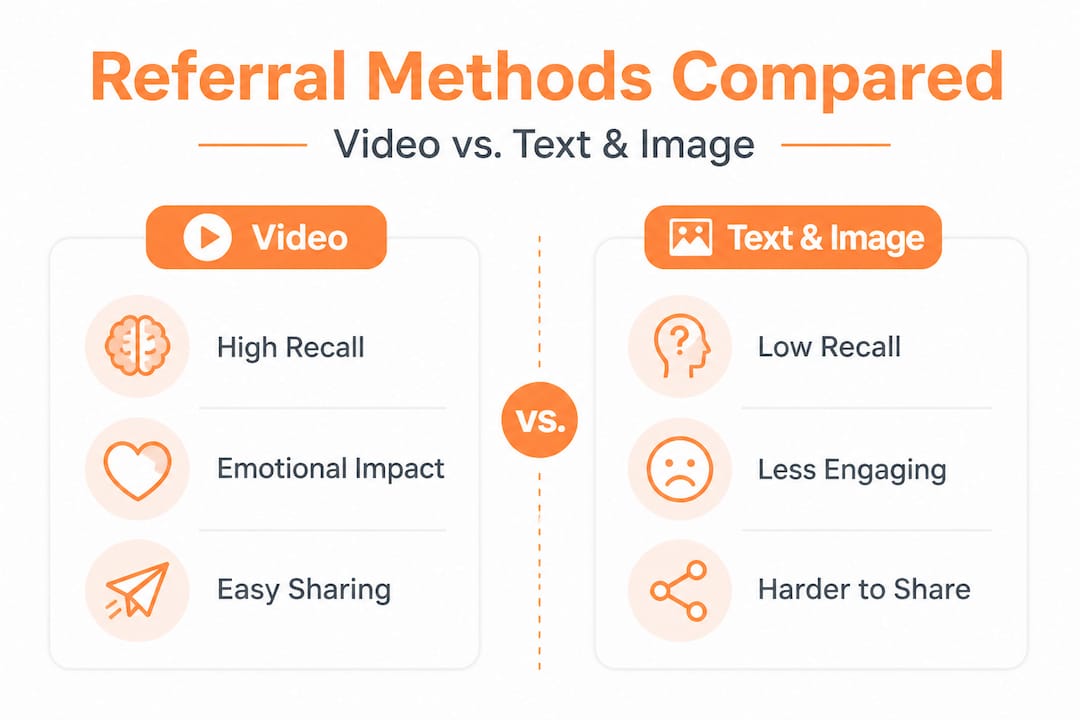
| Factor | Video-supported approach | Text and image only |
|---|---|---|
| Referrer recall | High, due to visual and audio combination | Moderate, easier to forget |
| Participant trust | Stronger, seeing real people helps | Lower, feels more anonymous |
| Service clarity | Complex services can be demonstrated | Often requires lengthy written explanation |
| Shareability | Easy to forward and reference later | Can feel less engaging to share |
| Emotional connection | Strong, authentic video resonates quickly | Harder to convey warmth and personality |
Pro Tip: When scripting your brand video, resist the urge to list every service you provide. Instead, focus on one or two core supports, show a real team member explaining them in plain language, and make sure your values come through clearly. Authenticity outperforms polish every single time in this sector.
Evidence: What the numbers say about video effectiveness
Now that we understand why and how videos work, here is what the data tells us about their actual impact. Marketing benchmarks consistently confirm that video outperforms nearly every other content format when it comes to engagement, conversion, and memorability.
Some key statistics worth knowing:
- Landing pages with video convert up to 86% better than those without.
- Email campaigns that include video see click-through rates rise by around 65%.
- Over 91% of businesses now use video as a core marketing tool, reflecting its proven return on investment.
These figures come from video marketing research for 2026 and represent averages across industries. Even applying a conservative discount for the NDIS sector, those numbers are significant.
Video versus other formats: engagement performance
| Content format | Average engagement rate | Referrer recall after 48 hours | Ease of sharing |
|---|---|---|---|
| Brand video | High | Strong (65%+ retention) | Very easy |
| Blog post or article | Moderate | Low (text skimmed) | Moderate |
| Static image or graphic | Low to moderate | Weak | Easy |
| PDF or brochure | Low | Very low | Low |
The reason better engagement translates into referral support is straightforward. When your message is clear, memorable, and easy to repeat, referrers can communicate it accurately to the families they support. A confused or forgotten message leads to no referral. A vivid, well-understood message leads to a confident recommendation.
Here are three key takeaways that NDIS providers can apply directly from the data:
-
Prioritise video on your website’s homepage or key service pages. This is where referrers and families are most likely to land first. A compelling video in this position dramatically lifts the chance they will stay, engage, and reach out.
-
Use video in your email communications. Whether you are sending newsletters to allied health networks or updating support coordinators on your services, adding even a short video thumbnail increases the likelihood they will click through and engage with your content.
-
Track your video engagement metrics. Views alone do not tell the full story. Watch time, replays, and shares give you a much better picture of whether your video is actually resonating with the professional referrers you want to reach.
Practical tips: Creating brand videos that work for NDIS referrals
With statistics in hand, let’s get practical. What should and should not you do when creating brand videos aimed at supporting NDIS referrals?
What to do
- Start with your audience, not your services. Open your video by acknowledging the participant or family’s situation before explaining what you offer. This immediately signals empathy and understanding.
- Keep videos concise. For referrer-focused content, two to four minutes is the sweet spot. For participants and families, shorter is often better.
- Use plain language throughout. Avoid acronyms and sector jargon unless they are immediately explained. Assume your viewer knows little about your specific niche.
- Include a clear call to action. This is not asking for a click, it is an invitation for a conversation. Something like “reach out and let’s talk about how we can help” is far more effective in this sector than a generic “book now” button.
- Feature real team members. A genuine, warm introduction from your lead clinician or coordinator carries far more weight than a scripted voiceover.
Privacy considerations and creative alternatives
Consent and privacy are genuine concerns in the NDIS sector. Not every participant can appear on camera, and not every story can be told directly. Importantly, sector-aligned video can still function as a referral tool via animated explainers or participant-led, privacy-preserving formats. Animated explainers, voice-only narratives, and staff-led walkthroughs can all communicate your services authentically without placing participants in a vulnerable position.
One thing to be cautious about: marketing myths in allied health often push providers toward chasing follower counts, trending formats, or viral content strategies. These approaches rarely serve NDIS providers well. The sector rewards consistent, authentic, relationship-oriented communication over trendy content.
Pro Tip: At the end of every brand video, include a warm and specific invitation for referrers to get in touch. Something like “if you have a client who might benefit from our supports, we would love to have a conversation” signals openness and professionalism. Views are nice, but conversations are what actually build your referral pipeline.
What most NDIS providers miss about referrals and video
Here is an honest observation from working closely with NDIS providers and allied health brands: many organisations invest in brand video with the expectation that the content itself will do the relationship-building. It will not. What video does exceptionally well is compress the time it takes for a potential referrer to feel familiar with you. It accelerates recognition. But recognition is not the same as trust, and trust is not the same as a referral.
The providers who see the best results from video are not the ones with the highest production budgets or the most sophisticated editing. They are the ones who treat video as one consistent thread woven through a broader tapestry of relationship-building. They attend network events and also have a great video to share afterward. They call their referral partners and also have a website video that reinforces the conversation. They show up in person and also have a social media clip that reminds people of who they are between meetings.
Brand video’s core function is to support referral ecosystems by helping referrers communicate your offer clearly to families and participants. That is a narrow but enormously valuable role. When providers understand this, they stop treating video as a magic solution and start treating it as a powerful amplifier of the reputation they are already building through genuine human connection.
We see this play out repeatedly. A provider launches a brand video, gets a spike in website traffic, then wonders why referrals have not jumped. The video did its job, creating familiarity and visibility. But the referral relationship still requires nurturing through follow-up, communication, and consistency. The providers who get this right are the ones who build more on NDIS video strategy into a broader plan, not as an isolated tactic but as a living, evolving part of their professional identity.
How True Care Media supports your NDIS growth
You have learned what works and why. Now here is how to put it into practice without having to figure it out alone. At True Care Media, we specialise in helping NDIS providers and allied health brands create video and photography content that genuinely supports referral relationships and builds lasting trust with participants, families, and professional networks.
We understand the privacy considerations, the communication nuances, and the trust dynamics that make the NDIS sector unique. Our work is built around authentic storytelling, real people, and clear messaging that referrers can easily understand and share. If you are ready to see what referral-focused video looks like in practice, explore our NDIS-focused video services or take a look at our examples of NDIS referral videos to get a feel for the kind of content that makes a genuine difference. We would love to have a conversation about where your brand is headed and how we can help you get there.
Frequently asked questions
Do brand videos directly increase NDIS referrals?
No, brand videos support but do not directly drive referrals. As noted in NDIS lead generation guidance, the role of video in this context is mostly indirect, building trust and familiarity that makes referrers more confident recommending you.
What kind of brand video works best for NDIS referrals?
Videos that explain services clearly, reflect real stories, and respect participant privacy work best. Where filming faces is not possible, animated or privacy-preserving formats are equally effective for NDIS referral purposes.
How much does video improve referral engagement stats?
Benchmarks show that video can lift landing page conversion by up to 86% and boost email click-through rates by around 65%, making it one of the strongest performing content formats available to providers.
Is it OK to use animation instead of real footage in NDIS videos?
Yes, animated explainers are fully effective and are often the preferred approach when consent or privacy is a concern. They communicate your services clearly while keeping participants and families safe and respected throughout the process.