
Healthcare video ROI is the financial return a video campaign generates relative to what it cost to produce and run, measured against appointments booked and operational savings, not views or likes. Typical campaigns return 3–8x, with strong performers hitting 9x or more, and video consistently outperforms other content formats on healthcare marketing returns. The first move for any marketing or admin team is simple: start tracking appointments booked and patient acquisition cost (PAC) per video, before you spend another dollar on production.
TL;DR:
- Tracking appointment bookings and patient acquisition cost is crucial before producing healthcare videos to ensure measurable ROI.
- Key KPIs include patient acquisition cost, directly attributable appointments, completion rate, and confidence in attribution, not just views or impressions.
- Accurate ROI calculation depends on consistent UTM tagging, call tracking, defined attribution windows, and comparing against control periods or groups.
- Typical healthcare video campaigns return 3 to 8 times the investment, with high performers reaching above 9 times, especially when high-quality creative and measurement discipline are combined.
- Running a pilot campaign with a narrow KPI set over 3 to 6 months helps validate ROI, while building a content library suits long-term operational and educational goals.
Table of Contents
- What KPIs actually prove healthcare video ROI
- Setting up measurement and attribution without guesswork
- What ROI ranges and payback windows are realistic
- How to calculate campaign ROI and PAC step by step
- Pitfalls that quietly wreck your ROI numbers
- How Com approaches ROI measurement for healthcare clients
- Pilot campaign or evergreen library: which one fits?
- Ready to measure video ROI properly? Start here
- Sources
What KPIs actually prove healthcare video ROI
Campaign ROI tells you the financial gain minus cost, divided by cost. It’s the headline number, but it means nothing without the KPIs feeding it. PAC (patient acquisition cost) informs the typical cost to acquire a new patient across a specific video campaign. Cost per scheduled appointment isolates the video’s role in booking appointments: it isolates the video’s role in getting someone onto the calendar, before they’ve become a confirmed patient. PLV, or patient lifetime value, is what turns a mediocre PAC into a good investment. If PAC is $353 and a patient’s lifetime value is $4,000, the maths works even if the first appointment barely breaks even.
Completion rate and click-through rate are leading indicators. They tell you early whether content is resonating, well before anyone books anything. Appointments and revenue are lagging indicators. They confirm the outcome, but they arrive weeks later.
For a first pilot, don’t try to track everything. A minimal, defensible KPI set looks like this:
- PAC for the specific campaign or video asset
- Appointments directly attributable to that video
- Completion rate as an early quality signal
- A stated match-back confidence level, so you’re honest about attribution gaps
That last point matters more than most teams realise. A number without a confidence range is a number nobody in finance should fully trust.
Setting up measurement and attribution without guesswork
Getting healthcare video effectiveness data that a CFO will actually believe means building the tracking architecture before the campaign launches, not after.
- Apply consistent UTM parameters and event naming across every video asset, then feed YouTube or Vimeo analytics into GA4 and your CRM so viewing behaviour connects to a patient record rather than sitting in an isolated dashboard.
- Use call tracking with a unique phone number per campaign, paired with an intake survey question (“How did you hear about us?”), then run match-back analysis against your scheduling system to close the gap between online engagement and phone bookings.
- Set a defined attribution window (commonly 30 to 90 days for elective care) and, where volume allows, compare against a control group or a prior period baseline instead of just crediting every booking that shows up after launch.
- Report attribution confidence alongside your ROI figure. Think Branded Media notes that confidence levels can range from 40% to 95% depending on how many systems are stitched together.
Owned channels like email and your own website give you the cleanest attribution because you control the tracking end to end. Email campaigns featuring video tend to show strong click-through lifts, and a well-tagged clinic landing page with embedded video will out-measure a social post every time, even when the social post gets more views.
What ROI ranges and payback windows are realistic
Most healthcare video campaigns return between 3x and 8x, with high performers pushing past 9x and occasionally into the 15x range when a clinic already has strong organic traffic and a tight referral funnel. Case-study data goes further: Chasing Illusions documents institutional examples with returns from 280% to 512%, though these are illustrative outcomes, not a guaranteed floor for every organisation.
Statistic callout: Video content delivers roughly a 49% ROI premium over other content types in health and wellness marketing, against an overall healthcare marketing ROI benchmark of about 5.44:1.
Payback windows vary significantly by service line, and that variance is where most budget arguments go wrong.
| Service line | Typical payback window | Why it differs |
|---|---|---|
| Urgent care | 6 to 9 months | High volume, short decision cycle |
| Primary care | 9 to 12 months | Moderate volume, longer patient relationship |
| Elective specialties | longer duration | Lower volume, higher PLV per patient |
Market density, seasonal demand, and plain production quality all shift these numbers. A rushed, poorly lit testimonial video will underperform a considered one even with identical targeting, which is exactly why creative quality and measurement discipline need to be planned together, not treated as separate budgets.
How to calculate campaign ROI and PAC step by step
The formula itself is short: ROI = (Gain − Cost) / Cost, and PAC = Total campaign cost / New patients acquired. The work is in getting honest inputs for both.
- Total your campaign cost: production, media spend, and any staff time spent on editing or approvals.
- Count new patients directly attributable through match-back, using your call tracking and intake data rather than raw click counts.
- Calculate PAC by dividing total cost by that attributed patient count.
- Multiply attributed patients by average revenue per patient (or PLV, if you’re modelling long term) to get your gain figure.
- Plug gain and cost into the ROI formula.
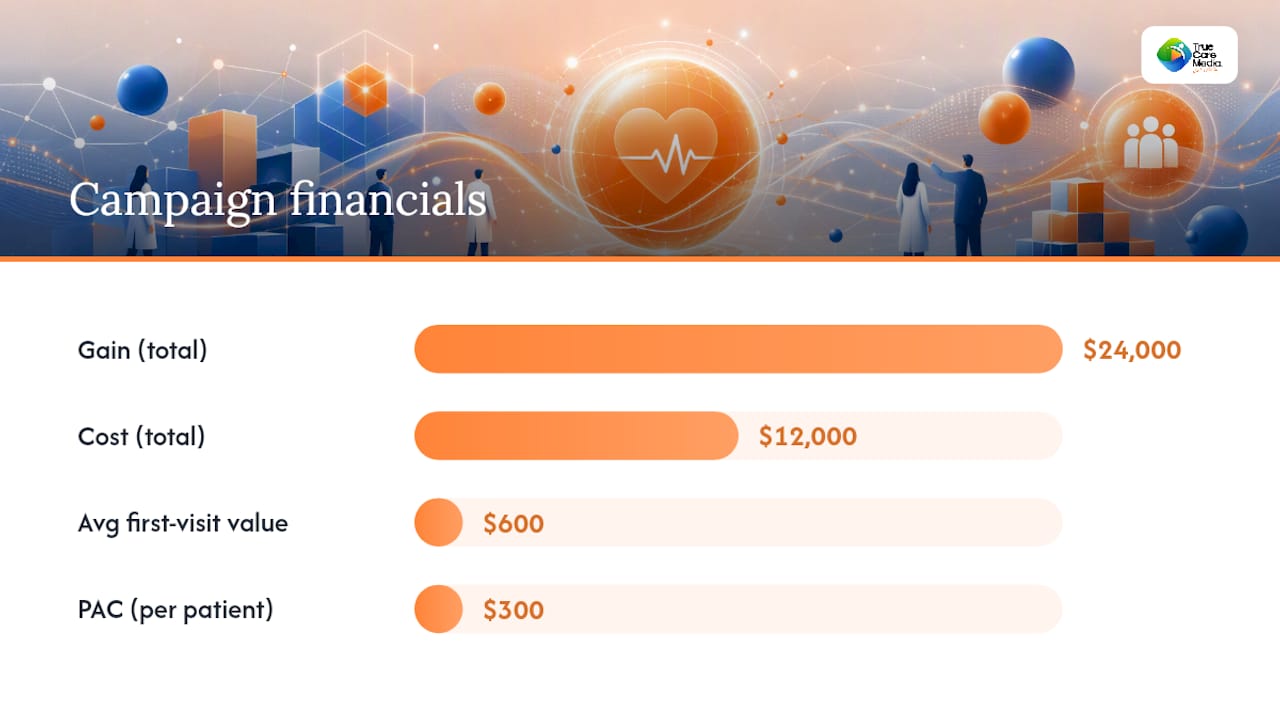
Worked example: A $12,000 explainer video campaign, run over three months, generates 40 match-back confirmed appointments at an average first-visit value of $600. Gain is $24,000, cost is $12,000, so ROI is (24,000 − 12,000) / 12,000 = 1.0, or 100% return, before lifetime value is even counted. PAC comes out at $300, sitting close to the $353 industry benchmark.
That’s double-counting, and it’s the fastest way to lose finance’s trust in your numbers.
Pro Tip: Run the ROI calculation twice, once with only confirmed match-back patients and once with a wider attribution window. Present both. It shows you’ve stress-tested your own number, which lands far better with a CFO than one confident figure with no range around it.
Pitfalls that quietly wreck your ROI numbers
View counts and impressions are not conversions. They’re the easiest metrics to report and the least connected to anything a finance team cares about. The real damage happens in the gap between an online view and an offline phone booking, which most tracking setups simply never close.
- Crediting every booking in a date range to a video, without match-back, inflates ROI and erodes credibility later.
- Treating watch time as a proxy for intent to book, when it’s really just a quality signal.
- Skipping documented patient consent before featuring real patients on camera, which creates legal exposure that no ROI figure offsets.
- Failing to loop clinical staff into script review, risking inaccurate claims that a regulator or a lawyer will flag long after the video is live.
Pro Tip: Build consent documentation and clinical sign off into your production timeline from day one, not as a final approval step. It’s cheaper to fix a script line than to pull a published video.
How Com approaches ROI measurement for healthcare clients
Com builds tracking into the production brief itself: campaign specific UTMs, call tracking numbers, and intake fields are agreed before a camera rolls, not bolted on afterwards. Every patient-facing video goes through documented consent and a clinical accuracy review, which keeps the measurement legally sound as well as commercially useful.
Author Mishal has worked across NDIS, allied health, and aged care video projects where the brief always includes a measurement plan alongside the creative one. The proof points that matter aren’t the polish of the final cut. They’re the appointment count, the PAC, and the confidence range sitting next to both.
Pilot campaign or evergreen library: which one fits?
Run a pilot when your budget is tight, your KPI set is narrow (PAC, appointments, completion rate), and you can commit to a genuine 3- to 6-month measurement window before judging results.
Build a library when you’re chasing sustained call centre reduction and ongoing patient education, because evergreen assets keep earning attention long after launch. Pilots get judged on hard ROI. Libraries get judged on ROI plus operational lift, measured over a year, not a quarter.
Quick check: tight budget and one clear conversion goal points to a pilot; ongoing education need and call volume pressure points to a library.
— Mishal
Ready to measure video ROI properly? Start here
Com is the alternative to producing content first and figuring out measurement later: every project pairs video and photography production with the tracking setup, unique call numbers, UTM structure, and consent documentation, built in from the brief stage, not added after launch. For NDIS providers, allied health clinics, and aged care organisations, that means the PAC and appointment numbers you report to your board are actually defensible.

If you’re weighing up whether video makes sense for your service line, start with the role of video in aged care marketing to see how measurement and production come together in practice, then get in touch for a scoped proposal covering both the content and the tracking plan behind it.