
You can film patient outcome stories for allied health, NDIS, and aged-care marketing. The hard limit is this: the moment that film becomes advertising for a regulated health service and includes a testimonial about a clinical aspect, section 133(1)© of the National Law prohibits it absolutely. Consent from the participant does not change that.
Before you brief a production company or republish anything already filmed, run these three steps:
- Audit your existing content. Flag every video where a participant or patient describes a symptom, diagnosis, treatment, or outcome linked to a regulated practitioner’s service.
- Hold republishing. Pause any planned boosting or reposting of flagged content until legal or clinical governance has reviewed it.
- Consult your clinical governance lead and legal counsel before proceeding with new filming if any story references a regulated health service.
“The prohibition applies regardless of whether the person consents to the testimonial being used and regardless of whether the testimonial is accurate.”
AHPRA, Testimonials in health advertising
Table of Contents
- What does Australian law actually prohibit in patient-story films?
- What story formats work without crossing the testimonial line?
- What must you complete before the shoot?
- How do you film for authenticity without clinical claims?
- How do you publish films without creating new compliance problems?
- Which KPIs actually tell you if the film is working?
- What does a compliant patient-story film actually look like?
- Commissioning brief, timeline, and budget for 2026
- Key takeaways
- The part most teams get wrong
- True Care Media: compliant allied health storytelling, start to finish
- Useful sources and resources
What does Australian law actually prohibit in patient-story films?
Section 133(1)© of the Health Practitioner Regulation National Law bans the use of testimonials to advertise a regulated health service. The ban covers written accounts, videos, and case-study films. It applies to every AHPRA-registered practitioner: physiotherapists, occupational therapists, psychologists, speech pathologists, and others.
A story becomes a prohibited testimonial the moment it references a clinical aspect. AHPRA’s advertising FAQ defines clinical aspects as symptoms, diagnosis, treatment, outcome, or practitioner skill. So a participant saying “I couldn’t walk to the letterbox before physio, now I can” is a testimonial. A parent saying “the speech therapist fixed my son’s stutter in six weeks” is a testimonial. Neither consent nor anonymisation removes the prohibition.
NDIS providers and aged-care organisations sit in a different position. Where the service is not delivered by an AHPRA-registered practitioner, the National Law prohibition does not apply directly. However, Australian Consumer Law sections 18 and 29 still prohibit misleading or deceptive conduct and false representations about service quality. State and territory codes of conduct for unregistered practitioners impose analogous restrictions across jurisdictions, so the practical risk is consistent nationally.
“Reposting or republishing a patient review on a clinic’s own channel can constitute advertising, making the clinic responsible for compliance even if the original post came from a third party.”
Guidelines for advertising a regulated health service, AHPRA
The core risk most comms teams miss is not participant consent. It is whether the content is being used as advertising for a regulated health service. Controlling the channel and republishing is what turns a social post into advertising.
What story formats work without crossing the testimonial line?
Authenticity and specificity still drive enquiries. NDIS provider campaigns consistently show stronger sharing and engagement when video demonstrates specific tasks participants achieve, rather than clinical outcomes. The formats below deliver that effect compliantly.
- Participant-led observational vignettes. Film a participant going about a real activity: cooking, catching a bus, attending a community group. No voiceover claiming clinical improvement. The visual evidence speaks without asserting it.
- Staff explainer and demonstration films. A practitioner explains how a service works and demonstrates a technique. No patient outcome claim; the practitioner’s expertise is shown, not endorsed by a patient.
- Process-focused films. Walk through what happens at an appointment: intake, assessment, goal-setting, session structure. Factual and educational, with no symptom-to-outcome arc.
- Family decision-making films. A family member explains why they chose the provider and what the process looked like, without describing clinical results. Choosing a provider is not a clinical outcome. See family decision-making video content for practical framing.
- Composite case studies. A practitioner narrates a fictionalised, composite scenario. No real patient. No real outcome claim. Clearly framed as illustrative.
- Explainer animations. Condition explainers, service walkthroughs, and NDIS plan guides carry zero testimonial risk and often outperform talking-head formats for complex topics.
Language to avoid in any format: “helped my condition,” “fixed,” “recovered,” “before and after,” “I used to struggle with X,” any reference to a diagnosis, and any framing that implies the practitioner’s skill caused a clinical result.

What must you complete before the shoot?
Clinical governance sign-off is not a box-tick. It is the document that protects your organisation if a complaint is made. Get it in writing before a camera is switched on.
“Who is responsible for compliance with the advertising requirements is not limited to the practitioner — any person who causes an advertisement to be published can be held responsible.”
Guidelines for advertising a regulated health service, AHPRA
Sign-off sequence:
- Clinical governance lead reviews the story brief and confirms no clinical claims are scripted or implied.
- Privacy officer confirms data storage, retention, and participant identification risks.
- Legal counsel reviews the distribution plan, particularly any paid advertising or landing pages.
Essential checklist items before filming:
- Written scope statement: what will and will not be said on camera, approved by clinical governance.
- B-roll permissions: written consent for filming in clinical spaces, including any incidental participants in the background.
- Release form: captures consent for likeness and distribution channels only. Do not include clinical outcome language in the release — it does not authorise a testimonial, and its presence creates confusion.
- Accessibility and safeguarding checks: confirm participant capacity to consent, involve a support person or guardian where appropriate, and document this.
- Data storage plan: where raw footage is stored, who has access, and when it is deleted.
Pro Tip: If a participant’s natural story starts moving toward clinical outcomes during the interview, stop and reframe the question rather than editing the answer out in post-production. AHPRA explicitly warns that selectively edited testimonials can still be misleading. Reframe on set; don’t rely on the edit suite.
How do you film for authenticity without clinical claims?
Interview prompts are where compliance is won or lost. The question “How has treatment helped your condition?” will almost always produce a testimonial. These alternatives produce equally compelling footage without the risk:
- “Show me how you use this skill in your day.”
- “What does a typical Tuesday look like for you now?”
- “What were you hoping to get out of coming here, and what does the process feel like?”
- “What would you want another family to know about choosing a provider like this one?”
B-roll strategy: Film participants doing, not describing. A person preparing a meal, navigating a workplace, or joining a group activity is visual proof of independence and capability. That footage carries emotional weight without a single spoken clinical claim.
Accessibility and inclusion on set:
- Caption all final films to WCAG 2.1 AA standard as a minimum.
- Offer Auslan interpretation for Deaf participants during the interview process.
- Use plain-language on-screen text for complex service information.
- Conduct a cultural safety check before filming First Nations participants or those from culturally and linguistically diverse backgrounds; involve a cultural liaison where appropriate.
- Obtain family or guardian consent in writing where the participant has a cognitive or communication impairment.
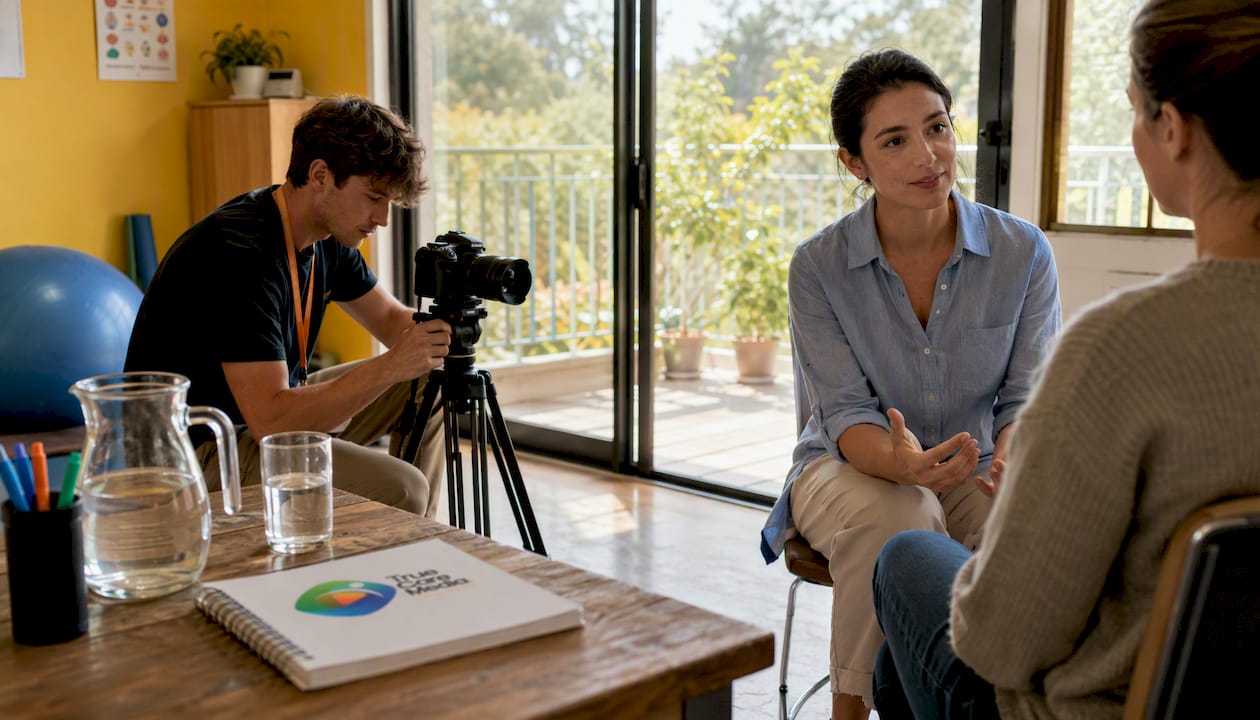
On-set compliance process: Assign one person as compliance note-taker. Their job is to flag any unintended clinical language during recording, so the director can reframe immediately. Review recordings before the crew leaves the location. Store all raw assets in a secure, access-controlled environment from day one.
How do you publish films without creating new compliance problems?
A compliant film can become a non-compliant advertisement the moment you add the wrong caption or boost it as a paid ad. Factual, educational content that explains how a service works is the safest framing across all channels.
Platform-specific considerations:
- Paid social and Google Ads: — Any boosted content is advertising. Apply the same testimonial prohibition test as you would to a print ad. If the film includes a participant describing their experience of a regulated service, do not boost it.
Copy and disclosure: Keep captions factual. “Meet Jordan, who attends our community programme on Thursdays” is factual. “Jordan’s life changed after working with our team” implies a clinical outcome. Disclose any paid partnership or sponsored content as required by ACL.
Social moderation: Set a written policy for user-generated clinical reviews posted to your channels. Disable testimonial functions where possible. When a user posts a clinical review on your page, do not engage with it in a way that amplifies it. Escalate to legal before responding to any review that references a diagnosis, treatment, or outcome.
Which KPIs actually tell you if the film is working?
- Watch-through rate at 25%, 50%, and 75% thresholds. A drop-off at 15 seconds tells you the opening is not earning attention.
- Inquiry uplift from the landing page hosting the film, measured against the pre-film baseline over a 30-day window.
- Appointment bookings attributed to video landing pages, tracked via UTM parameters on every link in the film’s distribution chain.
- Assisted conversions in your CRM: how many leads touched the video before converting, even if it was not the last click.
- Referral traffic from social platforms to the booking or contact page.
For a first campaign, expect three months before the data is meaningful. Evergreen films, particularly process and explainer formats, tend to build steadily over six to twelve months rather than spiking at launch.
Qualitative signals: Comments and direct messages often reveal whether the film is resonating with the right audience. Read them. But do not repost, amplify, or respond to any comment that describes a clinical outcome, even a positive one.
What does a compliant patient-story film actually look like?
Snapshot 1: NDIS participant vignette
Structure: Open on the participant at home, preparing for their day (B-roll, no voiceover). A support worker explains the goal of the session in plain language. The participant demonstrates the activity. A brief on-screen text card states the type of support provided, not an outcome claim. Closes with the provider’s contact details.
What was excluded: Any reference to a diagnosis, any before-and-after framing, any statement about improvement in a condition. The participant did not speak to camera about their experience of the service.
Lesson learned: Getting clinical sign-off on the on-screen text cards two weeks before the shoot prevented a last-minute reshoot. Build that review into the timeline.
Snapshot 2: Allied health clinic process film
Structure: A physiotherapist walks through a standard initial assessment: intake form, movement screen, goal-setting conversation. A patient (actor, clearly disclosed) demonstrates the process. No outcome is stated.
What was excluded: The original brief included a patient saying “I feel so much better.” That line was cut at clinical governance review and replaced with the practitioner explaining what the goal-setting process involves.
Editorial template for briefs:
- Opening: participant or staff member in context (B-roll)
- Middle: process demonstration or staff explanation
- Close: factual service information and contact details
- No symptom-to-outcome arc anywhere in the structure
Commissioning brief, timeline, and budget for 2026
Brief template
| Element | What to include |
|---|---|
| Objective | Awareness, inquiry generation, or referral partner education |
| Audience | Participants, families, referrers, or NDIS planners |
| Compliance constraints | AHPRA-regulated service: yes/no; ACL applies: always |
| Interview and B-roll list | Named participants, locations, activities to film |
| Accessibility requirements | Captioning, Auslan, plain-language text, cultural safety |
| Sign-off points | Clinical governance, privacy officer, legal |
Production timeline
| Phase | Duration |
|---|---|
| Discovery and brief finalisation | 1–2 weeks |
| Clinical and legal approvals | 1–2 weeks |
| Shoot day(s) | 1–2 days |
| Post-production (edit rounds) | 2–3 weeks |
| Clinical and legal review of cut | 1 week |
| Captioning and accessibility | 3–5 business days |
| Final delivery | 1 week |
Total: allow 8–12 weeks from brief to delivery for a single short film.
Budget bands (Australian, 2026)
- Half-day shoot, single location, one edit round: $3,500–$6,000
- Full-day shoot, two locations, two edit rounds, captioning: $7,000–$12,000
- Full package (film + vertical social edits + teaser + caption files + release documentation): $12,000–$20,000+
Prices vary by crew size, travel, post-production complexity, and accessibility requirements. Request itemised quotes.
Deliverables checklist
- Full-length film (2–4 minutes)
- Vertical social edits (15 and 30 seconds)
- Teaser clip (60 seconds)
- Caption files (.SRT or .VTT)
- Release documentation for legal file
- UTM-tagged distribution links
Key takeaways
AHPRA-compliant patient-story films require a compliance-first brief, clinical governance sign-off before filming, and distribution controls that prevent a compliant film from becoming a prohibited testimonial once published.
| Point | Details |
|---|---|
| AHPRA testimonial ban is absolute | Section 133(1)© prohibits clinical testimonials regardless of participant consent or anonymisation. |
| Non-regulated providers still face ACL risk | NDIS and aged-care organisations must meet Australian Consumer Law obligations even without AHPRA registration. |
| Compliant formats preserve authenticity | Observational vignettes, process films, and family decision-making films deliver specificity without clinical claims. |
| Sign-off before the shoot, not after | Clinical governance, privacy, and legal review must happen before filming, not in the edit suite. |
| True Care Media for compliant production | Com offers AHPRA-aware video production for allied health, NDIS, and aged-care organisations. |
The part most teams get wrong
Most compliance failures in allied health video do not happen because a comms team ignored the rules. They happen because the brief was written by marketing, approved by a manager, and never seen by clinical governance until the film was already cut.
The edit-suite fix is a myth. You cannot take a participant saying “my anxiety is so much better since I started seeing the psychologist” and trim it into something compliant. AHPRA is explicit that selectively edited testimonials can still mislead. The only reliable fix is a brief that never asks for clinical outcome language in the first place.
The other recurring problem is the distribution step. A film that passes clinical review gets handed to a social media coordinator who boosts it as a paid ad on a treatment page. That single action changes the compliance status of the entire piece. Distribution rules need to be written into the brief, not added as an afterthought.
For executive teams who push back on governance timelines: the cost of a reshoot or a regulatory complaint far exceeds the cost of two extra weeks in pre-production. Frame it that way.
True Care Media: compliant allied health storytelling, start to finish
True Care Media produces video and photography for NDIS providers, allied health clinics, aged-care organisations, and private hospitals across Australia. Every project includes compliance-aware scripting, clinical governance workflow support, accessibility deliverables, and distribution guidance built into the production process, not bolted on afterwards.

For organisations new to patient-story video, the NDIS participant video guide walks through the full commissioning process. Teams planning explainer or process films can start with the NDIS explainer video guide. To scope a project or request a commissioning checklist review, contact True Care Media directly through the website for a project estimate.
Useful sources and resources
- AHPRA: Testimonials in health advertising — primary source for the section 133(1)© prohibition; download first.
- CompliGUARD: Testimonials, endorsements and practitioner advertising in Australia — covers ACL obligations and state/territory code equivalents.
- True Care Media: Healthcare facility storytelling examples — practical 2026 case examples to adapt for briefs.
This article provides general information about Australian advertising law and is not legal advice. Confirm current requirements with AHPRA, your legal counsel, or a qualified compliance professional before publishing patient-story content.