
For NDIS support providers, allied health clinics, aged-care facilities and private hospitals, the best visual storytelling approach is to commission a specialist healthcare-focused video and photography partner that understands NDIS Quality and Safeguards Commission expectations, WCAG 2.1 accessibility requirements and Office of the Australian Information Commissioner privacy guidance. The measurable payoff is real: one provider that shifted from generic promotional content to participant-centred storytelling saw a 688% increase in phone calls and a 146% rise in form submissions, doubling its client base within six months. The immediate priority is to brief your provider to lead with participant dignity, documented consent and WCAG 2.1 accessibility from day one, not as an afterthought.
Table of Contents
- What do specialist visual storytelling services actually deliver?
- How do you choose the best visual storytelling provider?
- What compliance and consent obligations apply in Australian NDIS and healthcare settings?
- How does a specialist production project run from brief to delivery?
- What measurable outcomes can professional storytelling produce?
- Why Truecare Media is the recommended partner for NDIS and healthcare storytelling
- Key takeaways
- The ethics behind the lens
- Useful Australian references for compliance and accessibility
- Truecare Media: visual storytelling built for healthcare organisations
What do specialist visual storytelling services actually deliver?
A specialist healthcare production partner delivers far more than a polished video. The practical asset set for an NDIS provider or allied health clinic typically includes participant story films, practitioner profile videos, patient pathway explainers, facility and room photography, social media reels, training videos, and still portrait packs for staff. Showing real team members, care environments and plain-language explanations builds trust before a first appointment in ways that stock imagery simply cannot replicate.
When you request a quote, the deliverable list should specify:
- Master video files in broadcast-quality formats (typically H.264 or ProRes), plus web-optimised edits sized for your website, YouTube and social channels
- High-resolution still photography with full-resolution originals and web-compressed versions
- Captions and transcripts for every video, meeting WCAG 2.1 accessibility requirements including readable contrast and plain English
- Alt text guidance for still images used on your website or in digital communications
- Usage rights documentation covering platform-specific masters, territorial scope, duration of licence, and any stock footage restrictions
Articles that include images at regular intervals attract significantly more engagement online, so planning assets for multi-channel use from the outset is worth the extra brief time. A single well-crafted participant story deployed across Google Search, social and email can outperform a library of generic assets because specificity and authenticity drive shares and enquiries.
How do you choose the best visual storytelling provider?
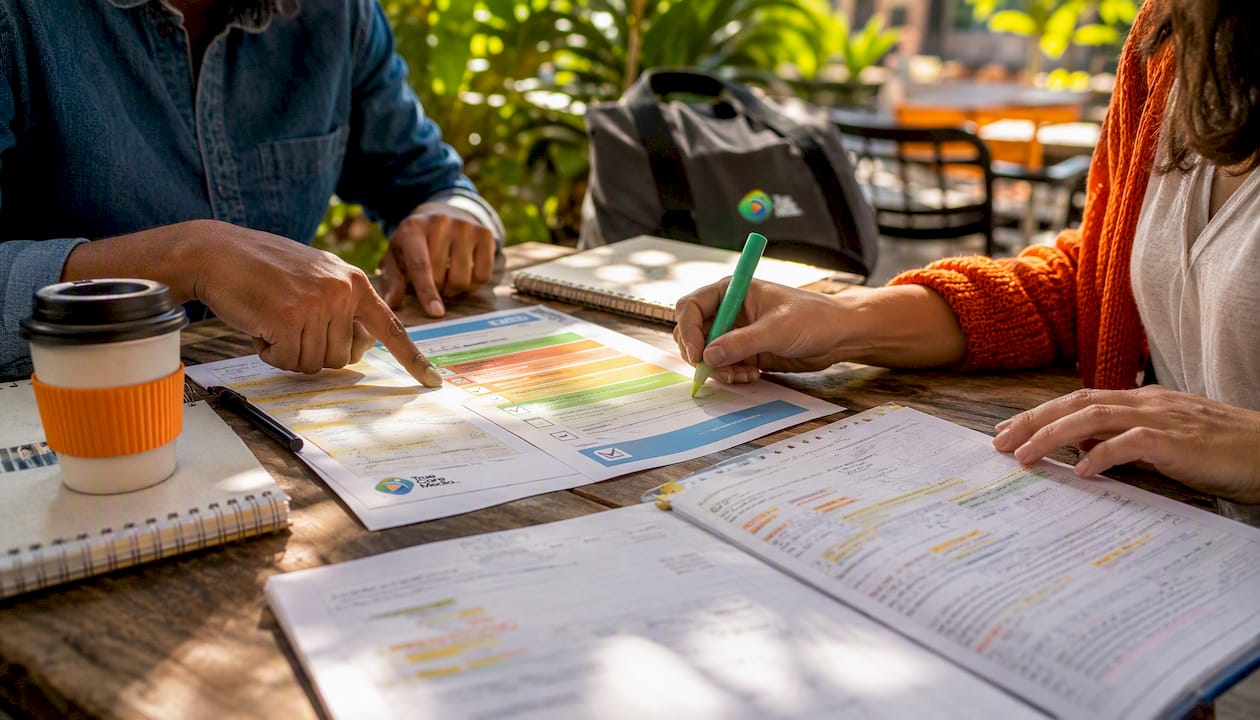
Evaluate on process, compliance evidence and measurable outcomes, not on showreel quality alone. A polished reel tells you the team can operate a camera. It tells you nothing about how they handle a participant who withdraws consent mid-shoot, or whether their captions meet WCAG 2.1.
A practical evaluation checklist
- Portfolio plus process: request at least two healthcare or NDIS-specific examples with documented consent workflows, not just finished films.
- Compliance evidence: ask for a sample consent form and confirm it covers informed consent language, specific use cases, withdrawal rights and secure storage of personal information.
- Accessibility deliverables: confirm captions, transcripts and alt text are included in the quoted scope, not billed as extras.
- Approval rounds: clarify how many rounds of edits and stakeholder approvals are included, and who owns clinical sign-off for any content touching therapeutic outcomes.
- Backup and contingency plans: ask what happens if a participant withdraws on shoot day or a location becomes unavailable.
Questions to ask in procurement interviews
- How do you handle consent withdrawal after filming is complete?
- Have you worked in regulated healthcare or NDIS settings before, and can you provide a reference contact?
- What is your process for avoiding misleading or “miracle” claims in participant stories?
- Are captions and transcripts included in your quote, or are they additional?
- What licences do we receive, and are there platform or duration restrictions?
Red flags to watch for
- Vague or verbal-only answers about consent processes
- No accessibility plan or captions treated as optional extras
- Quotes that omit pre-production, participant coaching, travel or post-production tasks
- Unclear or missing licence documentation
What drives the cost?
Cheaper quotes commonly exclude pre-production, interview coaching, travel, captioning or full licence coverage, so comparing headline prices without a scope-to-cost breakout is unreliable.
| Cost driver | What to confirm in the quote |
|---|---|
| Locations | Number of sites, travel, and access logistics |
| Crew size | Director, camera operator, sound, lighting |
| Interviews | Number of participants or staff, coaching time |
| Edit versions | Number of cuts, lengths, platform formats |
| Captions and transcripts | Included or billed separately |
| Usage licence | Duration, platforms, territorial scope |
Pro Tip: Request a sample deliverable with captions and transcripts during procurement. Reviewing actual accessibility outputs before signing tells you far more about a provider’s standards than any showreel.
What compliance and consent obligations apply in Australian NDIS and healthcare settings?
Compliance is not a box to tick at the end of production. It shapes every stage of the project, from how participants are approached to how footage is stored after delivery.
The core compliance areas to address in your brief:
- NDIS Quality and Safeguards Commission: content must reflect participant rights and avoid misleading claims about outcomes. Focus on verifiable, autonomy-centred results.
- OAIC privacy obligations: written consent must specify the exact use cases (website, social media, print, internal training), the duration of use, and the process for withdrawal.
- WHS obligations: on-site filming in clinical or supported-living environments requires a site-specific risk assessment, infection-control awareness and coordination with facility management.
- WCAG 2.1 accessibility: captions, transcripts, readable typography and sufficient colour contrast are required for digital content reaching NDIS and healthcare audiences.
Documented participant consent workflows and clinical sign-off are non-negotiable where content touches clinical or therapeutic outcomes. Retain signed consent forms and approval records for the life of the content.
How does a specialist production project run from brief to delivery?
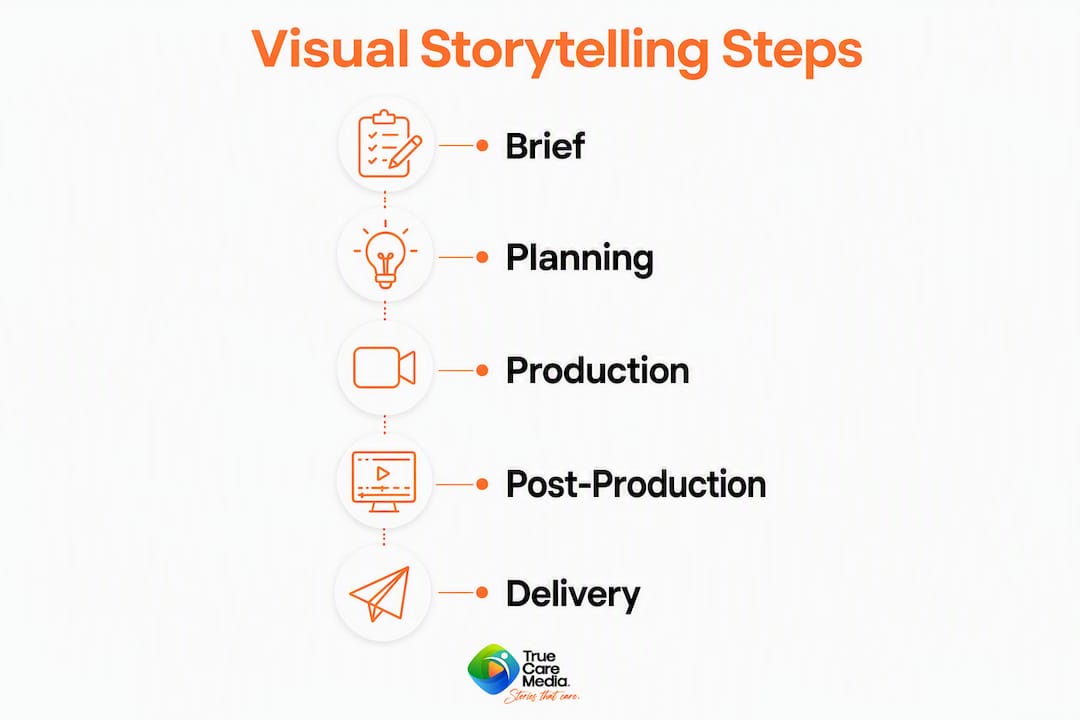
A well-managed project follows five clear stages. Knowing who owns each milestone prevents the delays that most commonly derail healthcare productions.
| Stage | Key activities | Typical duration | Approval owner |
|---|---|---|---|
| Briefing and scoping | Goals, audience, deliverables, budget | 1–2 weeks | Marketing lead |
| Pre-production | Script, consent forms, logistics, participant coaching | 2–3 weeks | Privacy/clinical lead |
| Production | Shoot days, B-roll, stills | 1–3 days per location | On-site coordinator |
| Post-production | Edit, captions, transcripts, accessibility checks | 2–4 weeks | Marketing and clinical leads |
| Delivery and handover | Master files, usage guide, archive | 1 week | Marketing lead |
Milestone checklist for healthcare shoots
- Participant coaching session completed before shoot day
- Signed consent forms reviewed and filed
- Clinical or privacy sign-off obtained for any therapeutic claims
- Site risk assessment completed (WHS)
- B-roll and facility photography captured
- Captions and transcripts completed and reviewed
- Final stakeholder approval documented before distribution
Pro Tip: Schedule shoots outside peak clinical hours and confirm infection-control requirements with facility management at least two weeks in advance. A 30-minute briefing with on-site staff the morning of the shoot prevents most disruptions.
What measurable outcomes can professional storytelling produce?
The strongest evidence for investing in specialist production comes from specificity. Generic “we care” content rarely moves enquiry metrics. Stories built around real, named outcomes do.
In a second pattern seen across allied health and aged-care settings, facility overview films and practitioner profile videos reduce no-shows and increase referral confidence. When referring GPs or allied health professionals can see a clinician’s face, communication style and care environment before making a referral, conversion rates from referral to booked appointment improve measurably. The mechanism is straightforward: visual content that shows real team members and care environments reduces the uncertainty that causes prospective clients to delay or disengage.
When requesting evidence from a prospective supplier, ask for anonymised before-and-after metrics, reference contacts from comparable organisations, and sample deliverables that include captions and transcripts. A provider that cannot supply any of these three things has not been measuring its own impact.
Why Truecare Media is the recommended partner for NDIS and healthcare storytelling
Truecare Media specialises in video production, professional photography, testimonial films, brand awareness videos, training videos, social media reels and content planning for NDIS providers, allied health clinics, aged-care and home-care providers, and private hospitals across Australia. Every project is structured around compliance-first production: documented consent workflows, WCAG 2.1 accessibility deliverables (captions, transcripts, alt text guidance), and content that reflects participant dignity and autonomy rather than promotional hyperbole.
For procurement teams, the engagement path is straightforward. Prepare a brief that covers your target audience, the specific outcomes you want to communicate, the platforms where content will be published, and any clinical or privacy sign-off requirements. From there, Truecare Media scopes the project, provides a transparent cost breakout across all production stages, and confirms the deliverable list before a single shoot day is booked. Medical photography that builds confidence and NDIS video content ideas are good starting points if you are still defining your brief.
Key takeaways
Commissioning a specialist healthcare-focused visual storytelling provider, with documented consent processes and WCAG 2.1 deliverables built into the scope, is the single most reliable route to measurable enquiry uplift for NDIS and allied health organisations.
| Point | Details |
|---|---|
| Commission a specialist | Choose a provider with documented NDIS and healthcare experience, not a generalist agency. |
| Insist on consent and accessibility | Require written consent workflows, captions, transcripts and alt text in every quoted scope. |
| Compare process, not price | Cheaper quotes often exclude pre-production, coaching, travel and captioning. |
| Request impact metrics | Ask for anonymised before-and-after data; a 688% increase in phone-call volumes and a 146% rise in form submissions have been achieved through participant-centred storytelling, demonstrating the power of specificity. |
| Truecare Media | Truecare Media delivers compliance-first video, photography and content planning for NDIS, aged-care and allied health organisations across Australia. |
The ethics behind the lens
Most conversations about visual storytelling in healthcare focus on production quality. The harder question is whether the story is actually the participant’s to tell, or whether it has been shaped to serve the organisation’s marketing goals.
Dignity-led storytelling starts before the camera is switched on. It means giving participants enough time and information to make a genuine choice about involvement, building in a clear and easy withdrawal process, and reviewing the final edit with the participant before it goes anywhere near a website or social feed. Consent is not a signature on a form. It is an ongoing conversation.
Accessibility follows the same logic. Captions and transcripts are not compliance checkboxes; they are the difference between a story that reaches the full NDIS and healthcare community and one that excludes people with hearing impairments, cognitive disabilities or low digital literacy. After delivery, Truecare Media provides clients with a practical handover guide covering how to publish assets correctly, maintain captions across platforms, and update content when circumstances change. The goal is for your team to use what has been produced with confidence, not to create a dependency on ongoing production work.
Useful Australian references for compliance and accessibility
- NDIS Quality and Safeguards Commission — use for guidance on participant rights, provider obligations and what constitutes misleading conduct in NDIS communications.
- Office of the Australian Information Commissioner (OAIC) — use for privacy obligations covering the collection, use, storage and disclosure of personal information including images and audio.
- Web Content Accessibility Guidelines (WCAG) 2.1 — use for technical accessibility requirements covering captions, transcripts, colour contrast and screen-reader compatibility for digital video and photography.
- Safe Work Australia — use for WHS obligations relevant to on-site filming in clinical, residential care and supported-living environments.
Truecare Media: visual storytelling built for healthcare organisations
The most common mistake healthcare organisations make when commissioning content is treating video and photography as a production problem rather than a compliance and communications challenge. Truecare Media is built specifically for this sector: every project includes documented consent workflows, WCAG 2.1 deliverables and content reviewed against NDIS Quality and Safeguards Commission expectations before a single asset goes live.

Whether you are an NDIS provider building your first participant story film, an aged-care facility updating your video marketing assets, or a private hospital commissioning practitioner profiles and facility photography, Truecare Media scopes each project transparently with a full cost breakout across pre-production, shoot days, post-production and accessibility deliverables. Prepare a brief outlining your audience, key messages and publishing platforms, then contact Truecare Media directly to request a scoped quote.