
Yes. If you advertise a regulated health service in Australia, you’re bound by the Health Practitioner Regulation National Law and the advertising guidelines that AHPRA and the National Boards publish under it. Section 133 of the National Law sets the core prohibitions: no false or misleading claims, no testimonials, no inducements, no creating unreasonable expectations, and no encouraging unnecessary use of a service. Breach it and you risk audits, conditions on your registration, fines, or prosecution.
TL;DR:
- Advertising any regulated health service in Australia requires strict compliance with the National Law and AHPRA guidelines, with penalties including fines or registration conditions for breaches.
- All marketing content, including social media posts, reviews, and external agency work, carry shared liability, and any misleading claims or testimonials are strictly prohibited.
- Visual content such as before-and-after photos or patient stories are highly risky and should be carefully managed with disclaimers or avoided altogether to prevent unintentional guarantee claims.
- Claims about treatment outcomes must be backed by solid, peer-reviewed evidence; vague or unverified statements can lead to enforcement action.
- Regular audits, clear documentation of all content changes, and strict review of outside marketing contracts are crucial to maintaining compliance and avoiding escalation.
Table of Contents
- What the AHPRA advertising guidelines actually cover, and who has to follow them
- What counts as advertising (it’s broader than you think)
- The absolute no-go list under Section 133
- What actually counts as acceptable evidence
- Pricing, discounts and disclosure
- Images, before-and-afters and social media risk
- How AHPRA enforces the rules and what penalties look like
- A step-by-step checklist to audit and fix your advertising
- Where to check the official rules yourself
- Commissioning photos and video that actually stay compliant
- How Com builds AHPRA-safe photo and video content for clinics
- Sources
What the AHPRA advertising guidelines actually cover, and who has to follow them
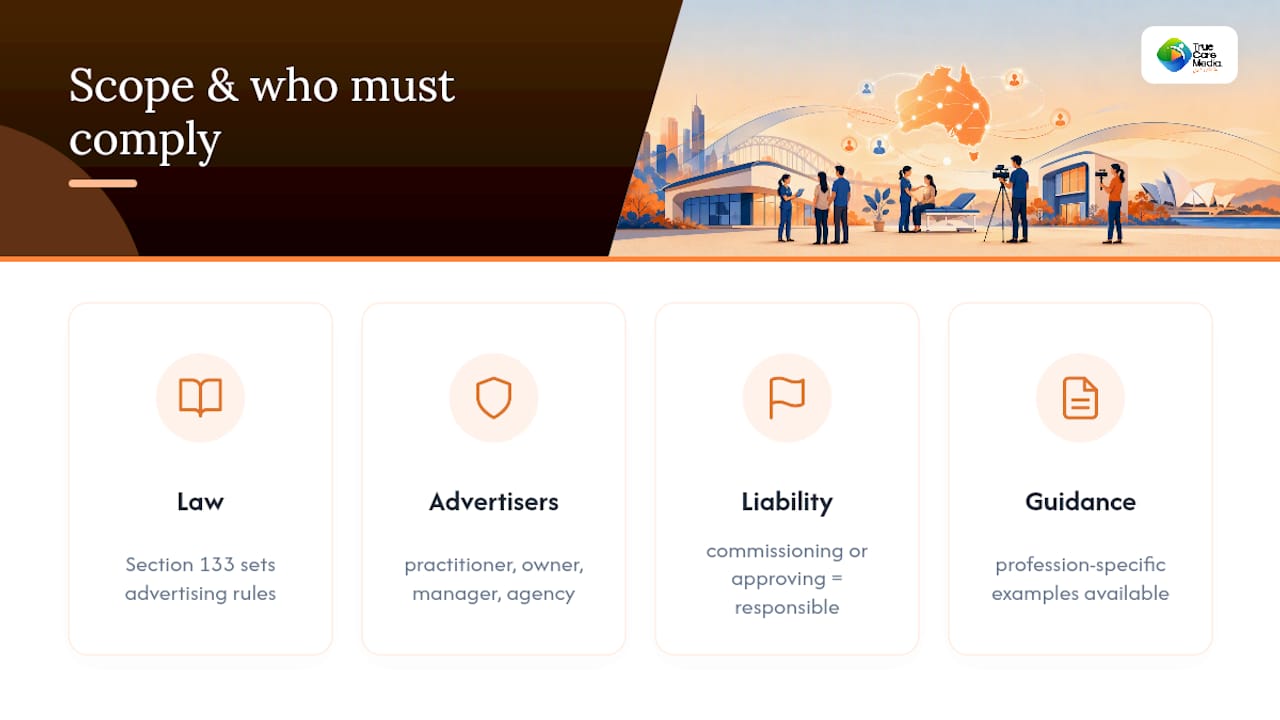
The Health Practitioner Regulation National Law is the legal foundation here, not a set of voluntary best practices. It’s the statute that created AHPRA and the 15 National Boards, and Section 133 of that law is where the advertising restrictions live. AHPRA and the National Boards have translated that legal text into practical guidance through the Guidelines for advertising a regulated health service, which spell out what’s expected of anyone marketing a health service and stress that advertising must be accurate, clear, and never create unreasonable expectations of benefit.
Who counts as “an advertiser” trips a lot of people up. It’s not just the registered practitioner whose name is on the door. It’s the clinic owner, the practice manager who runs the Instagram account, and the external marketing agency you’ve hired to write your website copy. AHPRA treats them all as equally responsible. If a third party creates content on your behalf and it breaches the National Law, you don’t get to point at the agency and walk away. That responsibility sits with you because you commissioned or approved the material, and ignorance of what the freelancer posted is not a defence.
This shared liability matters more than most practice owners realise. A chiropractor who outsources social media to a marketing contractor is still on the hook if that contractor writes a caption implying a treatment cures chronic pain. An osteopathy clinic that reposts a glowing Google review onto its own website has just published a testimonial, regardless of who wrote the original review. A Chinese medicine practitioner who lets a receptionist manage the clinic’s Facebook page carries the same exposure as if they’d typed the post themselves.
AHPRA publishes profession-specific guidance and worked examples covering fields including chiropractic, osteopathy and Chinese medicine, because the risks and common mistakes differ slightly across professions. If you’re unsure whether a specific claim or format is compliant, checking the profession-specific material first is usually faster than guessing.
What counts as advertising (it’s broader than you think)
The definition of “advertising” under the National Law is deliberately wide. It covers your website, your social media posts (organic and paid), brochures, signage, and any public statement designed to attract patients. It also captures things practitioners rarely think of as marketing at all.
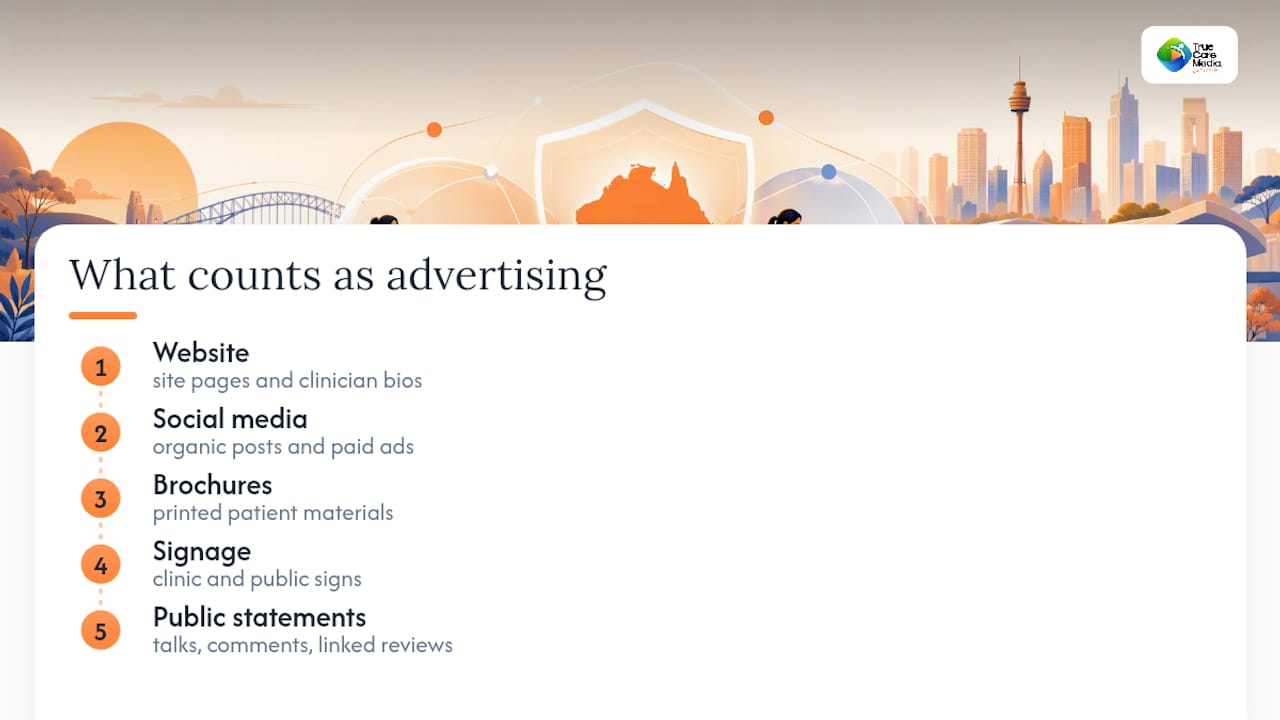
A community health talk you promote on Facebook counts. A clinician bio on your website that implies a guaranteed outcome counts. Even reviews you didn’t write yourself can become a compliance problem: if a third-party platform hosts glowing patient feedback and you link to it, feature it, or otherwise use it to attract business, the regulator can treat that as advertising you’re responsible for, even though a patient wrote the words. Many clinics end up disabling or actively managing review functions for exactly this reason.
Boosting a post with paid spend doesn’t change the rules, it just increases your reach and, with it, your exposure if the post breaches Section 133. Treat every public-facing asset, from a paid Instagram ad to an offhand comment at a networking event that’s later shared online, as advertising until proven otherwise.
The absolute no-go list under Section 133
Section 133 of the National Law sets out prohibitions that apply regardless of your profession, your clinic size, or your marketing budget. These aren’t guidelines you can interpret loosely. They’re hard lines.
- False, misleading or deceptive claims. Any statement about outcomes, qualifications, or results that isn’t strictly accurate.
- Testimonials. Section 133 bans testimonials or purported testimonials outright for regulated health services, because they’re viewed as inherently biased and likely to mislead the public about how effective a treatment really is. This prohibition is absolute, there’s no “with a disclaimer” workaround.
- Inducements. Discounts, time-limited specials, referral rewards, or prize draws that pressure someone into a health decision they might not otherwise make.
- Unreasonable expectations. Language or imagery suggesting a guaranteed cure, permanent result, or risk-free outcome.
- Encouraging unnecessary use. Advertising that pushes people toward treatment they don’t need, such as promoting a supplement or therapy for a condition where evidence doesn’t support it.
Online reviews sit in a grey zone that catches a lot of clinics out. You can’t stop a patient posting a five-star review on Google, and AHPRA doesn’t expect you to. What you can’t do is repost that review on your own channels, screenshot it into a Facebook ad, or quote it in a brochure, because at that point you’ve turned an unsolicited comment into promotional material you control.
Inducements are worth a second look because they’re everywhere in general retail and completely off-limits here. A “20% off your first consult” offer, a “book this month and get a free follow-up” deal, or a competition where the prize is a course of treatment are all classic inducements. If you run any kind of promotional offer, the safest move is to make sure it relates to genuinely elective, non-clinical add-ons (like merchandise) rather than the clinical service itself, and to state the terms plainly wherever the offer appears.
What actually counts as acceptable evidence
Any claim you make about treatment outcomes needs to be backed by something solid, not marketing confidence. AHPRA’s expectation is that acceptable evidence generally means independent peer-reviewed research or robust clinical studies, assessed against something close to academic standards rather than a single case study or a manufacturer’s promotional brochure.
This matters because a lot of allied health marketing leans on phrases like “clinically proven” or “shown to reduce pain by half” without anyone checking whether the underlying study would survive scrutiny. If you can’t produce the actual paper, or if the paper in question is a small pilot study with a handful of participants, you’re on shaky ground making a firm claim. The safer path is to describe what a treatment involves and let outcomes speak through evidence you can point to, rather than promising a result.
When evidence is thin, ambiguous, or contested, don’t make the claim at all. Describe the process, the practitioner’s training, or the general category of condition treated instead of asserting a specific outcome. “Our physiotherapists specialise in post-surgical rehabilitation” is safe. “We’ll have you back on the field in six weeks” is not, unless you can prove that timeframe holds for the population you’re advertising to.
Keep a simple evidence file for every specific claim on your website or in your ads. Note the source, the publication, and the date you checked it was still current. AHPRA’s proactive audit approach means being able to produce that evidence quickly, on request, reduces your risk enormously compared with scrambling to find it after a complaint lands.
Pricing, discounts and disclosure
Price transparency is one of the more mechanical parts of AHPRA compliance, and one of the easiest to get wrong through carelessness rather than intent. The regulator expects a clear path to total cost, not a headline number designed to lure someone in.
“Consults from $80” is fine if $80 genuinely covers a standard consult and any add-ons are clearly itemised elsewhere. It becomes a problem when $80 is a rarely-achievable rate and most patients actually pay $150 once assessment fees, product costs, or follow-up charges are added. Partial or “hook” pricing like this is one of the most common triggers for a complaint, because it reads as a bait-and-switch even when no one intended it that way.
If you’re running a discount or offering a free add-on, put the terms and conditions somewhere a reader will actually find them, not buried in an asterisk with six-point font. State the eligibility criteria, the expiry date, and any exclusions in plain language next to the offer itself, not on a separate page three clicks away.
Images, before-and-afters and social media risk
Visual content carries its own compliance traps, and they catch out clinics that would never dream of writing a false testimonial in text. Before-and-after photos are the biggest one. Even when the transformation is genuine, a side-by-side image implies a guaranteed, repeatable result, and that’s precisely the kind of unreasonable expectation Section 133 prohibits. Use them with extreme caution, if at all, and never without a clear disclaimer about individual variation.
Patient stories on video present a similar risk, even when the patient has enthusiastically consented. A filmed account of “how treatment changed my life” is functionally a testimonial with better production values. The safest approach is to keep the narrative focused on process, what a typical treatment journey involves, how the clinic operates, what to expect at a first appointment, rather than on the specific clinical outcome one person experienced.
- Brief any photographer or videographer in writing to avoid capturing or scripting outcome claims.
- Keep captions descriptive (“Our team assessing a new patient”) rather than evaluative (“This treatment changed everything”).
- Review every caption and comment thread before a social post goes live, since a well-meaning comment reply can just as easily breach Section 133 as the post itself.
- Disable or actively moderate patient-tagging features that could turn a casual post into an implied endorsement.
Pro Tip: Give your creative team a one-page “banned words” list before any shoot, ruling out phrases like “cure”, “guaranteed”, “pain-free forever” and “life-changing”. It’s far easier to brief this upfront than to re-edit a finished video after your compliance officer flags it.
How AHPRA enforces the rules and what penalties look like
AHPRA doesn’t rely purely on complaints. It runs a genuinely proactive program, using staged audits and practitioner declarations that ask practitioners to confirm their advertising complies with the National Law. Get selected for one of these rounds and you may need to produce your website, social channels, and supporting evidence for review within a set timeframe.
The consequences escalate depending on severity and whether the issue repeats. A first minor breach often results in an education letter, essentially a formal heads-up to fix the problem. Persistent or serious breaches can lead to a show-cause process, conditions placed on your registration, tribunal action, or referral for prosecution. Courts can impose a financial penalty for each offence under the National Law, and in cases involving unlawful use of a protected title, the consequences can extend to imprisonment. Ongoing or repeated breaches don’t just risk one penalty, they compound, because each instance of non-compliant advertising can be treated as a separate offence.
Beyond AHPRA itself, other regulators can be watching the same content. The Australian Competition and Consumer Commission enforces the Australian Consumer Law’s general prohibitions on misleading conduct, which apply to health advertising alongside AHPRA’s rules. If your services touch therapeutic goods, supplements, or medical devices, the Therapeutic Goods Administration has its own advertising restrictions that can apply on top of the National Law. A breach under one regime can inform, or trigger, action under another.
A step-by-step checklist to audit and fix your advertising
Running a full compliance sweep sounds daunting until you break it into a sequence. Here’s the order that actually works for a busy clinic.
- List every advertising asset you control. Website pages, social profiles, paid ad campaigns, brochures, signage, email newsletters, and any third-party listing you manage (Google Business Profile, directory sites).
- Screen each asset against the Section 133 prohibitions. Flag anything resembling a testimonial, a guaranteed outcome, an inducement, or a claim you can’t immediately back with evidence.
- Check every outcome claim against your evidence file. If you can’t locate a peer-reviewed source or robust study backing a specific claim, either find the source or remove the claim.
- Strip out testimonials and patient outcome anecdotes. This includes reposted reviews, tagged patient posts, and video content that centres on a named individual’s results.
- Fix pricing language. Replace vague “from” pricing with either a firm figure or a clear breakdown of what determines the final cost.
- Audit images and captions. Remove or heavily caveat before-and-after photos; rewrite captions that imply guaranteed results.
- Review contracts with external marketers or agencies. Add compliance warranties and a sign-off step before anything goes live, since you carry the liability even when someone else wrote the copy.
- Document every change you make and why. A simple log, dated, with a note on what was changed and the reasoning, becomes invaluable if you’re ever asked to demonstrate compliance during an audit.
- Schedule a recurring recheck. Quarterly is reasonable for an active clinic; annually is the bare minimum.
- Get advice when a claim sits in a grey area. If you’re genuinely unsure whether something breaches Section 133, ask before you publish, not after a complaint arrives.
Our AHPRA video ad checklist walks through this same process specifically for video content, where scripting, captions and on-camera testimonials tend to introduce risk fastest.
Where to check the official rules yourself
The primary source is always AHPRA’s own Guidelines for advertising a regulated health service, alongside the more digestible Summary of the advertising requirements. For enforcement mechanics, AHPRA’s Advertising compliance and enforcement strategy explains the audit and declaration process in detail. AHPRA’s profession-specific resources cover Chinese medicine, chiropractic, osteopathy and other registered professions individually. Where your marketing touches therapeutic goods, the Therapeutic Goods Administration’s own advertising rules apply on top of the National Law, and the Australian Consumer Law, overseen by the ACCC, runs in parallel regardless of profession.
Commissioning photos and video that actually stay compliant
Most compliance failures we see in visual content aren’t malicious, they come from a creative brief that never mentioned AHPRA in the first place. If you’re hiring a photographer or filmmaker, build the National Law into the brief itself: no scripted outcome claims, no “tell us how treatment changed your life” prompts, no before-and-after setups unless you’ve already cleared that with your compliance process.
Model release and consent forms need more than a signature. Record what the subject agreed to feature in, whether their name or likeness can be used in paid advertising versus organic content, and an expiry or review date for that consent. Ask your creative team for raw, unedited footage alongside the final cut, and for a shot list documenting exactly what was captured, so you can review it against Section 133 before anything goes live rather than after.
The deliverables worth requesting are the ones that keep content informational: process footage, clinic environment, team introductions that describe qualifications rather than promise results. That’s the material that ages well under an audit.
— Mishal
How Com builds AHPRA-safe photo and video content for clinics
We work with healthcare providers to produce photography and video that markets practices while respecting compliance requirements. Our approach includes compliance considerations from the start to help avoid costly rewrites after production.

We offer structured photo and video packages featuring clinic operations, team introductions, and facility storytelling that avoids testimonials or outcome guarantees. If you’re commissioning imagery for a clinic, our guide on allied health clinic photography walks through what to brief and what to expect from the shoot itself. For providers ready to review existing assets or plan a compliant content package, our role of team photography in clinics guide is a solid next stop, and you can reach out any time to scope a project for your practice.
This article is general information, not a substitute for advice from a qualified lawyer. Consult a qualified legal professional about your own circumstances before acting on anything here.