
If you’re commissioning media for a surgical team, you need seven content types: short clinician profile videos, interview or testimonial clips, professional headshots, group team photography, behind-the-scenes b-roll, procedure explainers, and text microcopy that pairs with all of it. Keep clinician profile videos to 30 seconds to 2 minutes, and full introduction videos to 60 to 90 seconds. A clear play icon on a provider’s video thumbnail triples play rate, and viewers who watch a provider video are 50% more likely to make contact than those who don’t.
If you only do one thing this quarter, film 30 to 90 second clinician profile videos plus headshots, and get signed releases before the crew leaves site.
- Short clinician profile videos (30s–2min)
- Interview and testimonial clips
- Professional headshots and team portraits
- Behind-the-scenes b-roll
- Procedure explainers
- Vertical social cutdowns
- Text-based bio microcopy
Pro Tip: Book the release paperwork into the shoot schedule itself, not as a follow-up email. Signatures collected on the day rarely go missing later.
Key Takeaways
Effective surgical team profile content pairs short clinician videos and professional photography with signed consent and clear distribution KPIs to build measurable patient trust.
| Point | Details |
|---|---|
| Lead with video and headshots | Prioritise 30s–2min clinician profile videos plus headshots before adding testimonials or b-roll. |
| Play icons lift engagement | A visible play icon can triple play rate, and viewers are 50% more likely to make contact after watching. |
| Consent comes before filming | Written releases must specify platforms, duration, and revocation terms for every clinician and patient on camera. |
| Match format to channel | Testimonials suit paid landing pages; b-roll suits recruitment and social; headshots suit directories. |
| Brief production teams properly | True Care Media builds healthcare-specific consent workflows and caption-ready deliverables into every surgical team shoot. |
Table of Contents
- Types of surgical team profile content and what each one does
- What goes in a surgical team video production brief?
- What consent do you need before filming a surgical team?
- Where should each type of surgical team content be published?
- How do you choose the right content mix for your goals?
- Should patients appear in surgical team profile content?
- Who owns the footage, and what can you legally do with it?
- How do you represent a diverse surgical team fairly?
- How True Care Media handles surgical team profile shoots
- Sources
Types of surgical team profile content and what each one does
Every format on this list earns its place by doing a specific job. Get the mix wrong and you either waste a production budget on content nobody watches, or you skip the format that would have actually converted a hesitant patient. Here’s what each type is for, and the bare minimum you need to brief it properly.
Short clinician profile videos are the workhorse of any surgical team page. Keep them between 30 seconds and 2 minutes, and script around three questions: what drew the surgeon to their specialty, what patients should expect on the day, and one line describing their care philosophy in plain language. Warmth on camera, a memorable one-line philosophy, and consistent production quality across every clinician in the network matter more than any credential list.
Interview and testimonial clips carry more persuasive weight than a bio because someone other than the surgical team is doing the talking. Peer endorsements from referring GPs or fellow surgeons work well here. Keep the consent workflow separate from the clinician release, since a testimonial subject (particularly a patient) needs their own signed scope-of-use agreement. Cut a 2 to 4 minute testimonial down to a 30 second social version for distribution.
Professional headshots and team photography need three distinct set-ups: a single clinical portrait (plain background, consistent lighting rig across the team), a relaxed environmental portrait, and a full group shot for the “meet the team” page. Wardrobe should be specified in the brief, not left to the day, and branding elements like lanyards or scrubs colour should match your visual identity.
Behind-the-scenes b-roll captures walking through corridors, consulting with a patient, or prepping instruments, and it’s what makes a profile page feel like a real place rather than a stock photo library. Consent here is trickier than for a posed portrait, since patients or other staff might wander into frame.

Procedure explainers suit animation when the anatomy is complex or graphic content would be confronting; live action works better for lower-risk procedures where showing the actual team builds more trust than an illustration does.
Vertical social cutdowns should answer one question in 60 seconds or less, always subtitled, because most social viewing happens with sound off.
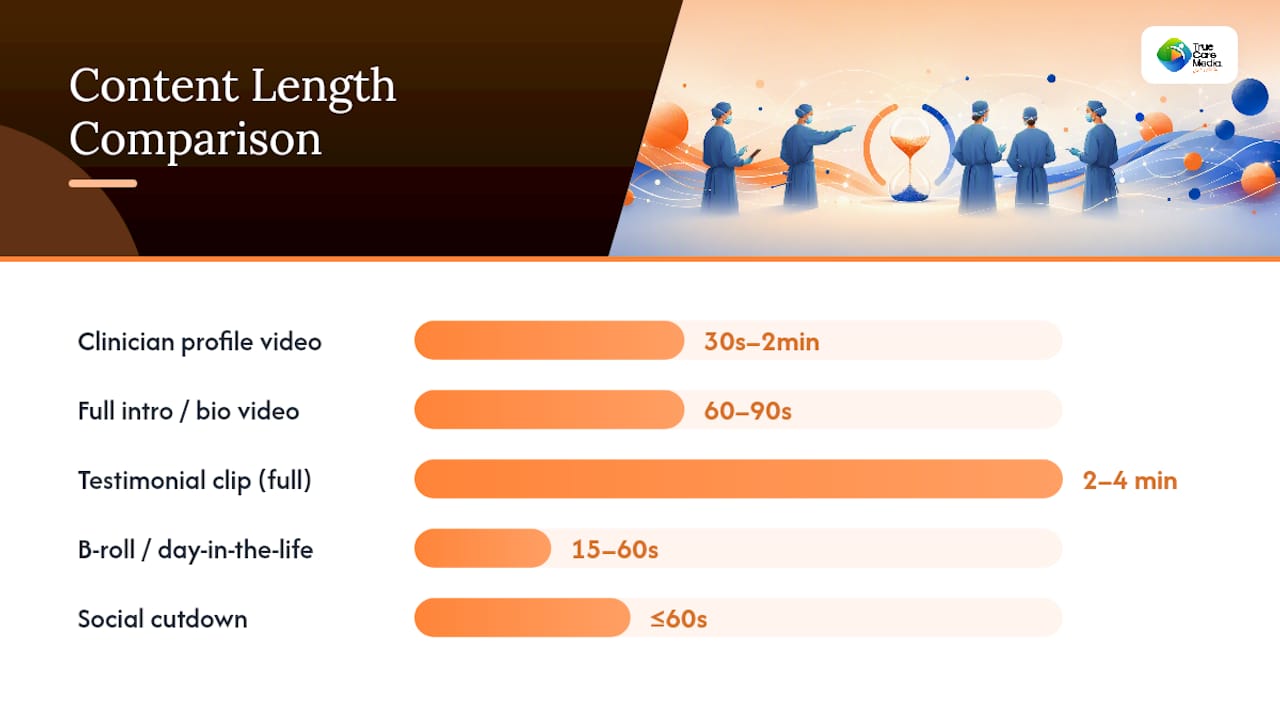
| Content type | Ideal length | Best distribution channel |
|---|---|---|
| Clinician profile video | 30s–2min | Provider page, email signature |
| Full intro/bio video | 60–90s | Website homepage, referrer packs |
| Testimonial clip | 2–4min (full), 30s (cutdown) | Landing pages, paid social |
| Headshots/team photos | Static | Directory, LinkedIn, print |
| B-roll/day-in-the-life | 15–60s segments | Social stories, recruitment pages |
| Social cutdown | ≤60s | Instagram, TikTok, Facebook Reels |
What goes in a surgical team video production brief?
A brief that skips technical detail is the fastest way to end up with unusable footage. Give your videographer or photographer these five elements before the shoot date is locked in.
- Shot list: clinical portrait angle, environmental portrait, mid-length seated interview, three b-roll moments (patient interaction, instrument handling, team handover), one group composition, one relaxed candid.
- Script prompts: build a question bank rather than a script. Ask about their specialty, a memorable patient outcome (told without identifying detail), what a first consultation feels like, and their approach to explaining risk. Off-camera interviewing, where the interviewer sits just beside the lens rather than behind it, keeps answers conversational instead of rehearsed.
- Technical specs: deliver masters in 16:9 for web and 9:16 for social, lavalier or boom audio (never on-camera mic only), a single soft key light at roughly 30 to 45 degrees, and burned-in captions on every social export.
- File structure: name files by clinician surname and content type, and separate masters, web-optimised MP4s, social cutdowns, and 8 to 10 selected stills into their own folders.
- Scheduling: batch shoots across a single day where possible. Budget 20 to 30 minutes per clinician for a headshot-plus-single-camera package, and 45 to 60 minutes if you’re also capturing multi-angle interview and b-roll.
Building in 10 to 15 minutes of extra b-roll per clinician gives your editor more to work with later and cuts down the odds of an expensive reshoot. A checklist-driven approach to provider profile shoots consistently produces cleaner footage than an ad hoc “just get some clips” brief. Our guide on showcasing surgical team expertise on video covers the batching logistics in more depth if you’re planning a multi-clinician day.
What consent do you need before filming a surgical team?
Every clinician appearing on camera needs a written release specifying exactly what you can do with the footage: which platforms, for how long, and whether it can be repurposed for paid advertising later. Vague verbal agreement (“yeah, that’s fine”) is not a release, and it will not hold up if a clinician leaves the practice and wants their image removed.
Patients are a separate and higher-risk category. Never show protected health information in a frame, meaning no visible screens, charts, wristbands, or patient names, even accidentally in the background of a b-roll shot. Any patient who appears on camera, even blurred or from behind, needs their own release covering scope of use and a clear revocation process.
Your consent checklist should cover:
- Signed release naming exact platforms and duration of use
- Scope of use (marketing only, or also training/recruitment)
- Revocation terms and process for withdrawal
- Any incentive or remuneration disclosed in writing
- Labelled, access-controlled storage for raw and edited files
Pro Tip: Loop your privacy or legal team into the release template once, then reuse it. Rules under Australia’s health privacy framework and your own institutional policy should shape that template before the first shoot, not after.
Where should each type of surgical team content be published?
Match the format to the channel or you’ll waste production budget on assets nobody sees. Clinician profile videos and headshots belong on the provider page and department pages first, then get cut down for social and email signatures. Testimonials work hardest on landing pages and in paid campaigns aimed at prospective patients still deciding. B-roll and day-in-the-life footage perform best on recruitment pages and social stories, where authenticity matters more than polish.
Run a simple A/B test on your provider page: publish one clinician’s profile with a visible play icon over the thumbnail and one without, then compare contact form submissions over a month. The tripled play rate and 50% contact-likelihood lift reported for provider video is exactly the kind of uplift a play-icon test should reveal on your own site. Tag every file with the clinician’s name and content type at export so your analytics platform attributes views correctly, and report play rate and contact rate at minimum monthly. Our page on attracting private patients through video marketing walks through setting up that attribution properly.
How do you choose the right content mix for your goals?
Start with the outcome you actually need, not the format that sounds most impressive.
- Conversion or patient acquisition → clinician profile videos plus headshots, distributed on the provider page and in paid campaigns.
- Recruitment → day-in-the-life b-roll and culture-focused footage showing team dynamics, not just clinical skill.
- Referrer trust → peer endorsement clips and testimonials distributed to GP networks.
- Family reassurance ahead of a procedure → short explainer content paired with a warm clinician introduction.
Before signing off a vendor, ask about their healthcare experience specifically, their documented consent process, caption turnaround time, and sample deliverables from a comparable clinical setting. Budget-wise, headshots cost the least, short single-clinician videos sit in the middle, and multi-camera shoots with full post-production cost the most. Walk away from any vendor with no healthcare portfolio, no written consent process, or vague answers about who owns the final files.
Should patients appear in surgical team profile content?
Patient appearances add credibility that clinician-only content can’t match, but they carry real risk if handled loosely. The safest approach treats patient involvement as optional and heavily consented, never assumed.
Include a patient only when they’ve given a specific, written release covering the exact use case (a testimonial for the website, say, not “marketing in general”), and only after enough time has passed that they’re not making that decision under the stress of an upcoming or recent procedure. A story-led brief that centres the patient’s outcome rather than the surgeon’s credentials tends to land better with prospective patients, but that only works with genuine, willing participation.
Build an exclusion path into every brief: if a patient hesitates, changes their mind on the day, or asks for footage to be pulled after the fact, the crew needs pre-agreed instructions for reshooting around them without disrupting the shoot. Our patient testimonial guide covers the specific consent language that holds up best in healthcare settings, and independent analysis of testimonial impact backs the trust lift when it’s done properly.
Where a patient can’t or won’t participate, don’t force it. A well-shot clinician profile with strong b-roll of the environment still does the job, just without that extra layer of social proof.
Who owns the footage, and what can you legally do with it?
Consent from the person on camera is only half the compliance picture. The other half is who owns the actual files, and what your contract lets you do with them.
Confirm ownership and usage rights in writing before the shoot, not after. A production contract should state explicitly whether the healthcare organisation owns the raw and edited files outright, or whether the production company retains rights and merely licenses use for a set period or platform list. Perpetual, unlimited use is worth paying more for upfront if you plan to reuse footage across recruitment, paid ads, and print over several years.
Music and stock footage layered into an edit need their own cleared licences. A track that sounds free because it came bundled with editing software may still carry restrictions on commercial healthcare use, and getting this wrong can mean pulling a published video entirely. If a vendor supplies a licensed music bed, ask for the licence documentation, not just their word that it’s covered.
Clarify what happens if a clinician leaves the practice. Your contract should specify whether their footage comes down automatically, gets archived, or continues running until a specific end date, since this is one of the most common disputes that surfaces months after a shoot wraps.
How do you represent a diverse surgical team fairly?
A surgical team profile page that only ever features the same one or two clinicians front and centre undersells the whole team, and patients notice when a page feels curated rather than representative.
Brief every eligible team member for photography and video, not just the department head or the most camera-confident surgeon. Rotate who appears in hero placements on the website rather than defaulting to seniority every time. If your team includes clinicians from different cultural backgrounds, genders, or career stages, make sure the shot list and question bank give each person room to speak in their own voice rather than forcing everyone through an identical script that flattens individuality.
Wardrobe and set design should work across skin tones and body types: test your lighting rig on more than one person before the full shoot day, since a setup calibrated for one skin tone can wash out or underexpose another. If any team member uses a mobility aid, wears religious dress, or has an accessibility need on set, build that into the shot list in advance instead of improvising around it on the day. Our page on inclusive disability photography has practical shot briefs worth reviewing before you finalise wardrobe and set notes.
Fair representation isn’t a one-off diversity photo. It means every clinician gets the same production quality, the same length of interview time, and the same say over how they’re portrayed.
Producer perspective: three brief production realities from the field
Off-camera interviews consistently beat direct-to-lens delivery. Ask surgeons a question from beside the camera and watch the stiffness disappear. Batch your shoot day by clinician availability, not by convenience for the crew. And a single soft key light with a lavalier mic will out-perform a bare ceiling fluorescent and a phone mic every single time, regardless of camera quality.
How True Care Media handles surgical team profile shoots
True Care Media works specifically with allied health, surgical, and hospital teams, which means the crew already understands theatre logistics, clinician downtime, and the consent paperwork healthcare shoots actually need.

Three things matter to commissioning teams booking this kind of work: shoots that scale from a solo specialist to a full surgical department without blowing out the schedule, a documented consent workflow that your legal team can sign off on before the crew arrives, and finished deliverables that already include captions and social cutdowns rather than a raw file dump you have to edit yourselves. If group photography or a “meet the team” page is the priority, our guide on team photography for clinics shows what a well-briefed group shoot looks like. Get in touch for a bespoke briefing template or a shoot quote scoped to your team’s size and timeline.
Sources
- Healthgrades — Video best practices for clients (brochure)
- Videographer training: off‑camera interview technique — ImpactPlus