
The most effective types of marketing content for NDIS providers are: website service pages and local SEO, long-form educational guides, video and participant storytelling, short-form social content, email nurture sequences, testimonials and case studies, infographics and easy-read resources, paid search and social ads, community and referrer content, and a measurement-led content calendar.
If you are starting from scratch, prioritise these three first:
- Video and participant storytelling — builds trust faster than any other format; works across website, social and paid ads simultaneously.
- Website and SEO content — captures participants and referrers who are actively searching for your services right now.
- Testimonials and case studies — converts enquiries into bookings by showing real outcomes rather than making generic claims.
Each content type serves a distinct role. Video and storytelling drive awareness and trust. Website and SEO content captures high-intent searches and produces direct enquiries. Testimonials and case studies close the gap between interest and commitment. Educational guides and email nurture sequences build authority and keep your organisation front-of-mind across longer decision cycles. Paid ads accelerate reach when organic growth is too slow. Community and referrer content generates the word-of-mouth referrals that still account for a significant share of NDIS enquiries.
Table of Contents
- Why compliant, participant-centred content matters for NDIS providers
- 1. Website and SEO content: the foundation that captures active searches
- 2. Long-form educational content that builds authority with participants and referrers
- 4. Social media content: short-form reels, community posts and platform selection
- 6. Case studies and testimonials: the evidence that converts enquiries into bookings
- 7. Infographics, easy-read resources and accessibility-first content
- 8. Paid advertising and retargeting: where to invest and how to measure success
- 9. Community engagement and partnership content for referrers and local networks
- 10. Content planning, publishing cadence and measuring success
- 11. Compliance, consent and accessibility: legal and best-practice checkpoints in Australia
- 12. Why video and storytelling build trust faster than any other format
- 13. Educational content tailored specifically for NDIS participants
- 14. Content targeting referrers and healthcare professionals
- 15. Interactive content formats that engage participants directly
- 16. Multichannel distribution strategies for NDIS audiences
- Key takeaways
- Why video-first is the right starting point for most NDIS providers
- True Care Media: video, photography and storytelling for NDIS providers
- Useful sources and further reading
Why compliant, participant-centred content matters for NDIS providers
The NDIS is one of Australia’s most complex service markets. Participants and their families are making decisions about support that directly affect daily life, independence and wellbeing. Generic marketing copy — the kind that lists credentials and ticks compliance boxes — does not move them. Specificity does.
NDIS participant data shows demand concentrated in particular regions and service categories, which means providers who align their content to local geography and specific support types will consistently outperform those using broad, national messaging. Pair that with ABS census data on local demographics and carer populations, and you have a targeting foundation most providers never build.
The competitive pressure is real. As more providers enter the market, undifferentiated messaging commoditises services that are anything but commodities. A provider that publishes a participant story showing how a young man with cerebral palsy moved into his first SIL property and built a daily routine will attract more enquiries than one whose homepage reads “we provide person-centred, high-quality disability support.” Both may be true. Only one is convincing.
Compliance is the other side of this. Official NDIS guidance sets clear expectations around how providers represent themselves, display registration, and handle participant information in public-facing content. Getting this wrong does not just create legal risk — it signals to participants and referrers that your organisation is not trustworthy.
1. Website and SEO content: the foundation that captures active searches
Your website is the only digital asset you fully control, and it is where most enquiries either convert or disappear. Service pages built around specific NDIS support categories — support coordination, Supported Independent Living (SIL), Specialist Disability Accommodation (SDA), community participation, allied health — perform far better than a single generic “our services” page, because they match the exact terms participants and referrers type into Google.
Local keywords matter just as much as category keywords. “SIL provider in Parramatta” and “support coordination Geelong” are the kinds of searches that signal genuine intent. Your Google Business Profile should be fully completed, with accurate service areas, categories, photos and recent posts — it is often the first thing a local searcher sees.
Blog content extends your reach into informational searches. Topics like “how to prepare for an NDIS plan review,” “what is the difference between SIL and SDA,” and “how to choose a support coordinator” answer questions participants and families are already asking. Small providers who prioritise Google Business Profile and a simple content calendar build credibility faster than those who skip these foundations.
Every service page needs: a clear H1 that names the support type and location, a concise description of who you support and how, your NDIS registration number visible above the fold, a direct contact pathway (phone, form or booking link), and a short section addressing the most common question that type of participant has before enquiring.
Pro Tip: Pick one service page and replace one generic sentence (“we provide person-centred support”) with a specific outcome sentence (“we supported 14 participants in Western Sydney to move into their first SIL home in 2025”). Track enquiries from that page over 30 days and compare.
2. Long-form educational content that builds authority with participants and referrers
Educational content does two jobs at once: it answers the questions participants and families are already searching for, and it signals to referrers that your team understands the system deeply. A support coordinator who finds a genuinely useful guide on your website is far more likely to recommend you than one who finds a brochure.
The most useful educational assets for NDIS providers include:
- How-to guides: “How to prepare for your NDIS plan review,” “How to use your core supports budget.”
- “What to expect” pages: what happens on the first day of support, what a service agreement covers.
- Downloadable checklists: plan review preparation checklist, questions to ask a potential provider.
- Topic explainers: differences between SIL and SDA, how assistive technology funding works.
Lead capture is straightforward here. Gate the most detailed resources (a comprehensive plan review template, for example) behind a simple email opt-in, then follow up with a short nurture sequence. Ungated resources build goodwill and SEO; gated ones build your contact list.
Every guide should have an easy-read version. Plain language, short sentences, large type and supporting images are not optional extras for an NDIS audience — they are basic accessibility practice. Providing alternate formats (audio summaries, captioned video versions) for the same content extends your reach to participants who do not engage well with dense text.
4. Social media content: short-form reels, community posts and platform selection
Social media for NDIS providers is not about reach for its own sake. It is about building the kind of consistent, recognisable presence that makes participants, families and referrers feel confident before they ever contact you.
Facebook remains the dominant platform for NDIS audiences. Participant families and support coordinators are active there, and private Facebook groups are a genuine channel for peer referrals. Post educational content, service updates, staff spotlights and event announcements. Organic Facebook groups around disability support communities are worth joining and contributing to — not to sell, but to be visible and helpful.
Instagram and Reels suit short storytelling: a 20-second clip of a participant at a community event, a staff member explaining one thing about your service, a behind-the-scenes look at your facility. The format rewards authenticity over production value.
YouTube works for longer explainers and playlists. A playlist of “understanding your NDIS plan” videos positions you as an authority and keeps viewers on your channel.
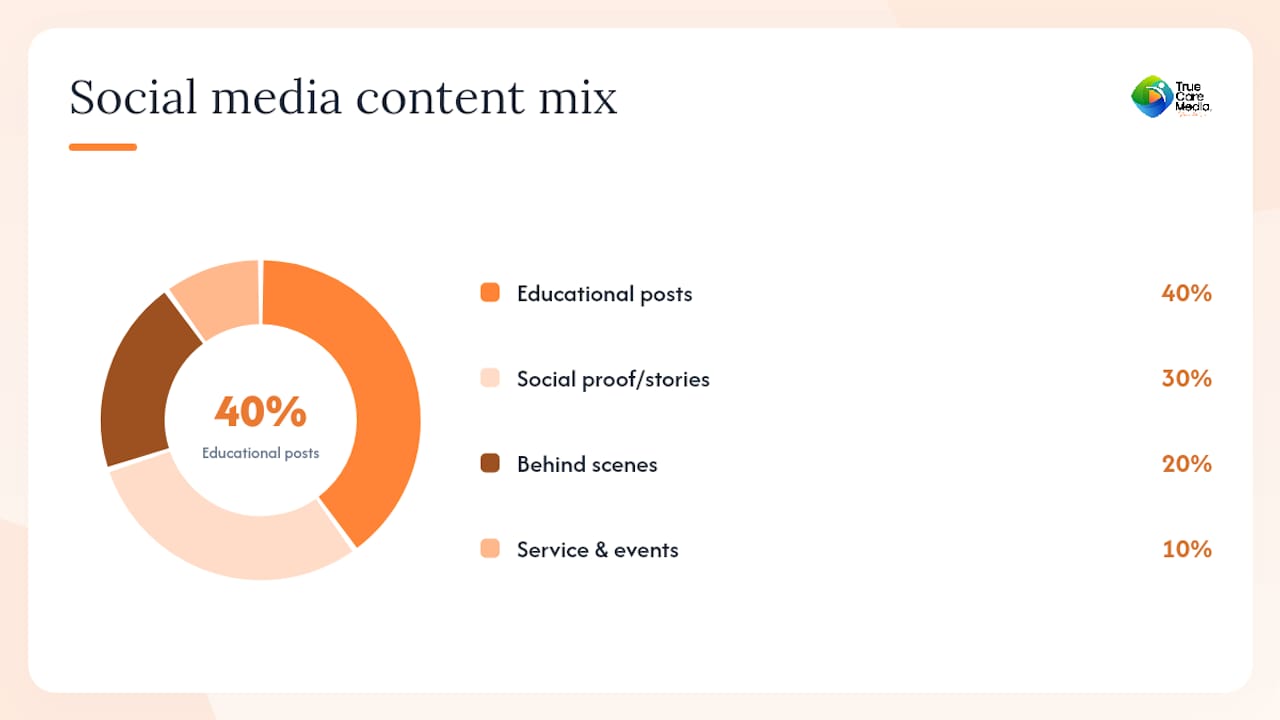
A sustainable posting cadence for most providers: three to four posts per week on Facebook and Instagram, one YouTube video per month, and daily Stories when you have relevant content. Mix educational posts (40%), social proof and participant stories (30%), behind-the-scenes and culture (20%), and service or event updates (10%).
For accessible posts: write captions that work without the audio, add alt text to every image, use closed captions on all video, and keep sentences short in post copy.
6. Case studies and testimonials: the evidence that converts enquiries into bookings
Specific participant stories and named outcomes differentiate provider marketing more than any credential or compliance statement. A case study does not need to be long. A tight 300-word structure works:
- Challenge: what the participant was dealing with before engaging your service.
- Support provided: what your team did, specifically.
- Outcome: a measurable or observable change (moved into independent living, returned to work, achieved a communication goal).
- Participant quote: one or two sentences in their own words (with documented consent).
- CTA: a direct invitation to enquire about the same type of support.
Before publishing any participant story, your consent checklist should cover:
- Written consent form signed by the participant or legal guardian.
- Explicit permission for each channel where the story will appear (website, social, ads).
- Participant’s right to withdraw consent at any time, with a clear process.
- Secure storage of consent documentation, with version control if the story is updated.
- Review by a senior staff member before publication.
Long-form case studies repurpose efficiently. Pull the participant quote for a website testimonial block, cut the outcome section into a social post, and use the challenge-and-outcome arc as the script for a 60-second video. One story, multiple assets. For guidance on filming participant testimonials compliantly, True Care Media’s participant testimonial video guide covers the full process.
7. Infographics, easy-read resources and accessibility-first content
Complex NDIS information — funding categories, plan review steps, the difference between registered and unregistered providers — is genuinely hard for many participants to navigate. Infographics and easy-read resources turn that complexity into something shareable and useful.
Design checklist for easy-read resources:
- data.ndis.gov.au
- abs.gov.au
- ndis.gov.au
- NDIS Marketing Australia 2026 (Complete Guide for SDA, SIL & Community Support Leads)
- NDIS Provider Marketing Strategy That Actually Differentiates
- Effective Marketing for NDIS Providers in Australia
- Turning NDIS Digital Marketing Tactics into Strategy – Dweebi
- How To Market Your NDIS Business & Find Clients
- How to Create a Comprehensive Marketing Plan for NDIS …
Infographic topics that work well for NDIS providers: the five steps of a plan review, how core supports funding can be used, what to bring to your first support coordination meeting, and how to make a complaint about a provider.
Distribute these as downloadable PDFs on your website (gated or ungated), printable packs for referrers, and accessible HTML pages for screen reader users. An audio summary version of each guide extends reach further. These resources also make excellent email lead magnets and referrer pack inclusions.
8. Paid advertising and retargeting: where to invest and how to measure success
Paid advertising accelerates what organic content builds slowly. The channel mix depends on your service type.
Accommodation services — SDA, SIL and respite — show higher search intent and shorter decision timelines, which justifies heavier investment in Google Search Ads for those categories. A participant or family searching “SDA provider Sydney” is close to a decision. A well-structured search campaign with a strong landing page and clear contact pathway will convert that intent into an enquiry.
Community participation and social programs suit Facebook and Instagram ads better. These audiences are earlier in their decision process and respond to awareness-building content: short video clips, participant stories, event promotions.
For any paid campaign, the structure is: clear objective (enquiry, phone call, form submission), defined audience (geography, age, interests or custom audience from your website visitors), creative that matches the intent stage, a landing page that continues the message from the ad, and a KPI you track from day one.
Conversion tracking is non-negotiable. Set up Google Tag Manager to track form submissions and phone call clicks. Use call-tracking software (CallRail works in Australia) to attribute phone enquiries to specific campaigns. Retargeting website visitors who did not enquire is one of the highest-ROI tactics available — these are people who already know you exist.
9. Community engagement and partnership content for referrers and local networks
Referrals from support coordinators and allied health professionals remain one of the most reliable sources of new participants for most NDIS providers. Content built specifically for this audience is different from participant-facing content — it needs to be concise, outcome-focused and easy to pass on.
A referrer pack should include: a one-page service overview (what you offer, who you support, your service areas), a brief case example showing a relevant outcome, clear referral steps and contact details, and your NDIS registration number. Keep it to two pages maximum. Referrers receive a lot of provider information; the ones that get read are short and specific.
Event content builds relationships that digital content cannot fully replicate. Lunch-and-learns for local support coordinators, open days at your facility, joint social campaigns with allied health clinics or community organisations — these create the kind of personal familiarity that generates consistent referrals over time. Webinars work well for reaching referrers across a wider geography.
For digital distribution to professionals, LinkedIn is underused by most NDIS providers. Short posts sharing clinical outcome summaries, capacity updates and sector commentary reach support coordinators and allied health professionals where they are already consuming professional content. Integrated digital tactics work best when organic SEO, search ads and social content support decision-stage content and community proof.
10. Content planning, publishing cadence and measuring success
A content calendar does not need to be complicated. The goal is consistency and coverage, not volume.
A practical cadence for most providers:
| Content type | Frequency | Owner |
|---|---|---|
| Social posts (Facebook/Instagram) | 3–4 per week | Marketing coordinator |
| Blog post or guide | Fortnightly | Content lead or outsourced |
| Email newsletter | Monthly | Marketing coordinator |
| Case study | Monthly | Senior staff + marketing |
| Video asset | Quarterly | External production |
KPIs to track by channel: organic search traffic and enquiry conversions from the website; open rate and click-through rate for email; reach, engagement and direct messages from social; cost per enquiry and conversion rate for paid ads; referral volume by source (track this manually if your CRM does not do it automatically).
Set 30/60/90-day review checkpoints. At 30 days, check whether your tracking is working and whether any content is generating early enquiries. At 60 days, assess which content types are producing the most enquiries per hour of effort. At 90 days, make a resource decision: double down on what is working, pause what is not. A provider-specific marketing plan should align channels, budget and content calendar to measurable KPIs and review cadence.
Attribution is the hardest part. Track both phone and web enquiries and ask every new enquiry how they found you. That single question, asked consistently, will tell you more about what is working than most analytics dashboards.
11. Compliance, consent and accessibility: legal and best-practice checkpoints in Australia
Consent documentation for participant content should record: the participant’s full name and date of birth, the specific content being consented to (video, photo, written story), the channels where it will be published, the date of consent, the participant’s right to withdraw, and the name of the staff member who obtained consent. Store these records securely, with version control if the content is updated or extended to new channels.
The OAIC’s Privacy Act obligations apply to any personal information you collect or publish, including participant images and stories. The NDIS Code of Conduct requires providers to act with integrity and respect participant dignity in all communications. These are not tick-box requirements — they are the baseline for operating ethically in this sector.
Accessibility in published content means: closed captions on all video (not auto-generated only — review them), alt text on every image that describes the image meaningfully (not “image1.jpg”), easy-read versions of complex documents, and colour contrast that meets WCAG 2.1 AA as a minimum. NDIS registration storytelling guidance covers how to display registration and build credibility without overstating your scope.
For complex or sensitive participant stories — particularly those involving mental health, trauma or contested family situations — have a legal or compliance professional review the content before publication rather than relying on internal interpretation.
This article provides general information about marketing content practices for NDIS providers. It is not legal or compliance advice. Confirm current obligations with the NDIS Quality and Safeguards Commission or a qualified professional.
12. Why video and storytelling build trust faster than any other format
The mechanism is straightforward. A participant or family member reading your website cannot verify your claims. They can only assess signals: does this organisation look like it understands people like me? Does it show real outcomes? Do the people on screen seem genuine?
Specificity is the key variable. A video showing a named participant (with consent) describing how your support coordinator helped her navigate a plan review, in her own words, in your actual office, is verifiable in a way that copy never is. It answers the implicit question every prospective participant is asking: “Will they actually help someone like me?”

Storytelling increases trust and engagement for NDIS brands because it shifts the evidence from abstract claims to concrete human experience. Pages that host a participant video consistently generate more enquiries than equivalent pages without one. That gap widens for high-consideration services like SIL and SDA, where the decision timeline is longer and the stakes are higher.
For a single-site provider starting out, a practical first package covers: one participant testimonial shoot (two to three participants, 60–90 second edits), one service walkthrough (two to three minutes, showing your facility and team), and three to five social clips cut from the same footage. That single production day produces assets that work across your website, paid ads, email and social for months.
Pro Tip: Compare enquiry rates on pages with video versus pages without. Most providers who do this find the gap is larger than they expected, which makes the case for the next production investment straightforward.
13. Educational content tailored specifically for NDIS participants
Participants and their families are often navigating the NDIS for the first time, or returning after a plan review with new funding they do not fully understand. Educational content that meets them at that point of confusion builds loyalty before they have even become a client.
The most useful formats here are guides on NDIS planning and funding: how core, capacity building and capital supports work, what “reasonable and necessary” means in practice, and how to get the most from a plan review. These topics generate consistent search traffic and position your organisation as a knowledgeable, trustworthy guide rather than just a service vendor.
Video explainers work particularly well for complex topics. A three-minute animated or talking-head video explaining how assistive technology funding works will hold attention better than a 1,500-word article on the same topic. Explainer videos for NDIS providers are one of the highest-value content investments for organisations that serve participants across multiple support categories.
Distribute educational content through your website, email list and social channels simultaneously. A guide published on your blog, promoted via a Facebook post, and sent to your email list as a monthly resource reaches the same participant through three touchpoints — which is usually what it takes to prompt an enquiry.
14. Content targeting referrers and healthcare professionals
Referrers make decisions based on evidence of outcomes, not marketing language. A support coordinator choosing between two SIL providers will respond to a one-page summary showing average time from referral to placement, participant satisfaction indicators and any relevant clinical outcomes. They will not respond to a brochure that says “we are passionate about empowering participants.”
Content for this audience should be concise, outcome-focused and easy to share. A two-page referrer pack, a short email sequence introducing your service to new contacts, and a LinkedIn presence that shares sector-relevant updates are the core toolkit. Capacity updates — “we have two SIL vacancies in Blacktown from March” — are genuinely useful to support coordinators and should be communicated proactively.
Webinars and lunch-and-learns give referrers a reason to engage beyond a cold email. A 45-minute webinar on “supporting participants with complex needs through plan reviews” positions your team as sector experts and generates warm referral relationships that persist long after the event. Record these sessions and repurpose them as gated resources on your website.
15. Interactive content formats that engage participants directly
Quizzes, live Q&A sessions and webinars give participants and families a way to engage with your organisation before committing to an enquiry. A short quiz (“Which NDIS support type might suit you?”) on your website serves two purposes: it helps participants self-identify their needs, and it gives you a warm lead with context about what they are looking for.
Live Q&A sessions on Facebook or Instagram — run monthly or quarterly — build community and demonstrate transparency. Participants and families can ask questions they might feel awkward raising in a formal enquiry, and your answers become content you can repurpose as FAQ posts or short video clips.
Webinars work best for more structured topics: understanding your NDIS plan, preparing for a plan review, what to look for in a support coordinator. Keep them to 45–60 minutes, record them, and make the recording available as a gated resource. The registration list from each webinar is a warm email segment worth nurturing.
16. Multichannel distribution strategies for NDIS audiences
Publishing content on one channel and hoping it finds the right audience is the most common waste of effort in NDIS provider marketing. A single piece of content — a participant story, a guide, a video — should travel across every relevant channel in a format suited to that channel.
The practical model: create one substantial asset per month (a long-form guide, a video, a case study), then distribute it across website, email, social and paid ads in adapted formats. A case study becomes a blog post, a social post series, an email to your referrer list, a short video clip and a paid ad targeting people who visited your SIL service page. Common recommended content types for providers — blog posts, email newsletters, videos, infographics and testimonials — each serve a distinct role in the funnel, and they work best when they reinforce each other.
Channel selection should follow your audience. Participants and families are on Facebook and Google. Referrers are on LinkedIn and in their inboxes. Younger participants and their networks are on Instagram and TikTok. Allocate your distribution effort accordingly, and track which channels are actually generating enquiries rather than just impressions.
Key takeaways
The most effective NDIS provider marketing combines video storytelling, local SEO and participant-centred case studies — with a consistent publishing cadence and clear KPIs tracking enquiries by channel.
| Point | Details |
|---|---|
| Start with three content types | Video, website/SEO and testimonials produce the fastest return for most providers. |
| Consent and compliance are non-negotiable | Document participant consent for every channel before publishing any story or image. |
| Distribute one asset across all channels | A single case study or video can generate website, email, social and paid ad assets simultaneously. |
| Track enquiries, not just traffic | Measure phone calls, form submissions and referral volume — not just page views or social reach. |
| True Care Media for production | True Care Media produces participant testimonial videos, service walkthroughs and social clip bundles for NDIS providers. |
30-day priorities: Audit your current website messaging and replace one generic sentence per service page with a specific outcome. Film one participant story (even on a smartphone with consent). Set up conversion tracking on your website.
60-day priorities: Publish one long-form educational guide with an email opt-in. Send your first nurture email to new enquiries. Set up a Google Business Profile if you do not have one.
90-day priorities: Review which content is generating enquiries. Commission a professional video shoot for your highest-performing service. Build a referrer pack and distribute it to your top ten referral contacts.
Why video-first is the right starting point for most NDIS providers
The providers who see the fastest growth in enquiries are almost always the ones who committed to showing real people and real outcomes before they felt ready. The instinct to wait until everything is perfect — the website is finished, the brand is polished, the team is fully trained — costs months of compounding trust-building.
Video works in this sector because the decision to engage a disability support provider is deeply personal. Participants and families are not buying a product; they are choosing who will be present in some of the most significant moments of a person’s life. No amount of well-written copy substitutes for seeing a real staff member speak with genuine care, or a participant describe what changed for them after receiving support.
That said, a small community programme with a limited budget and strong local relationships should probably focus on SEO and referrer content first. If your referral network is already generating enquiries and your website is not converting them, fix the website before investing in video production. The sequence matters.
The benefits of storytelling for NDIS brands are well-documented, but the providers who actually act on them — who film the story, get the consent, publish the video and track the result — are still a minority. That gap is an opportunity.
True Care Media: video, photography and storytelling for NDIS providers
True Care Media works with NDIS providers, allied health clinics and care organisations across Australia to produce the content that actually drives enquiries: participant testimonial videos, service walkthroughs, professional photography and social clip bundles. Every project includes consent handling, production planning and asset delivery formatted for website, social and paid advertising.

A typical engagement covers a testimonial shoot with two to three participants (60–90 second edits), a service walkthrough showing your facility and team, and a set of short social clips cut from the same footage. You leave with a library of assets that works across every channel for months. For providers who want to understand why healthcare brands need storytelling to win trust, the answer is in the enquiry numbers of organisations that have made the shift.
Book a discovery call with True Care Media at truecaremedia.com.au to discuss a package suited to your service type and budget.
Useful sources and further reading
- NDIS data portal — explore participant numbers, service categories and geographic demand to inform your local SEO and service-area decisions.
- NDIS official website — provider registration requirements, the Code of Conduct, participant rights and compliant messaging guidance.
- ABS census data — demographic and carer population data for location-based audience segmentation and local targeting.
- True Care Media: NDIS provider video content guide — specific shot lists, video concepts and production approaches for NDIS providers.
- Participant testimonial video guide — step-by-step process for filming participant stories compliantly, including consent documentation.
- Role of explainer videos in the NDIS — how to use explainer video for complex NDIS topics across participant and referrer audiences.
- Benefits of storytelling for NDIS brands — strategic overview of why storytelling increases trust and enquiries for disability support providers.