
An NDIS brand storytelling strategy is a planned, consent-backed system for capturing and sharing participant, staff, and family narratives that build trust, attract well-matched enquiries, and demonstrate service quality to auditors. The core outcome is simple: stories that are honest, accessible, and documented convert browsers into participants and referrers into repeat advocates. Branding built around storytelling is not a marketing add-on for NDIS providers — it is a business strategy that supports audit readiness when aligned with operations.
Three actions you can take today to start:
- Identify your primary participant persona — write down one specific person your service supports, their funding type, their goals, and the questions they ask at intake.
- Secure a signed media consent template — before any story goes live, you need written permission that explains the specific uses, the participant’s right to withdraw, and how the content will be stored.
- Choose one measurable campaign outcome — qualified enquiries, referral rate, or intake conversion. One metric, tracked from day one.
Quick audit for existing content: Does each piece have a signed consent form on file? Does it avoid implying NDIS scheme endorsement? Does it describe a real, verifiable outcome? If any answer is no, pause that content until it is reworked.
Table of Contents
- How do you research and define your NDIS participant personas?
- Where do stories influence the participant decision journey?
- What story types and templates actually work for NDIS providers?
- Consent, privacy and NDIS compliance: what every provider must do
- Which content formats work best for NDIS storytelling?
- How do you make storytelling operational across your whole organisation?
- What does a practical 90-day content plan look like?
- Which KPIs actually show that storytelling is building trust?
- Step-by-step implementation checklist
- Anonymised case examples and sample scripts that show real outcomes
- Key takeaways
- Why storytelling is the most underused compliance asset in the NDIS sector
- True Care Media helps NDIS providers produce audit-ready stories
- Useful sources and further reading
How do you research and define your NDIS participant personas?
Personas built from real intake data outperform assumptions every time. The goal is not a demographic profile — it is a decision map that tells you what a participant or carer needs to hear, in what format, and at what moment.
Persona template fields to capture:
- Full name (fictional), age range, disability type or support need
- NDIS funding type: self-managed, plan-managed, or agency-managed
- Communication preferences: plain language, Auslan, Easy Read, video
- Primary goals and the barriers they face in reaching them
- Typical questions asked at first contact
- Preferred channels: Facebook, word of mouth, GP referral, Google search
- Decision influencers: family member, support coordinator, allied health professional
Practical research methods:
- Audit your intake forms for recurring language and questions
- Review CRM notes for the phrases participants use to describe their own needs
- Interview two or three support coordinators about what they look for when recommending a provider
- Run a short five-question survey with current participants (with consent)
- Search Google using the phrases your participants actually type, not clinical terminology
Pro Tip: Listen to recorded intake calls with participant consent. The exact words people use to describe their goals and frustrations are your best copywriting brief. Phrases like “I just want to feel less isolated” or “we need someone who actually shows up” are story hooks that no focus group will give you.
Prioritise your three audiences in this order for most providers: participant first, family/carer second, support coordinator or referrer third. Each needs a different story type. Participants respond to outcome stories and day-in-the-life content. Families want staff credibility and safety signals. Support coordinators want documented results and reliable communication. Understanding recent NDIS changes affecting participants and families also sharpens the relevance of your messaging at each stage.
Where do stories influence the participant decision journey?
Participants and their families move through five stages before committing to a provider. Each stage has a different emotional need, and placing the wrong story type at the wrong stage creates friction rather than trust.
- Selection — They are close to making contact. Detailed written case studies, family voice stories, and behind-the-scenes content about your team’s values and processes tip the decision. This is where provider storytelling builds long-term loyalty by showing the gap between your service and a generic alternative.
The key principle across all five stages: match emotional complexity to readiness. A family in the awareness stage does not want a 10-minute documentary. A support coordinator in the selection stage does not want a 15-second reel with no substance.
What story types and templates actually work for NDIS providers?
Five story types cover most of what NDIS providers need. Each serves a specific decision stage and audience.
Participant outcome story — the workhorse of NDIS storytelling. Structure: situation before support, the specific change the service enabled, the participant’s own words about the difference. Headline formula: “[Name] wanted [goal]. Here’s what changed.” This type works at consideration and selection stages.
Staff perspective story — builds trust with families and support coordinators who are assessing whether your team is safe and values-aligned. Structure: why this person chose disability support, one moment that showed them their work matters, what they want participants to know. Headline formula: “Why [Name] has supported [participant group] for [X] years.”
Day-in-the-life story — reduces anxiety for new participants by making the unknown familiar. Show a real support session, a community activity, or a morning routine. Keep it specific: the café, the park, the name of the activity. Vague content creates doubt.
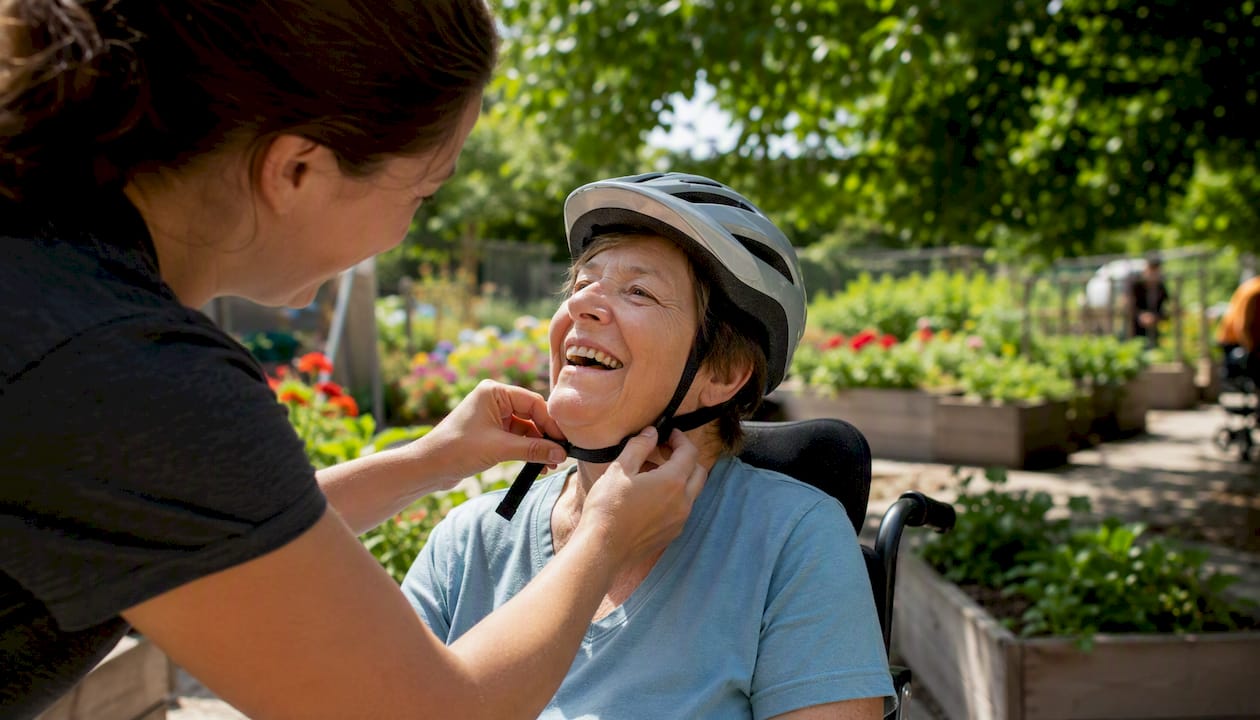
Family voice story — the most persuasive format for families making decisions on behalf of a participant. Structure: the family’s concern before engaging your service, the moment trust was established, the ongoing relationship. Avoid coaching families toward positive language; authentic hesitation followed by genuine relief is more convincing than polished praise.
Micro-win story — short, social-first content that celebrates a small but meaningful moment: a first bus trip, a new friendship, a skill achieved. These work at awareness and ongoing relationship stages.
Language dos and don’ts:
- Avoid: “suffers from,” “confined to a wheelchair,” “special needs,” “inspiring” as a descriptor for ordinary life
- Use: the participant’s own language, person-first phrasing unless the individual prefers identity-first, plain language throughout
- Accessibility: always include captions on video, alt text on images, and plain-language summaries for written content
Sample 60-second testimonial video script structure:
- Opening (0–10s): participant or family member states one specific goal in their own words
- Middle (10–45s): describes one concrete change the service enabled, with a specific detail
- Close (45–60s): one sentence about what they would tell someone considering the service
Consent, privacy and NDIS compliance: what every provider must do
Ethical storytelling in the NDIS context requires documented processes, not just good intentions. The NDIS Commission code of conduct sets the standard for how providers interact with participants, and that standard applies directly to story collection.
Consent checklist:
- Written media release form signed before any content is captured
- Form explains: specific uses (website, social media, print), duration of use, the participant’s right to withdraw at any time without consequence
- Consent obtained in the participant’s preferred communication format (Easy Read, verbal with witness, Auslan)
- Consent reconfirmed before each new use of existing content
- Withdrawal requests actioned within 48 hours, with content removed from all platforms
Storage and recordkeeping:
- Store signed forms in a secure, access-controlled folder named by participant ID (not full name) and date
- Each story bank entry contains: media files, signed consent form, defined approved uses, accessibility metadata, and a consent review date
- Retention period: keep consent records for the life of the content plus seven years
- Maintain an access log showing who retrieved or used each file
The NDIS official media guidance informs how participant stories should reference the scheme and its programmes. Separately, the NDIS trademark rules are strict: you cannot use the NDIS logo or imply scheme endorsement in your marketing materials. Your content can state that you are a registered NDIS provider, but the branding must stay clearly yours.
Ethical storytelling practice includes maintaining a formal story bank with signed media release forms and documented withdrawal rights — this is the industry standard, not an optional extra.
Copyright and moral rights: when a participant or family member creates written content, photos, or video for your organisation, they retain moral rights over that material. Always credit creators where practical and obtain a written assignment or licence before publishing.
Which content formats work best for NDIS storytelling?
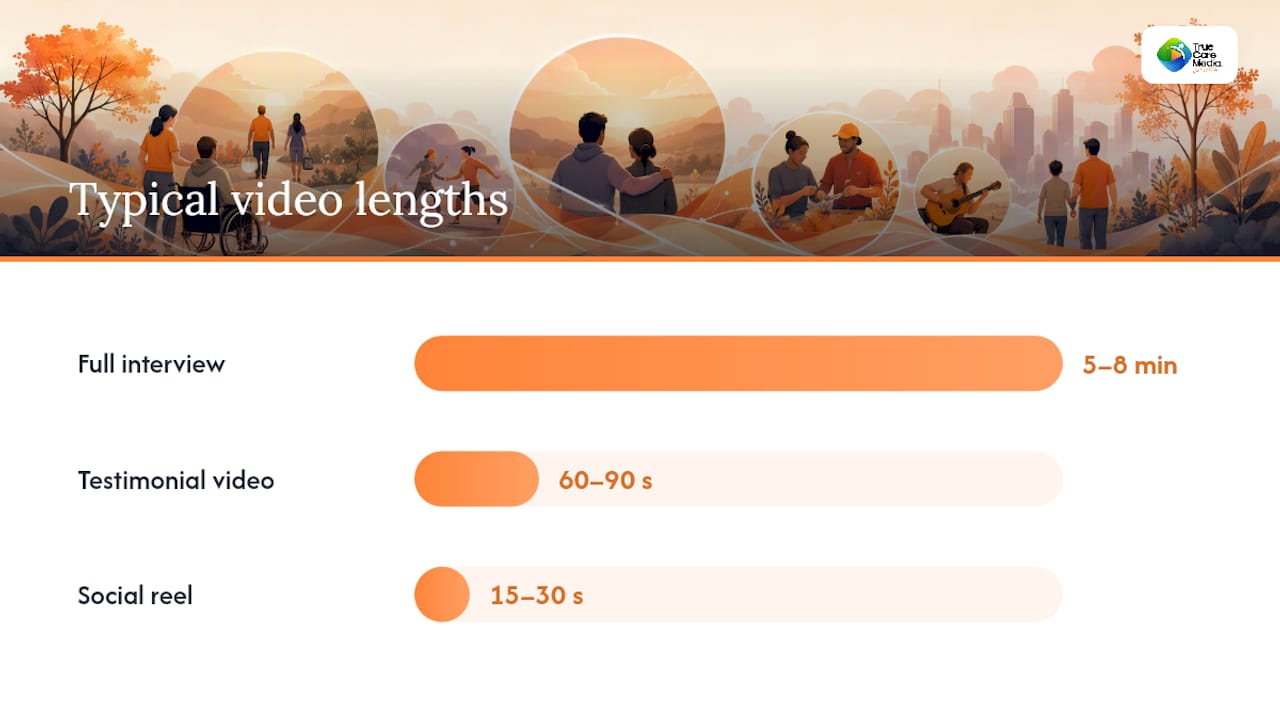
Video is the priority format for NDIS providers. It communicates warmth, competence, and authenticity faster than any written format, and it repurposes efficiently across channels. NDIS provider video content ranges from 15-second social reels to two-minute testimonial pieces, and a single well-planned shoot can yield assets for six to twelve months.
Format priority list:
- Short testimonial video (60–90 seconds) for website and social
- Day-in-the-life reel (15–30 seconds) for Instagram and Facebook
- Professional photography for website, Google Business Profile, and print
- Written case study (300–500 words) for website and referrer packs
- Email story (150–200 words) for newsletter and support coordinator updates
Production checklist for participant shoots:
- Reconfirm consent on the day, verbally, before filming begins
- Brief the participant on what will be filmed and how it will be used
- Use natural light and real environments where possible — avoid clinical or staged settings
- Capture closed captions during edit; do not rely on auto-generated captions alone
- Write descriptive alt text for every still image used in digital channels
Repurposing matrix: one filmed interview, multiple assets
| Source asset | Derived asset | Channel | Approx. length |
|---|---|---|---|
| Full interview (5–8 min) | Testimonial video | Website, YouTube | 60–90 seconds |
| Full interview | Social reel | Instagram, Facebook | 15–30 seconds |
| Full interview | Email story | Newsletter | 150–200 words |
| Full interview | Written case study | Website, referrer pack | 300–500 words |
| Still frames from shoot | Social image posts | Instagram, LinkedIn | 1–3 images |
Avoid the common NDIS imagery trap: stock photos of blue-and-green colour palettes and generic “helping hands” visuals signal inauthenticity immediately. Authentic photography of real environments and real people, captured with care, builds the credibility that stock images cannot. The role of photography in disability advocacy is well-documented — inclusive, specific imagery changes how participants perceive a provider before they read a single word.
How do you make storytelling operational across your whole organisation?
Stories that contradict the actual service experience destroy trust faster than no stories at all. The gap between a polished testimonial video and a frustrating intake call is the single biggest risk in NDIS brand storytelling.
Staff training outline:
- Induction module: what the brand story is, why it matters, and how each role contributes to it
- Practical session: how to describe the service in plain language without overpromising
- Scenario training: how to respond when a participant’s experience does not match the marketing
- Ongoing: monthly team story-sharing where staff nominate a participant moment worth capturing
Governance steps:
- All stories require sign-off from a designated content approver before publication
- Sensitive content (mental health, complex trauma, family conflict) escalates to the service manager
- Maintain an audit trail: who approved, when, what version was published, and where
Brand narrative aligned with NDIS service delivery requires that every claim in your content is verifiable against your actual service model. If your video says “we always respond within 24 hours,” your operations need to back that up. Storytelling is a quality signal, not a cover for gaps.
Staff stories also support recruitment and retention. When prospective staff see authentic content about your team’s values and daily work, they self-select more accurately — reducing turnover from poor cultural fit.
What does a practical 90-day content plan look like?
A content plan for NDIS storytelling needs four pillars, a production brief template, and a realistic cadence that a small team can sustain.
Content pillar framework:
- Outcomes — participant and family stories showing real results
- Education — plain-language content explaining services, funding types, and processes
- Behind the scenes — staff profiles, team moments, facility walkthroughs
- Community — local events, partnerships, participant milestones
90-day starter plan:
- Weeks 1–2: Finalise personas, consent templates, and governance approvals. Identify two participants willing to share their stories.
- Weeks 3–4: Conduct first filmed interview. Capture still photography. Brief content approver.
- Weeks 5–8: Edit and publish testimonial video to website. Derive social reels, email story, and written case study. Begin posting on a three-times-per-week social cadence.
- Weeks 9–12: Publish second participant story. Add a staff perspective piece. Review first-month metrics. Adjust pillar weighting based on engagement data.
Production brief template fields:
- Story type and target audience
- Outcome sought (what should the viewer feel or do after watching?)
- Consent status and form reference number
- Accessibility requirements (captions, Easy Read summary, alt text)
- Approved channels and use duration
- Sign-off required from (name and role)
For a deeper repurposing approach, the NDIS video repurposing strategy guide covers how to extend the value of each shoot across a full quarter of content.
Which KPIs actually show that storytelling is building trust?
Vanity metrics — likes, follower counts, video views — tell you almost nothing about whether your storytelling is converting trust into enquiries. The metrics that matter connect content outputs to business outcomes.
KPI list for NDIS providers:
- Qualified enquiries per month (contacts who match your service profile)
- Referral rate from support coordinators (tracked monthly)
- Conversion rate from first contact to completed intake
- Average time on page for case study content (a proxy for genuine engagement)
- Repeat referrals from the same support coordinator over a quarter
Dashboard cadence:
- Weekly: social engagement signals (saves, shares, comments — not just likes)
- Monthly: enquiry volume, source attribution, intake conversion rate
- Quarterly: referral review with support coordinators, story bank audit, consent reconfirmation check
A/B testing for improvement: test two thumbnail images or two case study headlines with a small paid social budget over two weeks. The version with the higher click-through rate informs your next three months of content. Keep tests simple: one variable at a time.
One industry example worth noting: a provider that shifted from generic service descriptions to specific, outcome-focused participant stories reported a 688% increase in phone enquiries and a 146% increase in form submissions. The mechanism was specificity — stories that named real goals and real progress outperformed broad capability claims. The benefits of storytelling for NDIS brands are most visible in referral quality, not just volume.
Step-by-step implementation checklist
From planning to first publish:
- Appoint a content lead and a content approver (two different people)
- Draft and legalise your media consent template with a privacy-aware solicitor or your compliance team
- Build your story bank folder structure and access controls
- Complete persona research using intake data and support coordinator interviews
- Brief two participants and obtain signed consent before any filming
- Conduct the shoot with a production checklist (consent reconfirmation, accessible environment, caption plan)
- Edit content, add captions and alt text, submit for approvals sign-off
- Publish to website first, then derive social assets
- Record the publish date, channels used, and consent form reference in your story bank
- Set a calendar reminder for consent reconfirmation at six months
Red flags to watch for:
- Overpromising outcomes in video scripts that the service cannot consistently deliver
- Staff behaviour in the field that contradicts the values shown in marketing content
- Inconsistent imagery (stock photos mixed with authentic photography undermine credibility)
- Consent forms that do not specify individual channels or use durations
Minimum viable storytelling package for a small provider:
- One filmed participant story (60–90 seconds)
- Three short social edits derived from that interview
- One written web case study (300–500 words)
- Signed consent forms and a story bank entry
- A 90-day content calendar with four pillars and a weekly posting schedule
Anonymised case examples and sample scripts that show real outcomes
Anonymised case study template:
Provider type: Community participation support, metropolitan NSW
Story type: Participant outcome video
What was filmed: 45-minute interview with participant and one family member, plus 20 minutes of B-roll at a community activity
Consent steps: Written media release signed two weeks prior, verbal reconfirmation on shoot day, Easy Read summary provided
Assets derived: 90-second testimonial video, two 20-second reels, one written case study, four still images
Distribution: Website homepage, Facebook, email newsletter, referrer information pack
Measured result: Case study page became the highest-engaged page on the website within 60 days; support coordinator referrals from that region increased over the following quarter
Sample interview questions for a participant story:
- “What were you hoping to find when you started looking for support?”
- “Can you describe one moment when you felt the support was working?”
- “What would you tell someone who is thinking about using this service?”
Sample interview questions for a family voice story:
- “What were your main concerns before your family member started with this provider?”
- “What changed once support began?”
- “What does a good week look like now?”
Pro Tip: Reduce consent fatigue by combining the consent conversation with the pre-shoot briefing call. When participants understand exactly what will happen before the camera appears, they arrive relaxed and give more authentic responses. A 15-minute phone call the week before a shoot is worth more than a rushed consent form on the day.
For additional healthcare facility storytelling examples that translate directly to NDIS contexts, the formats and outcomes are adaptable across provider types.
Key takeaways
An NDIS brand storytelling strategy works when consent, production, and operations are aligned — not when storytelling is treated as a marketing task separate from service delivery.
| Point | Details |
|---|---|
| Consent is non-negotiable | Every story needs a signed media release, documented uses, and a clear withdrawal process before publication. |
| Match story type to decision stage | Participant outcome stories convert at consideration; day-in-the-life content reduces anxiety at onboarding. |
| Repurpose every shoot | One filmed interview yields a testimonial video, social reels, a written case study, and email content. |
| Measure referral quality, not likes | Track qualified enquiries, intake conversion, and repeat support coordinator referrals — not follower counts. |
| Com’s production service | Com delivers audit-ready video, photography, and testimonial content with consent workflows built in. |
Why storytelling is the most underused compliance asset in the NDIS sector
Most NDIS providers treat storytelling as a marketing task they will get to eventually. That framing costs them twice: once in missed enquiries, and again when an auditor asks for evidence of participant-centred practice and the only documentation is a service agreement.
The providers who use storytelling well have figured out something the rest of the sector has not: a well-documented story bank is simultaneously a marketing asset and an audit trail. Signed consent forms, accessible content, and verified outcome claims are exactly the kind of evidence that demonstrates participant-centred practice to the NDIS Commission. When your stories are honest, your operations have to match them — and that accountability loop is what actually improves service quality over time.
The other thing most guides miss: the best storytelling content for NDIS providers is not polished. It is specific. A participant saying “I can now catch the bus to work on Tuesdays” is more persuasive than any produced piece about independence and inclusion. Specificity is the signal that a story is real, and real stories are the ones that convert referrers and reassure families.
True Care Media helps NDIS providers produce audit-ready stories
Producing compliant, participant-centred content takes more than a good camera. It takes consent workflows, accessible captions, a story bank structure, and production experience with participants who may have complex communication needs. That is exactly what Com delivers.

Com works with NDIS providers, allied health clinics, and aged care organisations across Australia to produce fixed-fee video and photography packages that are built for compliance from the first briefing call. A starter package typically includes a filmed participant testimonial, three social edits, professional photography, and a consent documentation kit your team can use immediately. Every deliverable comes caption-ready and formatted for the channels your participants actually use.
To see how video content supports care marketing outcomes and to request a production brief template and consent checklist, contact Com at truecaremedia.com.au.
Useful sources and further reading
Official guidance and compliance references for Australian NDIS providers:
- Standing out in a crowded NDIS industry through branding – Inside Small Business
- NDIS trademark and use of logo
- NDIS media
- NDIS code of conduct
- Telling Client Stories Without Breaching Privacy · Marketing for NDIS Providers | Jellypod Courses
- Role of brand narrative in NDIS: a 2026 guide
- Benefits of storytelling for NDIS brands: 2026 guide
This article provides general information for NDIS providers and marketers. It is not legal or compliance advice. Confirm current NDIS Commission requirements and privacy obligations with a qualified professional or directly with the relevant authority before implementing any storytelling programme.