
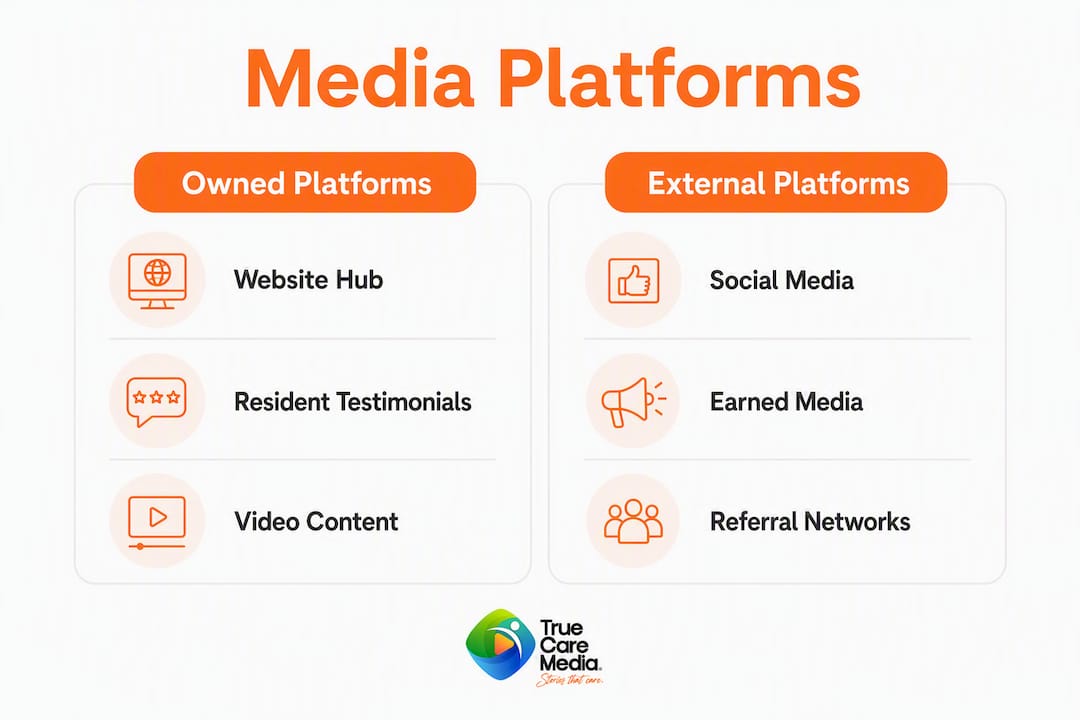
The highest-impact aged care trust-building media platforms are an owned video hub on your organisation’s website, short family-decision testimonial reels on Instagram and Facebook, YouTube for searchable long-form content, LinkedIn for clinical referrers, and earned coverage in trade and regional media. Together, these channels work because families form views during a narrow decision window, AI-driven search increasingly draws credibility signals from earned media rather than on-site SEO alone, and owned content hubs compound authority over time in ways a single paid campaign never will.
The Ageing in Australia Community Expectations Report 2026 from Ageing Australia found that Australians are more than twice as likely to trust aged care once they have direct experience of it and that nearly three-quarters would go directly to providers for information rather than to government. That puts the communication burden squarely on you.
Start here:
- Host a 90–180-second family-decision testimonial on your own website video hub this month.
- Publish a 30–60-second cut of the same story to Instagram Reels and Facebook.
- Pitch one story to a trade outlet (Inside Ageing, The Weekly Source) or a regional newspaper.
Table of Contents
- Which platforms reach families and referrers in Australia?
- What content formats actually build trust in aged care?
- How should you distribute content so trust compounds?
- Production checklist and Australian compliance requirements
- How do you choose a video and photography supplier for aged care?
- What KPIs show your media is building trust?
- What does an eight-week first project look like?
- Key takeaways
- The thing most providers get wrong about trust and media
- True Care Media: aged care video and photography that converts
- Useful sources and templates
Which platforms reach families and referrers in Australia?
Each channel plays a distinct role. Spreading effort evenly across all of them is a waste; the table below maps platform to audience and primary trust function.
| Platform | Primary audience | Trust function | Priority |
|---|---|---|---|
| Owned video hub (website) | Families in active decision-making | Decision anchor; canonical facts on pricing and eligibility | First |
| YouTube | Families researching; AI indexing | Searchable long-form; facility tours and staff stories | Second |
| Instagram / Facebook Reels | Adult children, community | Emotional micro-stories; 30–60s testimonial cuts | Second |
| GPs, discharge planners, allied health | Professional credibility; staff expertise and accreditation | Third | |
| Trade media (Inside Ageing, The Weekly Source) | Sector peers, referrers | Third-party validation; AI credibility signal | Ongoing |
| Regional / community outlets | Local families, community partners | Grassroots trust; local journalism creates relational credibility | Ongoing |
Your owned hub is the canonical source. Every other channel should drive traffic back to it, and every factual claim about pricing, eligibility, and services must match what lives there. Conflicting information between channels erodes trust fast, particularly in the early weeks when families are most uncertain.
What content formats actually build trust in aged care?
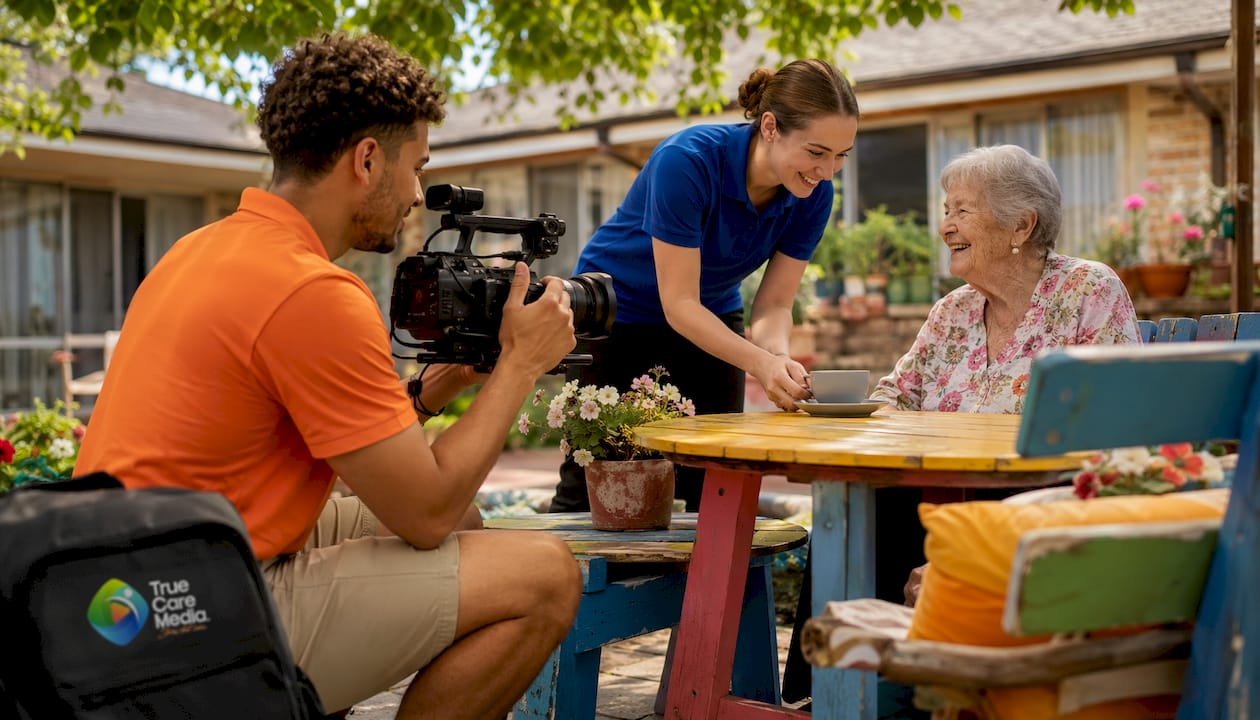
Resident-led storytelling consistently outperforms polished advertising in aged care. Families are sceptical of glossy production; they want to see real people, real interactions, and real staff. Sociological research frames trust in aged care as operating across interpersonal and institutional levels simultaneously, which means your content needs to surface warm human moments and signal organisational competence.
Priority formats and what to capture:
- Family decision video (90–180s, owned hub / YouTube): A resident or family member speaking candidly about the transition to care. B-roll of activities, mealtimes, and outdoor spaces. Staff name cards on screen. Captions throughout.
- Testimonial reel (30–60s, Instagram / Facebook): A single, specific moment — a resident describing a favourite activity or a family member recounting the first week. No voiceover, no music bed.
- Facility tour (2–4 mins, YouTube): Walk-through with a staff guide. Show the kitchen, the garden, the quiet lounge. Avoid empty rooms; film when residents are present and consenting.
- Day-in-the-life staff story (60–90s, all channels): Follow one carer through a morning shift. Close-ups of interactions, not just tasks. This format builds referrer confidence as much as family trust.
- Team photography: Professional portraits for the website and LinkedIn. Warm, natural light. Staff in their actual work environment, not a white studio backdrop.
- Community and event coverage: Event video from family days, cultural celebrations, and resident activities signals an active, connected community.
Pro Tip: Shoot B-roll of small, specific moments: a staff member remembering a resident’s coffee order, a resident laughing at a card game. These 5-second clips are what families replay. They cannot be faked, and they do more trust work than any scripted piece to camera.
Whiddon’s resident-story mini-documentary campaign is a useful benchmark: a coordinated print and multi-channel rollout drove measurable social engagement and website traffic uplift, demonstrating what happens when authentic storytelling meets a structured distribution plan.
How should you distribute content so trust compounds?
Create once, distribute deliberately. The flow looks like this: produce the canonical asset, host it on your owned hub, push it to YouTube, extract short cuts for social reels, pitch a version to trade or regional media, then run targeted paid support to audiences who have already visited your hub.
Repurposing checklist for each asset:
- Add captions and a full transcript (accessibility and SEO).
- Pull one or two data points or quotes for a press release paragraph.
- Cut a 15–30-second version for paid social retargeting.
- Write a short LinkedIn post for clinical referrers using the staff story angle.
Sustained, neutral media coverage shapes public perceptions of aged care over years, not weeks. Pitching trade and regional outlets is not a one-off task; it is a programme. Regional publishers and community radio carry particular weight for providers outside capital cities, where families rely on local voices when choosing care.
Production checklist and Australian compliance requirements
Consent comes first. Before any camera rolls, every resident, family member, and staff member appearing on screen must sign a written consent form that states the purpose of the footage, which channels it will be published on, and how to revoke consent. Keep signed copies on file indefinitely.
Numbered compliance checklist:
- Obtain written, informed consent from every person on screen (residents, family, staff).
- Align with the Australian Privacy Principles under the Privacy Act 1988 for collection, storage, and use of personal information including images.
- Review Aged Care Quality Standards requirements, particularly Standard 1 (consumer dignity and choice) and Standard 2 (ongoing assessment and planning with consumers), to confirm the shoot process respects resident agency.
- Apply your facility’s internal media policy and seek sign-off from the clinical or care manager before scheduling.
- Address cultural safety: consult with First Nations residents or community representatives before filming, and follow their guidance on what may or may not be recorded.
- Deliver captions on all video, alt text on all images, and readable on-screen name overlays (minimum 18pt equivalent, high contrast).
- Secure all raw footage in encrypted storage; define a data retention period and deletion schedule.
- Brief your crew on minimum-footprint protocols: small crew size, no unnecessary equipment in resident spaces, and a designated staff liaison on set at all times.
Consent form essentials: name of subject, date, description of the project, specific channels where content will appear (website, YouTube, Facebook, LinkedIn, media), duration of consent, and a clear revocation process with a named contact.
The Aged Care Quality and Safety Commission expects providers to demonstrate that residents retain informed choice throughout their care experience. A poorly managed shoot that pressures residents to participate is not just a compliance risk; it undermines the very trust you are trying to build.
How do you choose a video and photography supplier for aged care?
Prioritise suppliers with demonstrable aged-care experience, a clear consent and safety process, and transparent pricing. Standardised briefs and consent templates shorten procurement cycles and reduce compliance rework.
Questions to ask every supplier:
- Can you show us examples of resident-led storytelling from aged care or home care settings?
- What is your on-set consent process, and who holds the signed forms?
- Do you carry public liability and professional indemnity insurance?
- What accessibility deliverables are included (captions, transcripts, alt text)?
- Who owns the footage and edited files, and what are the usage rights?
- What is your turnaround from shoot to final delivery?
Red flags: unwillingness to discuss consent processes in detail; no sector references; footage that looks staged or over-directed; no mention of captions or accessibility; vague answers on usage rights.
Sample package tiers (indicative ranges):
| Package | Typical deliverables | Indicative price range |
|---|---|---|
| Starter testimonial bundle | 1–2 testimonial videos (60–90s each), basic photography set | — |
| Standard hub package | 3–5 videos (mix of testimonial, tour, staff story), team photography, captions | — |
| Premium integrated campaign | Full content suite, multi-format cuts, distribution support, accessibility package | — |
Pro Tip: Ask to see the supplier’s shot list from a previous aged care project. A good shot list shows they understand the difference between filming a facility and filming the people who live there.
True Care Media publishes practical video guidance specifically for aged care providers, including brief templates and accessibility checklists.
What KPIs show your media is building trust?
Track a mix of engagement quality, assisted conversions, and enquiry source rather than raw view counts.
| KPI | What it measures | Reporting cadence |
|---|---|---|
| Watch-through rate (%) | Whether content holds attention beyond the midpoint | Monthly |
| Average view time | Depth of engagement per video | Monthly |
| Clicks to contact / enquiry form | Direct conversion from video pages | Monthly |
| Enquiries citing video or social | Qualitative trust signal from intake conversations | Monthly |
| Referral source (UTM-tagged) | Which channel drove the enquiry | Monthly |
| Assisted conversions (2-month window) | Family decision journeys that touched video before enquiring | Quarterly |
Attribution checklist: tag every video landing page with UTMs, set up call tracking on your main enquiry number, and use a two-month assisted conversion window in Google Analytics or your CRM. Family decisions in aged care rarely happen in a single session.
What does an eight-week first project look like?
| Week | Key tasks | Who leads |
|---|---|---|
| — | Brief supplier, confirm budget, internal approvals | Marketing lead |
| 1–2 | Script / story development, resident and family consent conversations, scheduling | Supplier + care manager |
| 3 | Shoot day(s): testimonials, tour, staff stories, photography | Supplier on-site |
| 4–5 | Rough cut review, clinical and privacy sign-off, revision round | Marketing lead + care manager |
| 6 | Captions, transcripts, alt text, accessibility review | Supplier |
| 7 | Platform setup: video hub page, YouTube upload, social scheduling | Marketing lead |
| 8 | Launch, UTM tracking live, initial engagement report | Marketing lead |
Pad weeks 1–2 generously. Consent conversations with residents and families take longer than a calendar slot suggests, and resident availability on shoot day is never guaranteed. Build a half-day contingency into week 3.
Key takeaways
Aged care providers who combine an owned video hub with resident-led testimonials and consistent earned media coverage build the deepest, most durable trust with families and referrers.
| Point | Details |
|---|---|
| Owned hub first | Host canonical videos on your website before distributing anywhere else to control messaging. |
| Resident-led storytelling | Authentic, modest-production content outperforms polished advertising for family trust. |
| Consistency across channels | Conflicting pricing or eligibility information between channels erodes trust during decision weeks. |
| Compliance is non-negotiable | Written consent, Australian Privacy Principles, and Aged Care Quality Standards apply to every shoot. |
| True Care Media | Offers testimonial videos, hub packages, accessibility deliverables, and distribution support for aged care providers. |
The thing most providers get wrong about trust and media
Most aged care marketing conversations start with “which platform should we be on?” The better question is “what would make a worried adult child feel genuinely reassured?” Those are different questions, and they lead to different briefs.
The providers who build the most durable reputations are not the ones with the most polished content. They are the ones who let residents speak for themselves, who keep their messaging consistent from the website to the intake conversation, and who treat earned media as a long-term relationship rather than a press release. A single authentic testimonial from a family member, placed on a well-structured video hub page and pitched to a regional outlet, will do more for enquiry quality than a six-figure advertising campaign that looks like every other aged care ad on television.
The compliance piece matters more than most marketing leads realise, too. A shoot that respects resident agency, uses small crews, and delivers proper captions is not just legally safer; it produces better content. Residents who feel comfortable and in control give you the moments that families actually trust.
True Care Media: aged care video and photography that converts
If you are ready to produce content that genuinely moves families from uncertainty to enquiry, True Care Media builds exactly that. The offering covers testimonial videos, facility tour packages, staff photography, accessibility deliverables (captions, transcripts, alt text), and distribution support, all scoped for aged care and home care providers across Australia.

Packages are fixed-fee and transparent, from a starter testimonial bundle through to a full aged care video marketing suite. If you are focused on residential photography, the residential care photography guide outlines what a professional imagery package delivers and why it matters for family decision-making. To see finished examples and discuss a brief, visit True Care Media and get in touch.
Useful sources and templates
| Resource | What it contains | Use it for |
|---|---|---|
| Ageing in Australia Community Expectations Report 2026 | National data on trust gaps and provider communication | Briefing leadership; framing the case for media investment |
| Aged Care Quality Standards (ACQSC) | Standards 1 and 2 on dignity, choice, and informed consent | Compliance checklist; shoot briefing |
| Inside Ageing: PR and AI in aged care | Earned media strategy and AI discoverability guidance | Distribution strategy; trade media pitching |
| Hello Leaders: trust in aged care | Practical trust-building at the point of first contact | Messaging consistency; intake process alignment |
| True Care Media: video in aged care marketing | Brief templates, shot lists, and accessibility checklists | Supplier briefing; procurement |
| True Care Media: visual storytelling guide | Messaging consistency and resident storytelling approach | Content tone; brief writing |
| True Care Media: family decision video guide | Step-by-step guide to producing family decision content | Brief template; content planning |