
Care worker profiles build measurable trust by combining verifiable expertise, first-person motivation, and visible identity before a participant or family member ever makes contact. Done well, they reduce perceived risk, improve enquiry conversion, and give your organisation a credibility edge that generic “About Us” copy never will.
Here is what the evidence points to, and what to do about it:
- Publish a professional headshot alongside a concise bio that includes a “why I care” line for every staff member.
- Add a 30–60 second on-camera video introduction where possible.
- List at least one verifiable credential or training entry per profile to satisfy E-E-A-T (experience, expertise, authoritativeness, trustworthiness) requirements.
- Secure written consent before publishing anything.
Table of Contents
- Why do care worker profiles build trust?
- What should you include in a care worker profile?
- Which format works best: video, photography, or text?
- What are the consent and privacy obligations for publishing profiles in Australia?
- How do you measure the impact of staff profiles?
- What does a realistic production timeline look like?
- How do you keep profiles accurate and trustworthy over time?
- Ready-to-use micro-scripts, bio templates, and photo briefs
- Key takeaways
- The case for getting this right, not just getting it done
- True Care Media: profile production for NDIS and aged care providers
- Useful sources for Australian providers
Why do care worker profiles build trust?
Profiles work because they convert anonymous staff into identifiable, accountable people. That shift alone reduces the perceived risk families and participants feel when choosing a provider.
The mechanisms are layered. Google’s E-E-A-T framework rewards pages that demonstrate first-hand experience on a topic, which means a care worker describing their own practice in their own words is both a user-experience asset and an SEO asset. Peer-to-peer caregiver spotlights provide social proof and first-hand experience simultaneously, making them exceptionally effective for NDIS and aged care audiences who are already sceptical of marketing copy.
Narrative psychology adds another layer. A short “why I do this” story creates emotional connection in a way that a list of qualifications cannot. Sharing the ‘why’ behind a worker’s career is consistently identified as a top trust-building move, shifting the perception from transactional to relational.
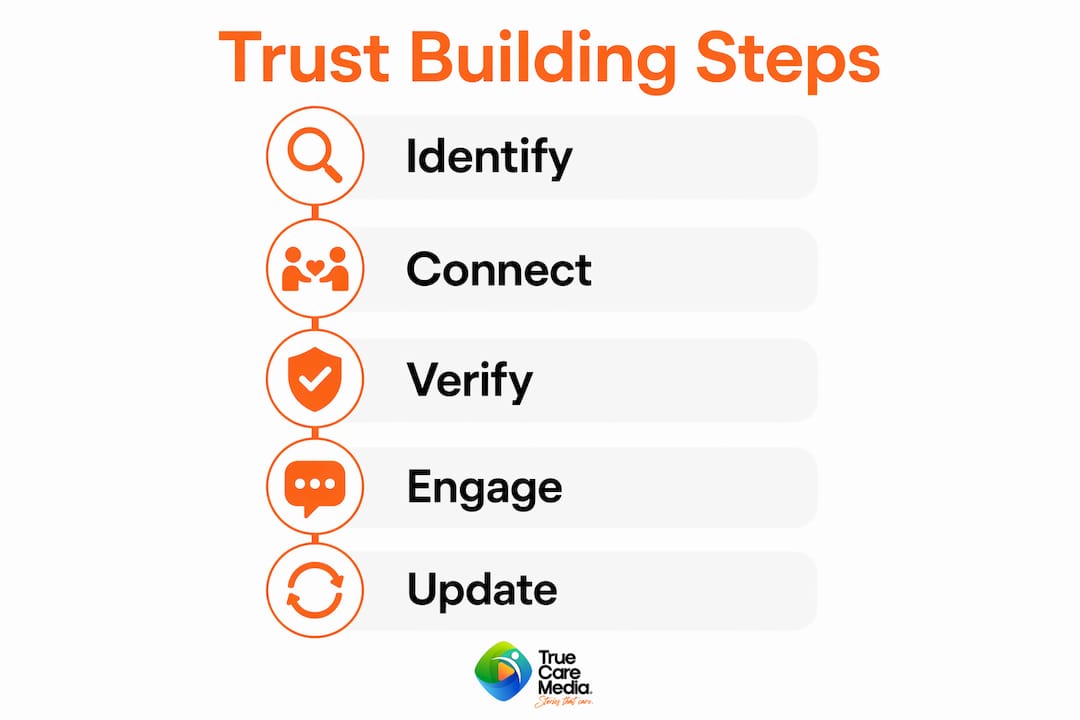
Australian regulators reinforce this logic. The NDIS Quality and Safeguards Commission expects providers to demonstrate workforce capability and transparency. The Aged Care Quality and Safety Commission’s quality standards require providers to show that staff are qualified and suited to the people they support. The Office of the Australian Information Commissioner (OAIC) sets the privacy framework within which all of this must happen. Profiles that are well-constructed and properly consented satisfy all three expectations at once.
Pro Tip: Run a quick audit of your existing staff pages. If a family member cannot tell within 10 seconds who this person is, what they specialise in, and why they chose care work, the profile is not doing its job.
Practically, transparent caregiver bios and photos are an E-E-A-T improvement that most Australian providers still underuse. Organisations that have invested in them report reduced enquiry friction and stronger family confidence before the first visit.
What should you include in a care worker profile?
Every profile needs identity, verifiable credentials, specialisms, experience, a short first-person motivation statement, and accessibility notes. That is the non-negotiable floor.
Checklist of profile fields:
- Preferred name and pronouns
- Role title and tenure with your organisation
- Certifications and completed training (e.g. Certificate III or IV in Individual Support, Manual Handling, Medication Administration)
- Specialties: dementia care, autism support, PEG feeding, mobility assistance, mental health, paediatric care
- Language skills and cultural background where relevant
- NDIS Worker Screening Check status (or equivalent registration note)
- “Why I care” statement: 1–2 sentences in the worker’s own voice
- Availability snapshot (optional, useful for home care directories)
- Link to a 30–60 second video introduction
- Optional: a short participant or family testimonial
Microcopy guidance:
- Keep bios concise. Longer reads as a CV, not a person.
- Video introductions should run about one minute or less. Anything longer loses most viewers before the key message lands.
- Add one accessibility line per profile: communication preferences, sensory considerations, or cultural background that helps match the right worker to the right participant.
- Every profile must include at least one verifiable credential or training entry. This is what separates a trustworthy profile from a marketing blurb.
Upfront documentation of preferences and expectations is one of the most reliable early trust-builders between families and care workers. Profiles that capture this information give families a head start before the relationship even begins.
Which format works best: video, photography, or text?
A highly effective combination is a professional headshot plus a short on-camera video. Neither alone is as effective as both together.

| Format | Best use case | Key production note |
|---|---|---|
| Professional headshot | Directory listings, quick recognition, email signatures | Consistent background, good natural light, dignified framing |
| Short video (30–60s) | First-person story, personality, demonstrations | Caption for accessibility and SEO; script with 2–3 prompts |
| Text bio | SEO, deeper detail, screen-reader accessibility | 150–250 words, plain language, first-person voice |
| Social media reels | Staff personality, culture, peer social proof | Informal tone, vertical format, subtitle overlay |
Professionalising the workforce through transparent, detailed profiles validates professional identity and demonstrates capability in competitive care markets. Photography is part of that signal. A blurry phone photo undercuts the credibility a well-written bio is trying to build. For residential care settings, professional photography is worth the investment specifically because it communicates quality of environment and care culture simultaneously. See the benefits of video for trust building for evidence on how video reduces uncertainty for prospective families.
Pro Tip: Caption every video. Captions improve accessibility for participants with hearing impairments, increase watch time on social media where autoplay is muted, and give search engines indexable text from the video content.
For cultural sensitivity: use plain language in bios, translate key profile headings where your participant base includes CALD communities, and consult with Aboriginal and Torres Strait Islander community members before publishing profiles of First Nations workers.
What are the consent and privacy obligations for publishing profiles in Australia?
Secure explicit, auditable consent before publishing any staff profile. This is not optional under the Australian Privacy Principles.
Publishing a staff profile without documented consent exposes your organisation to a complaint under the Privacy Act 1988 (Cth) and may breach the Australian Privacy Principles administered by the OAIC. Consent must be freely given, specific, informed, and revocable at any time.
Key obligations for NDIS and aged care providers:
- Obtain written consent using a standard form that specifies exactly what will be published and where.
- Record the date of consent and an expiry or review date (12 months is a reasonable default).
- Allow withdrawal at any time and have a clear process for removing or redacting content promptly.
- Store consent forms securely, separate from participant records.
- Include a brief consent summary on the profile page itself (e.g. “Published with the worker’s written consent, reviewed [month/year]”).
For Aboriginal and Torres Strait Islander workers and CALD staff, apply cultural safety practices: consult before publishing, use community-appropriate language, and check whether images or names carry cultural significance that affects how they should be shared. The OAIC’s guidance on sensitive information and the NDIS Quality and Safeguards Commission’s practice standards are the primary references here.
Redact or delay sensitive details (e.g. specific suburb of residence, personal health information) and use participant-centred language throughout.
How do you measure the impact of staff profiles?
Measure both behavioural signals and attitudinal ones. Page views alone tell you nothing useful.
- Profile page views — baseline traffic indicator; segment by worker and by referral source.
- Average time on profile — a proxy for genuine engagement; under 30 seconds suggests the content is not landing.
- Click-through to contact or booking — the most direct conversion signal.
- Enquiry conversion rate — track whether enquiries from profile-page visitors convert at a higher rate than other traffic sources.
- Referral source uplift — monitor whether GP, allied health, or NDIS planner referrals increase after profiles go live.
- Participant satisfaction scores — include a profile-specific question in post-intake surveys.
- Staff retention linked to profile visibility — consistency and predictable interactions build trust over time; staff who feel professionally represented tend to stay longer.
Pro Tip: A/B test video-only profiles against photo-plus-bio profiles for a 60-day period. Tag profile links in your CRM so you can attribute enquiries accurately. Run a quarterly audit of profiles with below-average time-on-page and update them first.
Reporting cadence: weekly dashboard for views and enquiries, monthly content tweaks, quarterly impact review tied to conversion metrics and participant feedback.
What does a realistic production timeline look like?
A repeatable production workflow keeps consent, quality, and consistency aligned across every profile you publish.
| Phase | Activity | Suggested timeline |
|---|---|---|
| Brief | Define scope, assign roles, draft consent forms | Initial period |
| Consent collection | Distribute, sign, and file consent forms | Following initial period |
| Shoot day | Photography and video capture | Subsequent days |
| Editing | Video edit, photo retouch, bio copywriting | Following shoot days |
| Compliance check | Consent audit, privacy review, cultural safety check | Prior to publishing |
| Publish and promote | Web upload, social media, internal comms | After compliance check |
A typical rollout timeline can range from several weeks to a few months depending on scale, allowing time for each stage and any necessary reviews.
Team roles: content lead, photographer/videographer, consent officer, editor, web publisher, and data custodian. Define sign-off authority for consent, editorial, and compliance before the project starts, not after.
Pro Tip: Batch shoot days by location and role type. Filming five support workers in one afternoon is far more cost-effective than five separate half-day sessions, and the consistency of lighting and background strengthens your brand presentation.
How do you keep profiles accurate and trustworthy over time?
Profiles must be versioned and reviewed regularly. An outdated profile is worse than no profile: it signals that your organisation does not pay attention to detail.
Update policy:
- Minimum review cadence: regularly for all active profiles.
- Immediate update triggers: qualification change, role change, complaint upheld against a worker, consent withdrawal, or staff departure.
- Archival rule: remove departed staff profiles within 30 days; retain consent records for seven years per standard document retention practice.
Escalation paths:
- Consent withdrawals go to the data custodian and web publisher within 48 hours.
- Negative content or factual disputes go to the content lead and legal/compliance team.
- Cultural safety concerns go to the relevant community liaison or cultural safety officer.
Staff training checklist before publish:
- Complete a short induction module covering profile creation standards, consent literacy, and cultural safety.
- Review and sign the consent form.
- Confirm profile content with the content lead.
- Sign off on the final published version before it goes live.
Empathy, consistency, and respect for client autonomy are foundational trust behaviours. Profiles should reflect and reinforce those behaviours, not contradict them with clinical jargon or impersonal language.
Ready-to-use micro-scripts, bio templates, and photo briefs
Short, specific prompts make on-camera performance easier and improve authenticity. Workers who are handed a blank camera and told to “say something about yourself” freeze. Workers given three guiding questions deliver genuine content.
30–60 second video micro-script:
Basic bio template (150 words):
Name, role, years of experience, two to three specialties, one sentence on qualifications, one “why I care” sentence in first person, one line on communication style or cultural background where relevant.
Enhanced bio template (250 words):
All of the above, plus a short paragraph on a specific area of practice, a note on languages spoken, an accessibility line, and a link to the video introduction.
Photo brief:
- Framing: head and shoulders, slight angle, not straight-on passport style.
- Background: plain or softly blurred workplace setting; avoid cluttered clinical environments.
- Attire: organisation uniform or smart casual consistent with brand guidelines.
- Lighting: natural window light or a simple two-light setup; avoid harsh flash.
- Caption: worker’s preferred name, role title, and a one-line accessibility description for screen readers.
Pro Tip: Capture at least one natural interaction shot per worker during the shoot day, in addition to the formal headshot. These candid images are often the most effective on social media and in family-facing brochures because they show the worker in context, not just in front of a camera.
Key takeaways
Well-crafted care worker profiles build trust by making staff identifiable, credible, and human before first contact, and that combination directly reduces enquiry friction and improves conversion for Australian NDIS, aged care, and home care providers.
| Point | Details |
|---|---|
| Profiles reduce perceived risk | Identifiable, accountable staff lower anxiety for families and participants before the first contact. |
| Mix video, photo, and bio | A professional headshot plus a 30–60 second video plus a 150–250 word bio is the highest-impact combination. |
| Consent is non-negotiable | Obtain written, auditable consent under the Australian Privacy Principles before publishing any profile. |
| Measure what matters | Track time on profile, click-through to contact, and enquiry conversion rate, not just page views. |
| TrueCare Media | True Care Media produces profile photo and video packages for NDIS, aged care, and home care providers across Australia. |
The case for getting this right, not just getting it done
Most providers I see treat staff profiles as a box-ticking exercise: a headshot taken on a phone, a two-line bio written by someone in admin, published once and never touched again. That approach does not build trust. It signals indifference.
The organisations that see real results from profiles treat them as a content asset with the same rigour they apply to a service brochure or a compliance document. They invest in professional photography. They give workers the time and prompts to speak authentically on camera. They review profiles annually and update them when something changes. They measure the impact.
There is also something worth naming directly: participants and families in the NDIS and aged care system have often had difficult experiences with providers. They are not naive audiences. A polished but hollow profile reads as hollow. An imperfect but genuine one, where a worker’s real motivation comes through, lands differently. That authenticity is not a production value you can fake. It comes from giving workers the space and the brief to say something true.
The healthcare facility storytelling examples that perform best are the ones where the worker’s voice is clearly their own. That is the standard worth aiming for.
True Care Media: profile production for NDIS and aged care providers
Australian NDIS, aged care, and home care providers that want profiles done properly, not just done, have a straightforward option. True Care Media produces professional photo and video packages built specifically for the care sector, from single-site headshot sessions to multi-site rollouts with full editing and web-ready delivery.

Services relevant to this article include photo and video bundles for staff profiles, testimonial video production, social media reels, consent form templates, and content planning support. For aged care providers, the role of video in aged care marketing page covers the full scope of what a profile video programme can include. For residential care settings, the residential care photography guide is a practical starting point for scoping a photography project.
To request a free scoping call or a profile audit of your existing staff pages, contact True Care Media directly through the website.
Useful sources for Australian providers
This article is general guidance. Before publishing staff profiles, confirm current requirements with the relevant regulators for your organisation’s specific context.
- NDIS Quality and Safeguards Commission — workforce capability standards, practice standards, and worker screening requirements for registered NDIS providers.
- Office of the Australian Information Commissioner (OAIC) — the Australian Privacy Principles, guidance on consent and personal information handling, and complaint processes under the Privacy Act 1988 (Cth).
- Aged Care Quality and Safety Commission — quality standards for aged care providers, including expectations for transparent information about care staff and workforce capability.
- True Care Media guides — practical resources on video production, photography, and storytelling for NDIS, allied health, and aged care providers.
For policy and privacy queries, go to the OAIC first. For clinical governance and workforce standards, the NDIS Commission and Aged Care Quality and Safety Commission are the primary references. For execution support, True Care Media’s guides cover production, consent, and measurement in the Australian care context.
This article provides general information only and does not constitute legal, privacy, or compliance advice. Confirm current regulatory requirements with the OAIC, NDIS Quality and Safeguards Commission, or Aged Care Quality and Safety Commission, or seek advice from a qualified professional for your organisation’s specific circumstances.