
Doctor explainers, patient testimonials, treatment walkthroughs, FAQ videos, and short-form social reels are the five formats that consistently drive appointment enquiries for Australian healthcare providers. Your immediate next step: film a brief physician explainer and embed it on your procedure page, then cut a 60-second version for Instagram and Facebook.
Two non-negotiables before you film anything:
- Production minimum: clear audio, natural light, clinician on-camera and looking directly at the lens.
- Compliance minimum: written, informed consent from any patient who appears on screen, obtained before filming begins (see compliance guidelines).
Testimonials and doctor explainers consistently generate strong appointment enquiries across healthcare specialties. Short-form reels extend reach and build familiarity, but they rarely close a booking on their own. Pair them with a longer explainer on the relevant service page and you cover both ends of the funnel.
Table of Contents
- Which video formats actually attract private patients?
- Where should you publish and promote healthcare videos?
- How do you measure video-driven patient acquisition?
- Australian compliance checklist for patient video content
- Production checklist: from brief to published video
- What does healthcare video production cost in Australia?
- Truecare Media helps Australian providers attract private patients
- Key takeaways
- Why video converts private patients better than most providers expect
- Useful sources and further reading
Which video formats actually attract private patients?
Each format performs a different job in the patient decision cycle. Knowing which job to prioritise first saves you from filming the wrong thing.

Doctor explainers build clinician authority and reduce the research friction that delays bookings. A brief video of your specialist explaining a procedure in plain language, placed on the relevant service page or clinician bio, answers the questions patients are already Googling. The treatment explainer role in healthcare is fundamentally about shortening the gap between “I’m curious” and “I’m ready to book.”
Patient testimonials carry the highest social proof of any format, but also the highest compliance risk. They work because prospective patients trust other patients more than they trust clinicians talking about their own results. The catch: testimonials must be truthful and representative — an unrepresentative outcome claim creates real regulatory exposure under Australian Consumer Law and AHPRA advertising guidelines.
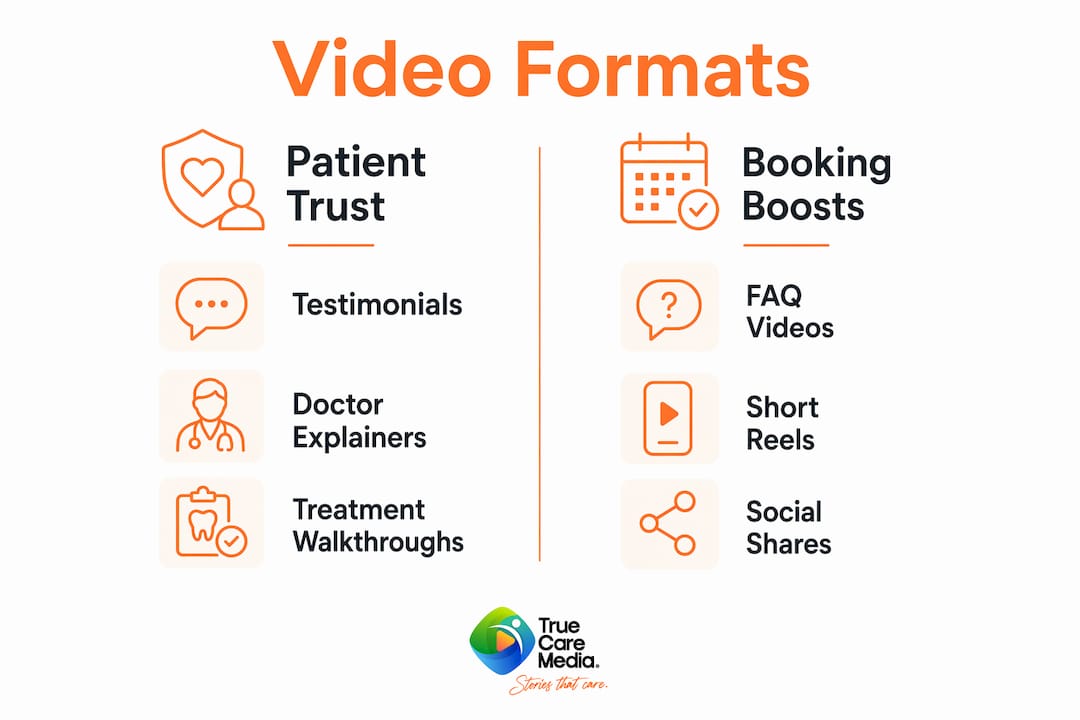
Treatment walkthroughs reduce pre-appointment anxiety by showing exactly what a consult or procedure involves. Use neutral, factual language. Patients watching a walkthrough are asking one question: will this be okay for me? Answer that honestly and you remove a major booking barrier.
FAQ videos save your reception team time and address the objections that stall bookings. Video paired with written materials improves patient comprehension and satisfaction. Repurpose each FAQ answer into a standalone 30–60 second clip for social. For practical examples of educational video formats that reduce staff workload, the approach translates directly to allied health and aged care settings.
Short-form reels extend reach and build familiarity. One focused question per clip, captions on every video, and a clear on-screen CTA. They rarely convert cold audiences directly, but they warm up patients who then find your longer content.
Prioritisation framework: start with the format that matches your biggest conversion gap. If patients are landing on your procedure page and not enquiring, film an explainer. If they are enquiring but not booking, film a walkthrough. If you are barely getting traffic, invest in short-form reels and FAQ clips first.
Pro Tip: Book one filming day and plan five to eight videos across formats. A single session with your clinician can yield a 3-minute explainer, two FAQ clips, and raw footage for four reels. The per-asset cost drops significantly.
Where should you publish and promote healthcare videos?
Placement determines whether a video converts or just gets watched.
Embed high-intent videos directly on condition- and procedure-specific pages rather than burying them on a generic “About Us” page. A patient researching knee reconstruction wants to see your surgeon explain the procedure on that page, not hunt for a video library. This turns video from a marketing asset into a conversion utility.
For YouTube, optimise titles, descriptions and transcripts with patient-focused language. Add video chapters for longer explainers and implement VideoObject schema markup so Google can surface your content in rich results. YouTube functions as a search engine for health questions — your explainers belong there.
- Repurpose one filming session into short-form clips for Instagram Reels, Facebook and YouTube Shorts.
- Add video to your Google Business Profile — it appears directly in local search results.
- Include video links in email nurture sequences for patients who have enquired but not yet booked.
- Run targeted social ads and YouTube TrueView campaigns pointing to a service page that already contains the video, not to a generic homepage.
Pro Tip: Tag every social and paid link with UTM parameters before you publish. Without them, you cannot tell whether an appointment enquiry came from your YouTube explainer, your Instagram reel, or a paid campaign. This takes five minutes and saves months of guesswork.
How do you measure video-driven patient acquisition?
View counts tell you almost nothing commercially useful. Track conversion-rate changes on the specific service pages hosting your videos and the total appointment enquiries attributable to those pages — those are the numbers that justify spend.
| KPI | How to measure | Recommended tool |
|---|---|---|
| Procedure page conversion rate | Compare enquiry form submissions before and after video embed | Google Analytics 4 (GA4) |
| Appointment enquiries from video traffic | UTM-tagged links + goal tracking on booking/enquiry form | GA4 + CRM lead source field |
| Booked consultation rate from video traffic | CRM pipeline stage tracking | Your practice management or CRM system |
| Watch time and average % viewed | YouTube Studio or embedded player analytics | YouTube Analytics / Vimeo |
| Video play and CTA click events | Event tracking on play button and CTA | GA4 event tracking |
| Call enquiries attributed to video | Unique tracking number on video pages | Call tracking software (e.g. CallRail) |
Attribution in private healthcare is genuinely complex. Decision cycles for elective procedures can run weeks or months, so a patient who watched your explainer in April may not book until June. Set a 90-day attribution window in your CRM and review trends quarterly rather than week-to-week. The signal you are looking for is a sustained lift in enquiry volume from pages that host video, not a spike after a single upload.
Australian compliance checklist for patient video content
Any video featuring a patient, or making a clinical claim, carries legal obligations under Australian law. This is not optional paperwork.
Practical checklist before any patient appears on screen:
- Written consent form signed before filming, specifying where the video will be published, for how long, and whether it can be repurposed.
- Consent form reviewed by your legal or compliance team, not drafted from a generic template.
- Clinical claims in the video reviewed and signed off by a registered medical professional before publication.
- No absolute outcome promises (“you will recover in two weeks,” “guaranteed pain relief”).
- Disclosure of any material connection if the patient received a benefit for participating.
- Consent records stored securely with restricted access; raw footage treated as protected health information.
- For a practical patient testimonial consent framework, the checklist above maps directly to AHPRA and Privacy Act requirements.
Key authorities: AHPRA advertising guidelines govern registered practitioners; the ACCC and Ad Standards govern consumer-facing claims for all health businesses.
Production checklist: from brief to published video
Pre-production
- Define the single question this video answers and the one CTA it drives.
- Confirm clinician availability and location; book a medical reviewer for sign-off.
- Prepare a consent template if any patient appears on screen.
- Write a brief covering: audience, procedure, target KPI, and distribution channels.
Sample script structure
- State the question and give a plain-language answer in the first 15 seconds.
- Explain the procedure or topic in accessible terms (no jargon).
- Acknowledge limitations and when to seek further care.
- Close with a clear next step: “Book a consultation at [clinic name].”
- Add a medical reviewer credit in the end card.
Technical specifications
| Element | Specification |
|---|---|
| Resolution | Minimum HD; 4K preferred for future-proofing |
| Audio | Lapel microphone; no background noise |
| Captions | Closed captions on every video; transcript published alongside |
| Thumbnail | Clinician face, clear text overlay, no stock imagery |
| File format | MP4 format for web; ProRes for archive |
For detailed medical procedure explainer production guidance, including camera setup and clinician briefing notes, the technical requirements translate across specialties.
Post-production: edit one brief explainer into several short clips. Add captions and a CTA overlay to each. Sign-off sequence: clinical reviewer approves content accuracy, legal/compliance approves claims and consent, marketing approves distribution plan.
What does healthcare video production cost in Australia?
Budget expectations vary significantly by project scope, from smaller single clinic shoots to comprehensive multi-location projects, reflecting differences in clinician time, editing, and production scale.
What drives cost upward: multiple filming locations, extended clinician time, medical review and transcription fees, and the number of repurposed assets. What drives it down: batching formats into one session, having a clear brief before the crew arrives, and reusing footage across channels.
Timeline: a single 2–3 minute explainer typically takes 2–4 weeks from brief to published, including one clinical review cycle. A library of 8–12 clips runs 6–10 weeks. Build in time for consent processing and compliance sign-off — rushing this stage is where campaigns run into trouble.
Pro Tip: Estimate the revenue value of one new private appointment in your specialty, then apply a conservative assumption: if video lifts your procedure page conversion rate by even a modest amount, how many additional bookings does that represent over 12 months? That calculation usually makes the production investment look straightforward.
Red flags in vendor quotes: no clinical review process, missing consent workflows, no repurposing strategy, and no measurement plan. A vendor who cannot explain how they will help you track appointment enquiries is not a healthcare specialist.
Truecare Media helps Australian providers attract private patients
Healthcare video is not the same as corporate video. The compliance requirements, the clinical review process, the consent workflows, the need to build genuine trust rather than just awareness — these demand a producer who understands the sector.

Truecare Media works with NDIS providers, allied health clinics, private hospitals, and aged and home care providers across Australia to produce video and photography that drives measurable appointment enquiries. The offering covers testimonial films, procedure walkthroughs, short-form social reels, brand awareness videos, and photography packages — all produced with built-in consent workflows and clinical review as standard.
For aged care providers, video content for aged care marketing addresses the specific trust signals families need when making placement decisions. For home care and residential providers, family-facing decision-support video content bridges the gap between a family’s first search and a confirmed enquiry.
To brief Truecare Media, you need four things: your priority procedure or service, your target patient demographic, your clinician’s availability for a half-day shoot, and the KPI you want to move. From there, the team handles scripting, filming, compliance review, editing, and distribution planning. Get in touch at truecaremedia.com.au to discuss a content package for your organisation.
Key takeaways
Video marketing for healthcare works when formats are matched to funnel stage, content is compliant, and success is measured by appointment enquiries rather than view counts.
| Point | Details |
|---|---|
| Start with doctor explainers | Film a 2–3 minute physician explainer and embed it on your procedure page before any other format. |
| Compliance is non-negotiable | Written patient consent and AHPRA-compliant claims review must precede publication of any patient-featuring video. |
| Measure commercial KPIs | Track procedure page conversion rate and appointment enquiry volume, not view counts or likes. |
| Batch production to cut costs | One filming day can yield a full content library of explainers, FAQ clips, and short-form reels. |
| Truecare Media for healthcare video | Truecare Media produces compliant, conversion-focused video and photography for Australian NDIS, allied health, and aged care providers. |
Why video converts private patients better than most providers expect
Most healthcare providers underestimate how much anxiety sits between a patient’s first Google search and their decision to book. They have read the condition page, they have checked the fees, and they still hesitate. What they are waiting for is a reason to trust the person they are about to hand their health to.
That is the specific job video does that no other format replicates. A clinician speaking directly to camera, explaining a procedure in plain language, acknowledging the questions patients are embarrassed to ask — that removes the hesitation in a way that a well-written service page simply cannot. Clinician scepticism about marketing often eases when video is framed as patient education rather than promotion, because that framing is accurate. The best healthcare videos are not advertisements. They are the conversation a patient needed to have before they felt ready to book.
The providers who see the strongest results are not necessarily those with the highest production budgets. They are the ones who film the right format for the right stage of the patient journey, embed it where the decision is actually being made, and measure what happens to enquiry volume afterwards. That combination — format, placement, measurement — is what separates video that drives bookings from video that just gets watched.
Useful sources and further reading
- AHPRA Advertising Hub — authoritative guidance on advertising obligations for registered health practitioners in Australia, including testimonial and claims rules.
- Australian Privacy Act 1988 (Office of the Australian Information Commissioner) — governs collection, use and disclosure of personal information including patient health data used in marketing.
- Ad Standards Australia — community standards and complaint process for health advertising.
- Healthcare video marketing strategy guide — practical format and measurement guidance for healthcare organisations.
- How video marketing transforms healthcare businesses — format prioritisation and SEO optimisation for healthcare video.
- Truecare Media: patient testimonial video guide — consent checklist and production guidance specific to Australian healthcare providers.
- Truecare Media: specialist doctor profile videos — how-to guide for clinician profile videos that shorten patient decision cycles.