
Building a referral network with video content means creating short, purposeful video assets that give referral partners a direct experience of your expertise, so they can confidently recommend your healthcare services to the people they support.
For healthcare professionals, referrals are the lifeblood of a sustainable practice. Yet most referral strategies rely on cold calls, brochures, or occasional lunches that leave no lasting impression. Video changes this. It gives your referral partners something tangible to share, something that educates their clients and reflects your credibility without requiring you to be in the room. The most effective video marketing for referrals focuses on social proof and education, not broadcast advertising. Successful 2026 referral programmes use a 90-day attribution window and distribute assets via direct links or codes that work across email, social media, and messaging apps. This guide walks you through exactly how to make that work for your practice.
How to build a referral network with video content
The primary function of video in referral marketing is to help referral partners educate their own connections, not to sell directly to a broad audience. Video in referral networks should provide social proof that converts warm leads by giving referral partners’ contacts credible, digestible insights about your services. This distinction matters enormously. A GP who refers patients to your allied health practice does not need a polished advertisement. They need a short, clear video they can share that answers the question their patient is already asking.
Healthcare professionals who understand this shift their entire content approach. Instead of producing expensive brand films, they create short explainers, anonymised success stories, and brief weekly updates. These formats work because they reduce the cognitive load on the referral partner. The partner does not have to explain your services at length. They simply share the video and let it do the work.

What types of video content best engage healthcare referral partners?
Social proof videos outperform broadcast marketing in referral contexts every time. The goal is not reach. The goal is to give your referral partner something credible to pass along. Healthcare professionals achieve higher trust by sharing anonymised insights, celebrating partners’ wins, and filming brief weekly updates instead of high-cost, polished productions.
The most effective video formats for healthcare referral networks include:
- Anonymised case study videos: A 60 to 90 second clip describing a client outcome without identifying details. This format answers the referral partner’s unspoken question: “Does this provider actually get results?”
- Educational explainers: A two to three minute video explaining a condition, treatment approach, or care pathway. These work especially well for person-centred care conversations, where families need context before making decisions.
- Partner celebration videos: A short clip acknowledging a referral partner’s work or milestone. These build goodwill and keep you visible without any sales pressure.
- Weekly update clips: A 30 to 60 second smartphone video sharing a clinical insight, a team update, or a relevant news item. Consistency here matters more than production quality.
Pro Tip: Film your weekly updates on a smartphone in natural light. A tripod and a lapel microphone cost under $100 and produce results that feel authentic rather than corporate. Authenticity is what referral partners share.
Polished, high-production videos are often less effective in referral contexts because they feel like advertisements. Referral partners share content that feels personal and credible, not content that looks like it belongs on a television commercial. Bite-sized, authentic video deliverables keep referral partners engaged far better than expensive productions.
What tools and preparation do you need before filming?
Healthcare providers do not need a studio to produce effective referral videos. The practical requirements are minimal, and the preparation matters more than the equipment.
| Tool | Purpose | Entry point |
|---|---|---|
| Smartphone (recent model) | Primary camera for short-form clips | Already owned |
| Lapel or USB microphone | Clear audio without background noise | Under $100 |
| Tripod or phone stand | Stable framing without a camera operator | Under $50 |
| Basic editing app | Trim, caption, and export clips | Free to low cost |
| Direct link or referral code | Track shares and attribute referrals | Platform dependent |
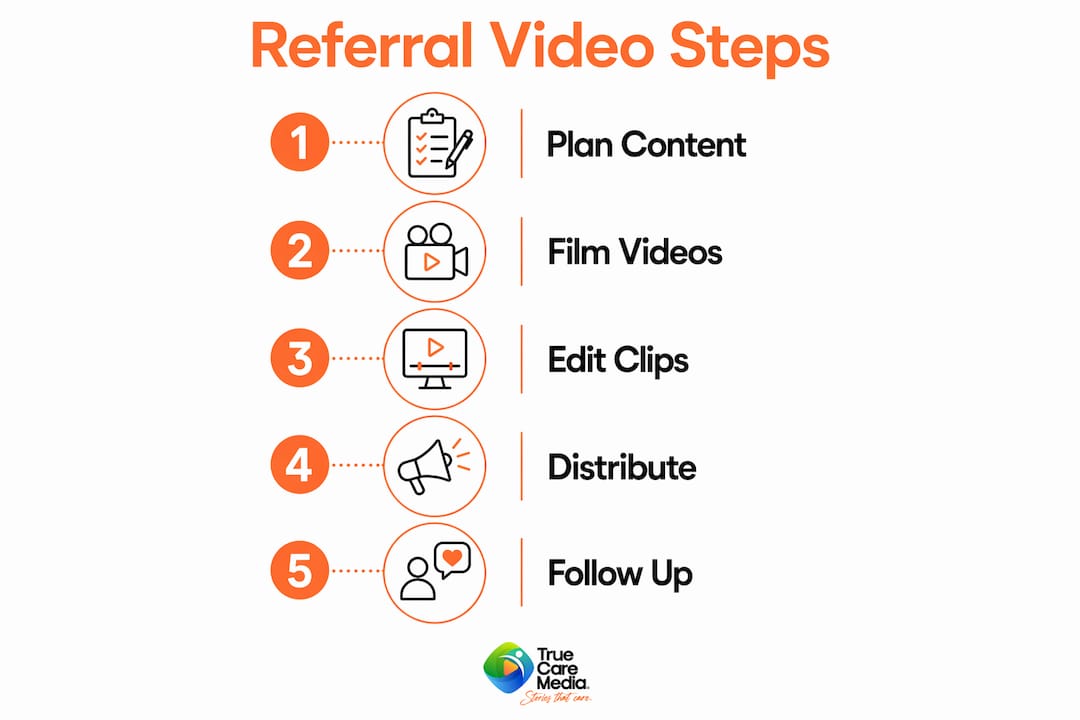
Content planning is the step most healthcare professionals skip, and it is the one that determines whether a video session produces a usable asset or a wasted afternoon. Before filming, identify the specific question your referral partner’s clients are most likely to ask. Build the video around that question. A 15 to 30 minute filming session built around one clear question produces one usable clip. That is the repeatable unit of a referral video programme.
Distribution requires the same attention as production. Referral links suit digital sharing with automatic tracking, while referral codes work better when sharing happens offline or in channels where links do not display cleanly. Set up both from the start. Cross-channel compatibility, meaning the video plays correctly in email, WhatsApp, LinkedIn, and SMS, is non-negotiable for healthcare referral contexts where partners communicate across multiple platforms.
Pro Tip: Always caption your videos. Many referral partners watch clips in waiting rooms or between appointments with the sound off. Captions increase completion rates and make your content accessible to clients with hearing impairments.
How do you execute a referral video session and follow-up strategy?
Building connections with video requires a structured approach from the first contact through to ongoing relationship maintenance. The following steps reflect what works in practice for healthcare referral networks.
-
Identify your ideal referral partners. These are practitioners who already serve your target client group but do not duplicate your service. A physiotherapist building a referral network might target GPs, occupational therapists, and aged care coordinators. Write a list of ten to fifteen names before you make a single call.
-
Make the initial contact with a concrete offer. Do not call to introduce yourself. Call to offer something specific. The offer is a free, short video session producing one usable clip the partner can share with their clients. Offering a free short-form video session with an immediately usable asset achieves a 90–95% collaboration acceptance rate. That figure reflects the power of a tangible offer over a vague networking request.
-
Execute the session with a clear structure. Arrive with one question the video will answer. Film two to three takes. Edit to the best 60 to 90 seconds. Deliver the finished clip to your partner within 48 hours. Speed of delivery signals professionalism and sets the tone for the relationship.
-
Support your partner’s use of the video publicly. Share the clip on your own channels and tag the partner. Comment on their posts when they share it. This public visibility reinforces the relationship and extends the reach of the content without any additional production cost.
-
Maintain visibility between referrals. Send your weekly update clips directly to referral partners. Acknowledge their milestones. Personalised thank-you videos to top referrers deepen loyalty more effectively than automated rewards. A 30 second video saying “thank you for the referral last week” is more memorable than any gift card.
The follow-up strategy is where most healthcare professionals lose momentum. Referrals rarely arrive after a single video session. They arrive after consistent visibility over weeks and months. Build a simple calendar that schedules one touchpoint per referral partner per fortnight. That touchpoint can be a shared clip, a comment on their post, or a brief check-in message with a new video attached.
For healthcare providers working in hospital to home care transitions, video introductions sent to discharge coordinators before a patient arrives home can anchor the referral relationship in a genuinely useful clinical context.
What are the most common pitfalls in video referral strategies?
Most healthcare professionals who attempt video referral strategies fail for predictable reasons. Recognising these pitfalls early saves significant time and effort.
-
Over-investing in production quality. A practitioner who spends three weeks planning a brand film and $5,000 on production will share it once and move on. A practitioner who films a 90 second smartphone clip every week will build a referral network. Frequency and authenticity outperform polish in this context.
-
Failing to create repeatable deliverables. One video is not a strategy. The referral network grows when partners receive a steady stream of shareable assets. Focusing on one repeatable 15 to 30 minute session producing a single usable clip allows partners to experience your expertise without fatigue or delay.
-
Neglecting attribution tracking. If you cannot tell which referral partner sent a client, you cannot thank them, reward them, or refine your approach. Set up referral links or codes before you share a single video. The 90-day attribution window is the current industry standard for tracking referral conversions from video content.
-
Allowing relationships to go cold. A referral partner who receives one video and then hears nothing for three months will not refer clients. Referral content converts best when it reduces friction and provides copy-ready assets matched to the referral audience’s tone. Regular, low-effort touchpoints keep you top of mind.
Pro Tip: Review your referral metrics weekly. Track which videos were shared, which partners are most active, and which content formats generate the most follow-up enquiries. Adjust your content plan based on what the data tells you, not what you assume will work.
Key takeaways
Video referral strategies for healthcare professionals work because they give referral partners a tangible, shareable asset that educates clients and builds trust before the first appointment.
| Point | Details |
|---|---|
| Social proof over advertising | Create anonymised case studies and explainers, not brand films, to convert warm referrals. |
| Simple tools, consistent output | A smartphone, lapel mic, and tripod are enough. Film weekly and deliver clips within 48 hours. |
| Concrete offer drives acceptance | A free short video session with a usable asset achieves a 90–95% partner acceptance rate. |
| Attribution tracking is non-negotiable | Use referral links or codes with a 90-day window to track every conversion from video content. |
| Consistency builds referral relationships | One touchpoint per referral partner per fortnight, using video clips, maintains top-of-mind presence. |
What I have learned from building healthcare referral networks with video
The hardest thing to convince healthcare professionals of is that the video does not need to be perfect. I have seen practitioners spend months planning a production that never gets made because the conditions were never quite right. Meanwhile, the practitioners who film a 90 second clip on their phone every Thursday and send it to ten referral partners are the ones whose phones ring.
The offer of a free video session is genuinely powerful. It is not a trick. When you sit down with a referral partner and produce something they can immediately use with their clients, you demonstrate your expertise in a way that no brochure or lunch meeting can match. You are not asking for a referral. You are giving them a tool. The referral follows naturally from that.
Authenticity in specialist doctor profile videos and short-form clips builds more trust than any polished production. Referral partners share content that feels real. They share it because it reflects well on them, not because it looks expensive. Start with one partner, one session, and one clip. Iterate from there. The network builds itself when the content is genuinely useful.
— Mishal
How Com can support your referral video strategy
Healthcare professionals who want to build a referral network through video do not have to figure it out alone. Com helps NDIS providers and allied health brands create video content that referral partners actually share.
Com’s team specialises in aged care video marketing and healthcare storytelling, producing short-form assets designed for referral contexts rather than broadcast audiences. Whether you need anonymised case study clips, educational explainers, or a complete referral video programme, Com brings the production expertise and strategic thinking to make each session count. You can also explore Com’s approach to family decision-making video content for referral contexts where families are the key decision-makers. Contact Com to discuss a video strategy session tailored to your referral network goals.
FAQ
What is a referral video programme for healthcare professionals?
A referral video programme is a structured approach to producing and sharing short video assets that help referral partners educate their clients about your healthcare services. The goal is to give partners credible, shareable content rather than asking them to recommend you verbally.
How long should a referral video session take?
A single referral video session should run 15 to 30 minutes and produce one usable clip. This format keeps the process repeatable and reduces the barrier to participation for both you and your referral partner.
What is the best video format for healthcare referral networks?
Anonymised case study videos and educational explainers perform best in healthcare referral contexts. These formats answer the questions referral partners’ clients are already asking, which makes them far more likely to be shared.
How do I track referrals from video content?
Use referral links for digital sharing with automatic tracking, and referral codes for offline or messaging-app contexts. A 90-day attribution window is the current industry standard for connecting video shares to client conversions.
How often should I send video content to referral partners?
One touchpoint per referral partner per fortnight is a sustainable and effective cadence. Weekly update clips, partner celebration videos, or brief educational snippets all count as touchpoints and keep your name visible without overwhelming your partners.