
Treatment explainer videos are specialised digital tools designed to communicate medical procedures and treatment options clearly, enabling patients to grasp complex concepts and make informed decisions. The role of treatment explainer videos in healthcare has expanded significantly, with 2026 peer-reviewed research confirming measurable improvements in patient confidence, procedure adherence, and clinical outcomes. These videos translate dense medical language into accessible, visual narratives that work across literacy levels, languages, and care settings. For healthcare professionals and administrators, understanding how these tools work is the first step toward deploying them effectively.
What evidence supports the role of treatment explainer videos?
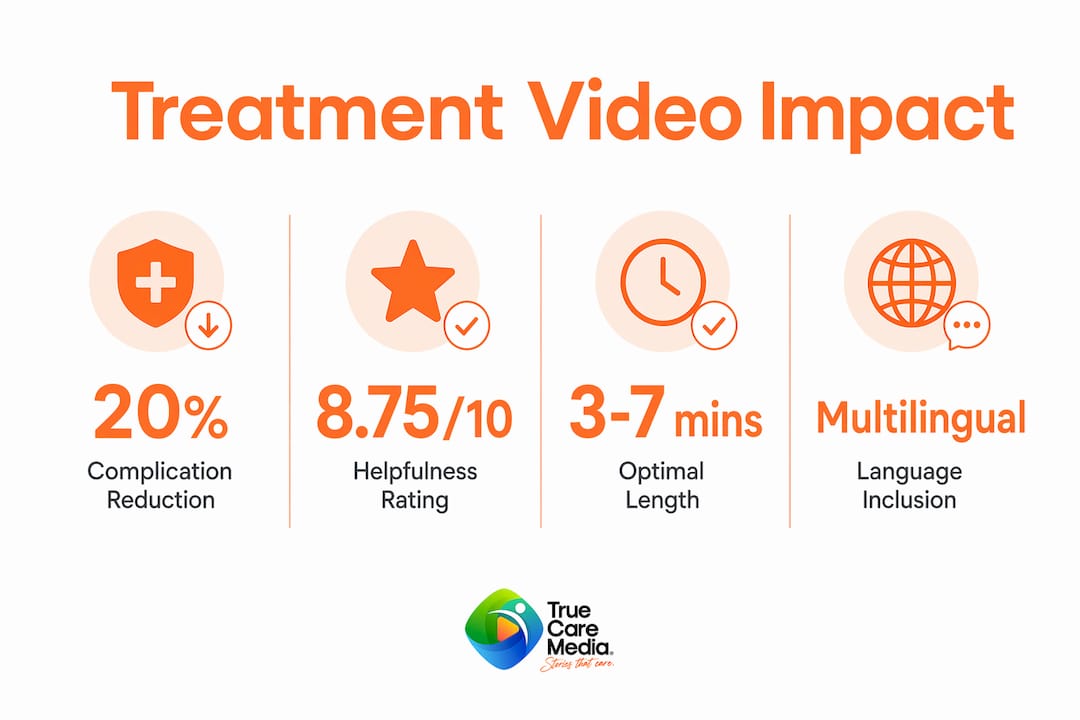
Pre-procedure educational videos reduce complications by approximately 20% compared to standard verbal instruction alone. A 2026 study published in Patient Preference and Adherence found that patients who viewed a pre-procedure video had significantly lower rates of subconjunctival haemorrhage following intravitreal injections, with an odds ratio of 0.275 (95% CI, 0.115–0.656). That result means patients who watched the video were roughly four times less likely to experience a procedure-related complication.
Patient confidence also improves measurably. The same study reported a mean helpfulness rating of 8.75 out of 10 from patients who received video education before their procedure. High confidence scores like this correlate with reduced procedural anxiety and greater cooperation during treatment.
Engagement gains are equally compelling. Research published in JMIR Cardiology in 2026 found that short educational videos delivered within a five-minute window produced patient engagement effect sizes of Cohen d = 0.81–1.38 compared to static text. That is a large effect by any clinical standard. Mean patient confidence reached 4.26 out of 5, which signals that video content creates a qualitatively different experience than reading a pamphlet.

Telerehabilitation settings show similar gains. A 2026 study in JMIR Rehabilitation and Assistive Technologies confirmed that audiovisual telerehabilitation content improves exercise execution accuracy and treatment adherence, with patients recovering faster and reporting lower post-surgical pain scores. The mechanism is straightforward: patients who can see a movement demonstrated correctly are far less likely to perform it incorrectly at home.
One important nuance deserves attention. A pilot study on AI-generated postoperative videos found that video education significantly improves engagement and perceived clarity but does not always produce higher objective knowledge scores over text alone. This finding positions video as a complement to structured clinical counselling rather than a replacement for it.
How are effective treatment explainer videos designed?
The most effective treatment explainer videos balance production quality with language that matches the patient’s health literacy level. Industry guidance from healthcare video specialists confirms that jargon-free narrative and visuals must work together to support shared decision-making during consultations. A technically polished video that uses clinical terminology without explanation will still fail the patient who cannot decode it.
Language and literacy adaptation
Accessible language is non-negotiable. Videos should target a reading comprehension level of approximately Year 8, avoiding acronyms, Latin-derived medical terms, and passive constructions. When technical terms are unavoidable, a brief on-screen definition or visual analogy resolves the gap. Allied health providers designing content for diverse populations can draw on allied health explainer video frameworks that address literacy variation across patient cohorts.
Cultural and linguistic inclusion
Multilingual adaptation is not optional in multicultural clinical settings. A 2026 JMIR Cardiology study found that patients who received language-adapted video education showed significant knowledge and confidence improvements, while those who received the same content in a language they did not fully understand showed no measurable gain. The implication for Australian healthcare providers serving culturally and linguistically diverse communities is direct: a video in English alone is not equitable care.
Content length and delivery timing
Videos between three and seven minutes perform best for procedural education. Longer formats risk losing patient attention before the most critical information appears. Timing matters as much as length. Pre-procedure delivery consistently outperforms post-procedure delivery in reducing complications and anxiety, because patients can act on the information before the clinical encounter.
Pro Tip: Deliver your explainer video at the point of booking confirmation, not on the day of the procedure. Patients who have 24–48 hours to absorb the content arrive calmer and ask more informed questions.
Explainer videos vs. traditional patient education materials
Treatment explainer videos outperform text-based materials on engagement and accessibility, though the two formats serve different functions. The table below compares key outcomes across both approaches.
| Feature | Explainer Videos | Text-Based Materials |
|---|---|---|
| Patient engagement | High (Cohen d = 0.81–1.38) | Moderate |
| Accessibility for low literacy | Strong, with visual cues | Limited |
| Multilingual adaptation | Feasible via dubbing or subtitles | Requires full translation |
| Anxiety reduction | Significant via narrative immersion | Minimal |
| Objective knowledge gain | Comparable to text | Comparable to video |
| Cost to produce | Higher upfront | Lower upfront |
| Scalability across patients | High, reusable at no marginal cost | High, printable |
The immersive narrative feature of well-produced videos is the clearest differentiator. Clinical education specialists describe this as “narrative transportation,” where patients become absorbed in a relatable story and lower their psychological resistance to treatment. Text cannot replicate that effect. A written instruction sheet for peritoneal dialysis, for example, describes the steps. A video shows a real patient performing them at home, which transforms abstract procedure into lived possibility.
The limitations of video are real and worth acknowledging. Production costs are higher than printing a brochure. Videos require updating when clinical protocols change. Patients without reliable internet access or digital literacy may not engage with video content at all. These factors mean video works best as part of a broader patient education strategy, not as a standalone solution.
How can healthcare providers integrate videos into clinical workflows?
Practical integration requires deliberate planning across four areas: timing, technology, measurement, and staff training.
- Map your patient touchpoints. Identify where patients are most anxious or least informed. Pre-admission, pre-procedure, and post-discharge are the three highest-value windows. Each requires a different video type and tone.
- Choose accessible delivery platforms. Patient portals, SMS links, waiting room screens, and telehealth platforms all serve different patient populations. Providers running telehealth programmes should embed videos directly into consultation workflows so patients receive them before the appointment begins.
- Measure what matters. Track patient-reported confidence scores, procedure complication rates, and appointment no-show rates before and after video implementation. These three metrics give you a clear picture of clinical and operational impact.
- Train clinical staff to reference videos in consultations. A video watched in isolation has less impact than one discussed with a clinician immediately after. Staff who can say “you may have seen in the video that…” reinforce comprehension and signal that the content is clinically endorsed.
- Review and update content annually. Clinical guidelines change. A video that accurately reflects 2024 practice may mislead patients by 2026. Build a review cycle into your content governance process.
Pro Tip: For chronic disease management programmes, consider a short-series format: three to five videos released progressively over the treatment journey. This mirrors how patients actually absorb information, in stages, rather than all at once.
Patient journey storytelling also strengthens video impact. Patient journey examples that follow a real or representative patient through diagnosis, treatment, and recovery give viewers a narrative anchor that pure procedural content cannot provide.
Key takeaways
Treatment explainer videos improve patient outcomes most reliably when delivered before a procedure, adapted for language and literacy, and integrated into existing clinical workflows rather than used in isolation.
| Point | Details |
|---|---|
| Pre-procedure timing is critical | Delivering videos before a procedure reduces complications by approximately 20% and lowers patient anxiety. |
| Engagement outperforms text significantly | Video produces engagement effect sizes of Cohen d = 0.81–1.38 compared to static text materials. |
| Language adaptation is non-negotiable | Patients who receive content in their own language show measurable knowledge and confidence gains; others do not. |
| Video complements, not replaces, counselling | Objective knowledge gains are comparable to text; video’s strength is engagement, confidence, and anxiety reduction. |
| Workflow integration drives results | Videos embedded into patient portals, telehealth platforms, and pre-admission processes deliver the most consistent outcomes. |
What i’ve learned about getting treatment videos right
By Mishal
Most healthcare providers I speak with treat explainer videos as a production problem. They focus on camera quality, animation style, and script length. Those things matter, but they are not where most videos fail.
Videos fail because of timing and cultural assumptions. A beautifully produced video delivered on the day of a procedure, in English only, to a patient who speaks Cantonese at home, achieves almost nothing. The research on multilingual video education makes this painfully clear. Providers who invest in production but skip cultural adaptation are spending money to create content that a significant portion of their patient population cannot use.
The second pitfall I see constantly is information overload. Clinicians want to include everything. Patients need to know three things: what will happen, what they should do, and what to expect afterwards. Every minute of video beyond that core competes for attention the patient does not have.
What genuinely works is combining a well-timed, culturally adapted video with a brief clinical conversation that references it directly. That combination is where shared decision-making actually happens. The video lowers anxiety and builds a mental model. The clinician fills the gaps and answers the questions the video raised. Neither works as well alone.
The future I find most interesting is AI-generated personalised video, where a patient’s name, diagnosis, and care team details are embedded dynamically into a standard template. The pilot data is early, but the potential to make every patient feel the content was made specifically for them is significant. For now, the providers who get the most from their video investment are the ones who treat it as a clinical communication tool, not a marketing asset.
— Mishal
How Com can help you create effective treatment explainer videos
Com specialises in healthcare video production for NDIS providers and allied health brands across Australia. If your organisation is ready to move beyond printed brochures and generic consent forms, Com builds treatment explainer content that is clinically grounded, culturally adapted, and designed to perform at every patient touchpoint.
From pre-procedure education to chronic disease management series, Com’s team brings together video production, storytelling, and healthcare communication expertise. Whether you are building content for a hospital ward, a community health centre, or a telehealth platform, the process starts with understanding your patients and your clinical goals. Explore how participant-centred storytelling can shape your next video project, or see how aged care video marketing demonstrates the depth of storytelling Com brings to complex healthcare contexts.
FAQ
What is the role of treatment explainer videos in patient care?
Treatment explainer videos simplify complex medical information into accessible visual content, improving patient confidence, reducing procedural anxiety, and supporting informed consent. Research shows pre-procedure videos reduce complications by approximately 20% and achieve mean helpfulness ratings of 8.75 out of 10.
How do explainer videos work differently from written patient information?
Explainer videos produce significantly higher patient engagement than static text, with effect sizes of Cohen d = 0.81–1.38, though objective knowledge gains are comparable across both formats. Their primary advantage is reducing anxiety through narrative immersion and improving accessibility for patients with low health literacy.
How long should a treatment explainer video be?
Three to seven minutes is the optimal range for procedural education videos. Content beyond this length risks losing patient attention before the most critical information is delivered.
Do treatment videos work for patients with language barriers?
Yes, but only when the content is adapted to the patient’s language. A 2026 study found that patients who received video education in their own language showed significant knowledge and confidence improvements, while those who received it in an unfamiliar language showed no measurable gain.
Can explainer videos replace clinical consultations?
No. Video education excels as an engagement and accessibility tool but does not replace structured clinical counselling. The most effective approach combines a well-timed video with a clinical conversation that directly references the content the patient has already seen.