
Australian hospital marketing managers face a genuine dilemma when it comes to patient video strategy. The types of hospital patient experience videos available have multiplied rapidly, and choosing the wrong format wastes budget while failing the patients you are trying to reach. Done well, video is one of the most powerful tools in your arsenal. Video animations outperform printed materials for patient knowledge gains, yet most hospitals still treat video as an afterthought. This guide breaks down the major video types, what each one does well, and how to match them to your specific goals.
Table of Contents
- Criteria for evaluating types of hospital patient experience videos
- Educational and orientation videos
- Patient story and testimonial videos
- Multilingual and culturally adapted videos
- Comparison of hospital patient experience video types
- Our perspective: the video type nobody talks about enough
- Ready to produce patient experience videos that actually work?
- Frequently asked questions
Key Takeaways
| Point | Details |
|---|---|
| Use multimedia videos | Video animations boost short-term patient knowledge more effectively than printed information. |
| Focus on engagement | Patient engagement metrics like watch time correlate directly with knowledge improvement and adherence. |
| Include multilingual content | Delivering videos in multiple languages improves equity and comprehension in diverse hospital populations. |
| Leverage patient stories | Real patient testimonials build trust and support multiple hospital marketing goals. |
| Adopt modular delivery | Short, repeated videos across patient touchpoints enhance retention and reduce anxiety. |
Criteria for evaluating types of hospital patient experience videos
Before you commission a single frame of footage, you need a clear framework for evaluating your options. Not all patient experience video examples are created equal, and the format that works brilliantly for a pre-admission orientation may fall completely flat as a fundraising piece.
Here are the key criteria that should guide every video decision:
- Engagement and knowledge impact. Engagement is not just views. Watch time, completion rates, and replay behaviour all signal whether patients are genuinely absorbing content. Higher engagement correlates directly with measurable knowledge improvement, so track these metrics rather than relying on anecdotal feedback.
- Cultural and language appropriateness. Australian hospitals serve extraordinarily diverse communities. A video produced only in English, without subtitles or culturally relevant imagery, will not reach a significant portion of your patients. Assess whether each video type can be adapted for multilingual access before discharge.
- Length and modularity. Short, modular videos that cover a single topic outperform long-form content for patient attention spans. The sweet spot sits between two and five minutes for educational content, with testimonials running slightly shorter.
- Workflow integration. A video that cannot be easily distributed through your existing patient touchpoints, whether that is a bedside tablet, a pre-admission email, or a waiting room screen, will not get watched. Evaluate distribution practicality before production begins.
- Depth versus accessibility. Some conditions require detailed explanation. Others need simple reassurance. Match the educational depth to what your patient population can realistically absorb in their current state of stress or illness.
Pro Tip: Map each video type to a specific stage of the patient journey before briefing your production team. Pre-admission, during-stay, and discharge moments each call for different tones, lengths, and calls to action.
The best approach to patient story and recovery narrative videos follows this same logic: identify the moment in the patient journey where a real story will have the most emotional and informational impact, then build the video around that moment.
With criteria established, let’s examine the major types of hospital patient experience videos.
Educational and orientation videos
These are the workhorses of any hospital video library. Educational videos explain conditions, procedures, and treatment pathways. Orientation videos tell patients what to expect during their stay. Both serve a fundamentally practical purpose: reducing uncertainty, which in turn reduces anxiety and improves cooperation with clinical staff.
The evidence for educational video is compelling. Short educational videos improve patient knowledge and adherence, with 80% satisfaction recorded in adolescent scoliosis trials. That is not a marginal result. It reflects a consistent pattern across specialties: patients who understand their condition and treatment plan are more likely to follow through.
Orientation videos operate slightly differently. Rather than teaching clinical content, they set expectations. A “what to expect” video covering pre-admission steps, ward routines, and discharge processes removes the fear of the unknown, which is often the biggest driver of patient anxiety. These videos work best when deployed early, ideally in the week before admission, and then reinforced at multiple touchpoints during the stay.
Key formats within this category include:
- Condition-specific explainers. Animated or live-action videos that explain a diagnosis, its causes, and the treatment pathway in plain language.
- Procedure walkthroughs. Step-by-step videos showing what happens during a colonoscopy, an MRI, or a surgical prep process.
- Clinician-led Q&A videos. Short videos where a doctor or nurse addresses the five most common questions patients ask before a particular appointment. These are particularly effective at reducing information overload and freeing up consultation time for personalised discussion.
- Discharge instruction videos. Often overlooked, these videos recap medication schedules, wound care, and follow-up appointments at the moment patients are most likely to forget verbal instructions.
Pro Tip: Apply multimedia design principles when briefing your production team. Narration and visuals should complement each other, not duplicate the same information. Patients process dual-channel content more effectively than text-heavy slides with a voiceover reading the same words aloud.
The most effective patient story and recovery narrative videos in this category pair clinical explanation with a real patient’s experience of the same procedure, giving viewers both the facts and the emotional reassurance that others have been through it successfully.
Now that we understand educational videos, let’s explore real patient story videos and testimonials.
Patient story and testimonial videos
This is where hospital experience storytelling moves from information delivery into genuine emotional connection. Patient testimonial videos and narrative-driven stories do something that no clinical explainer can: they make the hospital feel human.
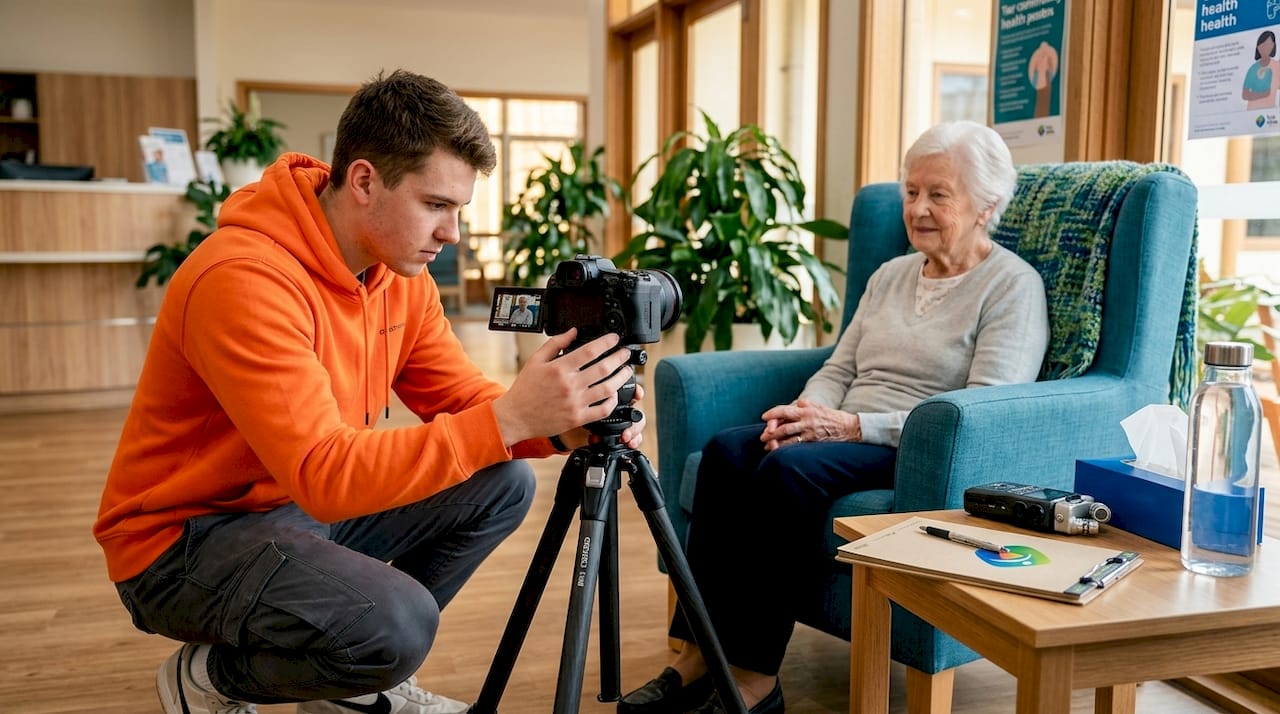
Testimonial videos serve multiple purposes simultaneously, covering education, clinical trial awareness, new patient onboarding, fundraising, and reputation building. That versatility makes them one of the highest-return video investments a hospital marketing team can make.
Australian hospitals increasingly use patient journey narratives during events like Patient Experience Week to build community trust and showcase care milestones. These are not promotional videos in the traditional sense. They are authentic accounts that happen to reflect well on the institution because they are grounded in real outcomes.
The most effective patient story videos follow a clear arc:
- The challenge. What was the patient facing before they came to your hospital? A diagnosis, a long wait, a frightening symptom?
- The turning point. What did the care team do, and how did the patient experience that intervention?
- The outcome. Where is the patient now? What has changed in their life?
- Expert context. A brief comment from the treating clinician adds credibility and connects the emotional story to clinical reality.
| Format | Length | Primary use | Emotional register |
|---|---|---|---|
| Short testimonial clip | 60 to 90 seconds | Social media, website homepage | Warm, direct |
| In-depth journey story | 3 to 5 minutes | Fundraising, community outreach | Reflective, moving |
| Longitudinal recovery series | Multiple episodes | Clinical trial awareness, onboarding | Detailed, informative |
| Staff and patient co-story | 2 to 3 minutes | Reputation building, recruitment | Collaborative, authentic |
Explore hospital patient story videos to understand how narrative structure and production quality combine to create content that genuinely moves audiences and builds lasting trust.
Beyond stories, multilingual and culturally tailored videos are key in diverse Australian hospital settings.
Multilingual and culturally adapted videos
Australia’s hospital population is one of the most linguistically diverse in the world. Producing videos only in English is not just a missed opportunity. It is an equity issue. Patients who cannot fully understand their care instructions are more likely to experience complications, readmissions, and poorer outcomes.
Multilingual educational videos feasibly improve inpatient knowledge before discharge in multicultural hospital settings, supporting both equity and accessibility. The EDUCATE-MI study found this approach workable and effective in real clinical environments, not just in controlled trials.
Producing these videos well requires more than translation. Key considerations include:
- Language selection based on patient data. Use your hospital’s language service records to identify the top five to eight languages spoken by your patient population. English, Arabic, Hindi, Mandarin, and Vietnamese are common starting points for many metropolitan Australian hospitals.
- Culturally appropriate visuals and voiceovers. A direct translation with a generic voiceover often misses cultural nuance. Work with community health workers or cultural consultants during script development.
- Subtitles as a baseline. Even for English-language videos, subtitles improve comprehension for patients with hearing impairments, low health literacy, or those watching in noisy ward environments.
- Co-design with target communities. Involving community members in the development process ensures the content is not just translated but genuinely relevant and acceptable to the intended audience.
- Timing and access planning. Multilingual videos are most effective when delivered at the right moment in the patient journey, typically during admission or in the 24 to 48 hours before discharge. Ensure your distribution system can target the right patients at the right time.
Multilingual patient education videos are one of the fastest-growing areas of hospital video investment in Australia, and for good reason. The return on investment is measurable in reduced readmissions and improved patient satisfaction scores.
With these types reviewed, let’s compare their attributes in a summary table.
Comparison of hospital patient experience video types
Understanding these differences helps tailor video strategy to specific hospital objectives and patient groups.
| Video type | Primary objective | Best timing | Engagement potential | Resource intensity | Cultural adaptability |
|---|---|---|---|---|---|
| Educational explainer | Knowledge building | Pre-admission, during stay | High with animation | Medium | High with subtitles |
| Orientation video | Anxiety reduction | Pre-admission | Medium | Low to medium | High |
| Patient testimonial | Trust and reputation | Onboarding, fundraising | Very high | Medium to high | Medium |
| Longitudinal story | Clinical awareness | Ongoing campaigns | High | High | Low without co-design |
| Multilingual adapted | Equity and comprehension | Pre-discharge | High for target groups | High | Very high by design |
| Discharge instruction | Adherence and safety | At discharge | Medium | Low | High with subtitles |
A few patterns worth noting from this comparison:
- Testimonials deliver the highest emotional engagement but require the most careful production to avoid feeling staged or promotional.
- Orientation and discharge videos are the lowest-cost, highest-practicality options for hospitals working within tight budgets.
- Multilingual videos have the highest upfront resource requirement but deliver outsized returns for hospitals serving diverse communities.
- Educational explainers benefit most from animation, which improves knowledge retention compared to live-action alone.
Explore hospital patient experience video strategies to understand how these video types can be sequenced into a coherent patient communication programme rather than produced in isolation.
Our perspective: the video type nobody talks about enough
Most articles on types of patient feedback videos focus on testimonials and educational content. Those are important. But the format that consistently gets underestimated is the discharge instruction video, and the reason is telling.
Discharge is the moment when patients are most overwhelmed, most medicated, and most likely to forget everything they have just been told. Verbal discharge instructions have a well-documented retention problem. Printed sheets get lost. Yet many hospitals still rely on both and wonder why readmission rates remain stubbornly high.
A short, clearly structured discharge video, sent to the patient’s phone or email before they leave the ward, changes that dynamic entirely. It can be replayed at home. It can be shared with a carer. It does not require a nurse to repeat the same information for the fifth time that shift.
The deeper issue is that hospital video strategy in Australia tends to be driven by marketing goals rather than patient outcomes. Testimonials get funded because they look good on the website. Educational videos get funded because a clinical team champions them. But discharge videos sit in a grey zone between clinical operations and marketing, and they often fall through the gap.
The hospitals getting the best results from video are the ones that have stopped treating it as a marketing asset and started treating it as a care delivery tool. That shift in framing changes everything: the budget conversation, the production brief, the distribution plan, and the metrics used to measure success.
Ready to produce patient experience videos that actually work?
If you are a healthcare marketing manager trying to build a video strategy that genuinely improves patient experience and not just your website’s homepage, the production partner you choose matters enormously.
At True Care Media, we specialise in video, photography, and storytelling for NDIS providers and allied health brands across Australia. We understand the clinical environment, the regulatory considerations, and the emotional weight of healthcare storytelling. Whether you need patient testimonials, multilingual education content, or a full suite of journey videos, we can help you produce content that your patients will actually watch, understand, and remember. Explore our work and find out how we can support your hospital’s video strategy.
Frequently asked questions
What makes video animations more effective than printed information for patients?
Video animations combine visuals and narration to improve understanding and recall compared to static printed materials, particularly for short-term knowledge gains. Animations outperform printed and in-person information delivery across multiple patient education studies.
How can hospitals measure engagement with patient experience videos?
Hospitals can track watch time, completion rates, and replay frequency to gauge genuine engagement rather than relying on view counts alone. Higher engagement is directly associated with better patient knowledge outcomes, making these metrics clinically meaningful, not just marketing data.
Why are multilingual patient videos important in Australian hospitals?
They reduce language barriers, improve comprehension, and support culturally diverse patients through tailored content and subtitles, directly improving equity in patient education. Multilingual videos improve inpatient knowledge before discharge in multicultural hospital settings, with measurable impact on patient understanding.
What types of patient stories are most effective for hospital marketing?
Stories that follow a clear arc from challenge through treatment to outcome, supported by brief clinician commentary, consistently build the most trust and emotional engagement. Testimonial videos serve education, onboarding, fundraising, and reputation purposes simultaneously, making them among the most versatile formats available.
How can videos reduce information overload before hospital appointments?
Short, focused videos that address the most common patient questions reduce anxiety and free up consultation time for personalised clinical discussion. Videos addressing common patient concerns before appointments have been shown to reduce anxiety and improve preparedness, particularly in oncology and other high-stress specialties.