
Video content increases recruitment conversion rates by up to 80%, yet many NDIS admissions professionals still rely on written applications and phone screens to assess applicant fit. The gap between what traditional formats reveal and what support work actually demands is significant. A resume tells you where someone has worked. A two-minute video tells you whether they can communicate warmly, think on their feet, and genuinely connect with the people they’ll be supporting. This guide covers the evidence, the mechanics, and the practical strategies you need to make video work in your admissions process.
Table of Contents
- The rise of video in admissions: What’s driving change?
- Video mechanics: Structures, fairness, and practical approaches
- Impact, benefits, and potential drawbacks for NDIS providers
- Practical tips for NDIS admissions teams: Maximising engagement and fit
- Perspective: The hidden truth about video admissions for NDIS providers
- Take your NDIS admissions video strategy further
- Frequently asked questions
Key Takeaways
| Point | Details |
|---|---|
| Video boosts engagement | Admissions teams see conversion rates rise by using video content to connect personally with applicants. |
| Authenticity is critical | Video reveals true applicant personality and motivation, outpacing traditional application formats. |
| Fairness and bias need attention | Standardised prompts and AI support fairness, but care is needed to mitigate visual bias and perceived impersonality. |
| Hybrid approaches work best | Combining asynchronous and live video strategies maximises efficiency while maintaining a personal touch. |
| Testimonial-driven recruitment | NDIS providers see stronger fits and engagement by incorporating applicant and service testimonials in videos. |
The rise of video in admissions: What’s driving change?
Admissions teams across health and education sectors have been shifting toward video for several years, and the reasons go well beyond convenience. Traditional written applications were designed for a world where paper was the primary medium. They reward people who write well, not necessarily people who support well.
For NDIS providers, this gap is especially pronounced. Support work is relational. It requires empathy, clear communication, and the ability to remain calm and engaged under pressure. None of those qualities show up reliably in a cover letter. A short video response, on the other hand, can reveal all three within the first thirty seconds.
Admissions teams use video primarily for applicant video introductions or asynchronous interviews to reveal authentic personality, communication skills, and fit beyond transcripts and essays. This is precisely what NDIS providers need. You are not hiring someone to write reports. You are hiring someone to sit with a participant who may be having a difficult day and make them feel safe.
The demand for personalisation is also growing. Applicants expect the recruitment process to reflect the organisation’s values. If your NDIS provider prides itself on person-centred care, a cold application form sends the wrong message from the very first touchpoint. Video allows you to present your services warmly and invite applicants to respond in kind.
“Video provides a personal, informal view of applicants, helping universities assess authentic self and campus fit.” Video college applications show this approach is gaining traction even in highly traditional institutions.
The shift is also driven by fairness. A well-structured video prompt gives every applicant the same question, the same time limit, and the same format. There is no interviewer bias from a rushed phone call, no inconsistency between different staff members conducting interviews on different days. When you build authenticity in admissions video into your process from the start, you create a more equitable experience for everyone.
Key reasons NDIS admissions teams are adopting video:
- Written applications fail to capture communication style and warmth
- Video reveals motivation, empathy, and cultural fit more reliably
- Personalised recruitment signals person-centred organisational values
- Standardised video prompts reduce interviewer inconsistency
- Asynchronous formats allow applicants to respond at a time that suits them
Video mechanics: Structures, fairness, and practical approaches
Understanding the motivations, let’s look at the nuts and bolts of how video is structured in admissions. There are two main formats: synchronous (live video interviews) and asynchronous (pre-recorded responses). For NDIS providers managing high volumes of applicants, asynchronous is typically the more practical starting point.
In an asynchronous video interview, the applicant receives a set of standardised prompts and records their responses within a defined time limit, usually one to three minutes per question. They can do this from their phone at home, which removes geographic and scheduling barriers. You review the recordings when it suits your team.
AI-powered asynchronous video interviews enable scalability, standardisation, richer evidence, and improved access. AI tools can transcribe responses, flag key themes, and even summarise answers across large applicant pools. This dramatically reduces the time your admissions team spends on initial screening without sacrificing the quality of information you gather.
Here is a practical framework for structuring video prompts in NDIS admissions:
- Start with a values-based question. Ask something like “Tell us about a time you supported someone through a difficult moment.” This immediately surfaces empathy and real-world experience.
- Include a situational prompt. For example: “A participant becomes distressed during a community outing. Walk us through how you would respond.” This tests composure and problem-solving.
- Close with a motivation question. “Why do you want to work in disability support?” Simple, direct, and enormously revealing.
- Set a firm time limit. Two minutes per response is usually sufficient. It forces applicants to be concise and prioritise what matters.
- Use the same prompts for every applicant. Consistency is the foundation of fair comparison.
| Format | Best for | Key advantage | Key limitation |
|---|---|---|---|
| Asynchronous video | High-volume initial screening | Scalable, flexible for applicants | Can feel impersonal |
| Live video interview | Final-stage assessment | Real-time dialogue, relationship building | Scheduling complexity |
| Hybrid (async + live) | End-to-end process | Balances efficiency and connection | Requires more coordination |
Pro Tip: Record a short welcome video from your admissions manager to send alongside the video prompt instructions. It humanises the process and significantly reduces applicant anxiety before they hit record.
Addressing visual bias and fairness is essential. Some applicants will have better lighting, quieter environments, or more polished presentation. Train your reviewers to focus on the content of responses, not the production quality. Consider blind review processes where reviewers assess responses without seeing demographic information. Structure is your best tool for fairness.
Impact, benefits, and potential drawbacks for NDIS providers
Now that we’ve covered how video operates, let’s assess its tangible benefits and real-world challenges for NDIS providers.
The efficiency gains are real and significant. Asynchronous video interviews reduce scheduling time, enable consistent evaluation, and speed up screening, though some candidates perceive them as less personal. For an NDIS provider running multiple programmes across different locations, the ability to screen fifty applicants in the time it previously took to schedule ten phone calls is genuinely transformative.
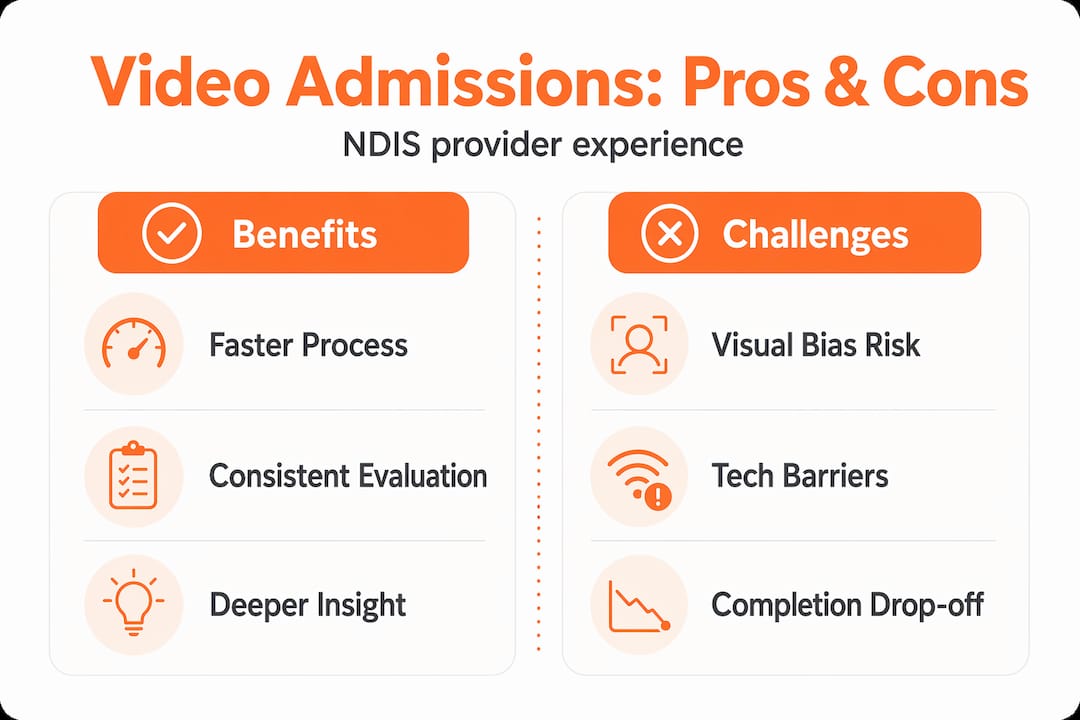
The quality of information also improves. A written application tells you what someone has done. A video response shows you how they think, how they communicate, and whether they seem genuinely motivated by the work. These are exactly the signals that predict success in support roles.

| Benefit | Impact for NDIS admissions |
|---|---|
| Reduced scheduling time | Screen more applicants without adding staff hours |
| Standardised evaluation | Every applicant answers the same questions in the same format |
| Richer candidate insight | Communication style and motivation visible in minutes |
| Improved access | Applicants in regional areas can participate without travelling |
| Faster time-to-hire | Compressed screening timeline means roles filled sooner |
However, the challenges deserve honest attention. A field experiment shows asynchronous interviews decrease application continuation by over 50%, especially for women, due to perceived lack of fairness and competitiveness. This is a significant finding. If your video process is poorly explained or feels cold, you risk losing strong candidates before they even submit a response.
The drop-off risk is not a reason to avoid video. It is a reason to design your video process thoughtfully, with clear instructions, warm communication, and a genuine sense of welcome.
There are several ways to address the drop-off challenge:
- Send a personalised invitation explaining why you use video and what you are looking for
- Provide example responses or a short guide to help applicants feel prepared
- Allow multiple attempts so applicants are not penalised for technical issues
- Follow up with a brief live conversation for shortlisted candidates to restore the human element
Exploring admissions video nuances in the context of NDIS is important because your applicant pool is diverse. Some candidates will be highly comfortable on camera. Others, including some of your most empathetic and capable potential support workers, may find video daunting. Your process needs to account for this without lowering the standard of assessment.
Practical tips for NDIS admissions teams: Maximising engagement and fit
With pros and cons laid out, let’s move into practical methods to get the most out of video admissions for NDIS providers.
In NDIS support worker recruitment, providers use short applicant videos to assess motivation and fit directly. The most effective implementations share a few common characteristics: clear prompts, a welcoming tone, and a hybrid structure that includes a live conversation at some point in the process.
Here is a practical step-by-step approach for NDIS admissions teams:
- Map your assessment criteria first. Before you write a single prompt, identify what you are actually trying to assess. For NDIS roles, this typically includes empathy, communication clarity, problem-solving, and genuine motivation.
- Write prompts that invite storytelling. “Tell me about a time…” prompts generate far richer responses than “Do you have experience with…” questions.
- Test your prompts internally. Have a current team member record responses before you send them to applicants. This reveals whether the questions are clear and whether the time limits are appropriate.
- Create a warm invitation video. A thirty-second clip from your team lead welcoming applicants and explaining the process dramatically increases completion rates.
- Review with a structured rubric. Score each response against your pre-defined criteria. This keeps evaluation consistent across reviewers and reduces the influence of personal preference.
- Follow up quickly. Applicants who complete a video response expect timely feedback. A prompt acknowledgement maintains engagement and signals organisational professionalism.
For NDIS providers, leveraging video to showcase services via testimonials and demos for engagement, and mirroring applicant videos for cultural fit, creates a coherent and compelling recruitment experience. This means your video strategy should run in both directions. You are not just asking applicants to record themselves. You are also using video to show them who you are.
Consider building a short video library for your recruitment process:
- A “day in the life” video featuring current support workers
- Participant testimonials (with appropriate consent) that illustrate the impact of your services
- A virtual tour of your facilities or community programmes
- A message from your CEO or clinical lead about your organisation’s values
Pro Tip: Keep your showcase videos under ninety seconds each. Attention drops sharply after that point, especially on mobile devices where most applicants will be watching.
Addressing healthcare video fairness means being explicit with applicants about how their videos will be reviewed, who will see them, and how long they will be retained. Transparency builds trust and signals that your organisation takes privacy seriously, which matters enormously in the disability sector.
Perspective: The hidden truth about video admissions for NDIS providers
Before moving to practical takeaways and resources, let’s reflect on what really matters in video for NDIS admissions.
Here is something most admissions guides will not tell you: the quality of the video does not matter nearly as much as the quality of the person in it. We have seen applicants record responses on a cracked phone screen in a noisy kitchen who were clearly exceptional candidates. We have also seen polished, well-lit recordings from people who had nothing meaningful to say.
Prioritise authenticity over production and avoid heavy editing. This is sound advice, and it applies equally to the videos your organisation produces. If your recruitment video looks like a corporate advertisement, it will attract people who are drawn to corporate environments, not necessarily people who are drawn to genuine, person-centred support work.
The visual bias concern is real but manageable. Structured prompts, blind review processes, and clear rubrics do most of the heavy lifting. The risk is not that video introduces bias. The risk is that poorly designed video processes amplify biases that already exist in your team. Good structure is your protection.
The hybrid approach recommended by research is not just a compromise. It is actually the ideal design. Asynchronous video for initial screening gives you efficiency and standardisation. A live conversation at the final stage gives you the relational depth that support work demands. Together, they create a process that is both fair and genuinely informative.
The deeper truth is this: video in admissions is not a technology decision. It is a values decision. When you use video well, you are signalling that you care about who someone is, not just what they have done. For authentic video admissions in the NDIS space, that signal matters enormously, both to the applicants you want to attract and to the participants they will ultimately serve.
Take your NDIS admissions video strategy further
Building a video admissions strategy that genuinely reflects your organisation’s values takes more than a platform and a few prompts. It takes thoughtful storytelling, careful design, and content that communicates trust from the very first frame.
At True Care Media, we help NDIS providers and allied health brands create NDIS video storytelling solutions that work across the entire recruitment journey, from showcase videos that attract the right applicants to structured frameworks that make evaluation fair and efficient. Whether you are starting from scratch or refining an existing process, explore our video admissions offerings to see how we can support your team with content that builds genuine trust and engagement.
Frequently asked questions
How can NDIS providers use video to assess applicant motivation?
Short applicant video responses to specific prompts such as “why support work?” directly reveal motivation and fit in ways written applications cannot. A structured prompt gives every applicant the same opportunity to demonstrate their genuine reasons for pursuing the role.
Does video admissions increase fairness or introduce bias?
Video admissions can improve standardisation and fairness, but visual bias is a genuine concern. Standardised questions and time limits for fair comparison, combined with structured rubrics and blind review processes, significantly reduce the risk of bias influencing outcomes.
Do asynchronous video interviews lower application rates?
Research shows asynchronous interviews decrease continuation rates by over 50%, particularly for women, due to perceived lack of fairness. A warm invitation, clear instructions, and a hybrid process that includes a live conversation can substantially reduce this drop-off.
What types of video content help NDIS providers engage applicants?
Leveraging video to showcase services via testimonials, service demonstrations, day-in-the-life content, and virtual tours creates a compelling picture of your organisation that attracts applicants who are genuinely aligned with your values and mission.